Quick Summary
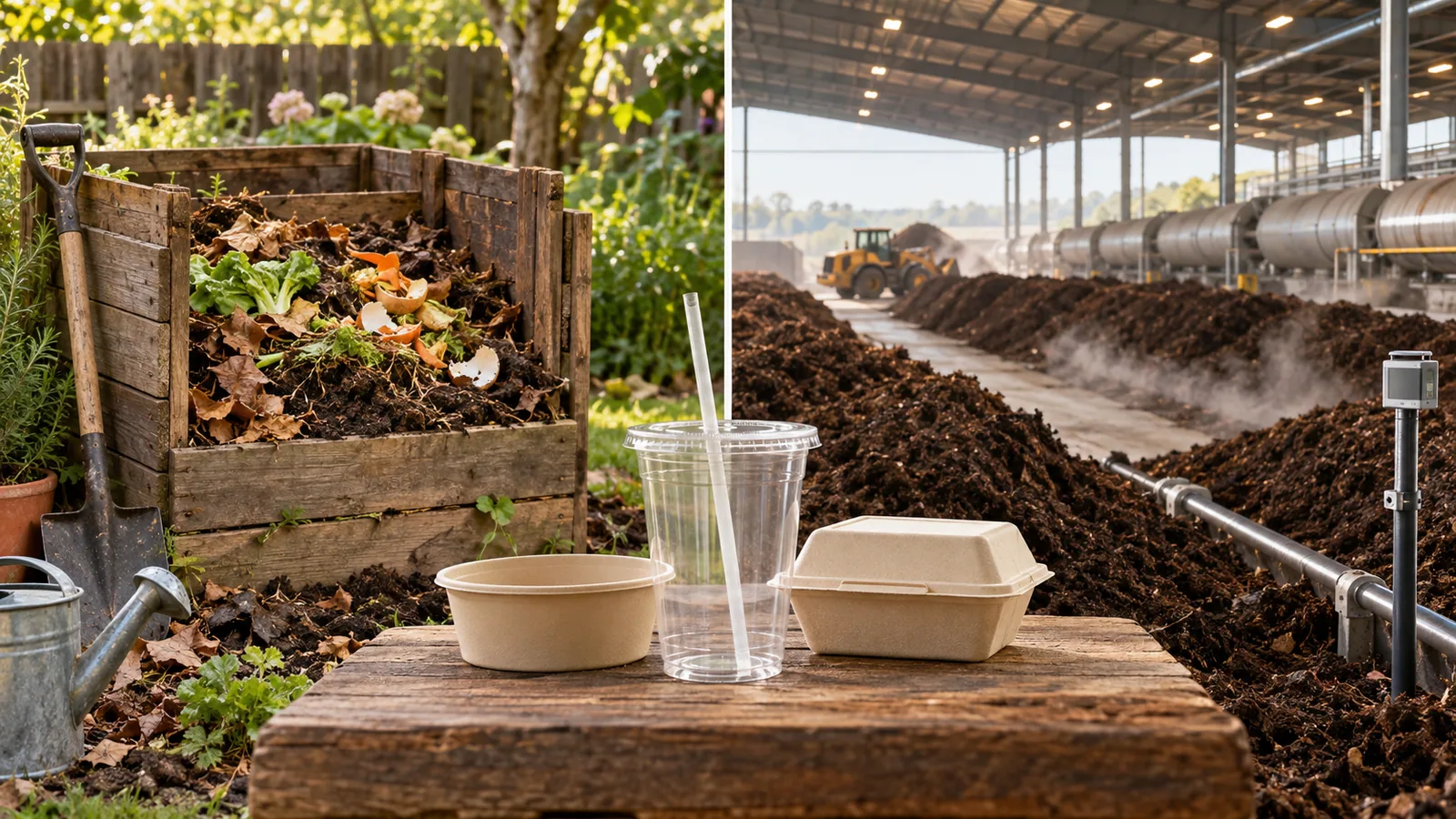
- Home composting operates at smaller scale under lower and more variable temperatures; industrial composting uses managed temperature, moisture, aeration and processing time.
- Industrial-compostability evidence does not automatically prove home compostability, outdoor degradation, landfill breakdown or acceptance by every composting facility.
- Buyers should verify the certification scheme, certificate holder, exact finished-product scope, artwork and component coverage, validity and licensed mark use.
- A compostable packaging program is incomplete until collection, sorting and an accepting processor are confirmed for the target market.
Home composting and industrial composting are not two names for the same process. They operate at different scales, temperatures and levels of control, and they use different certification evidence. A package proven for an industrial facility should not be presented as home compostable unless separate evidence supports that claim. For buyers evaluating a PLA compostable cup range, the correct question is not simply “Is it compostable?” but “Under which conditions, under which certification, for which finished product and through which actual disposal route?”
The Short Answer: Home and Industrial Composting Are Different Systems
Home composting relies on a properly managed backyard pile or bin that is smaller, cooler and more affected by weather and user practice. Industrial composting uses managed infrastructure that controls feedstock, moisture, oxygen, temperature and processing time. Because the test conditions and certification schemes differ, industrial-compostability certification cannot be expanded into a home-compostability claim without additional evidence.
Home Composting vs Industrial Composting: Buyer Comparison
The practical differences affect certification, artwork, customer instructions and the likelihood that used packaging reaches an appropriate processor. The table summarizes the decision points a packaging buyer should separate.
| Buyer question | Home composting | Industrial composting |
|---|---|---|
| Typical setting | Backyard pile, enclosed household bin or another properly managed small-scale system. | Commercial, municipal or institutional facility using managed composting equipment and procedures. |
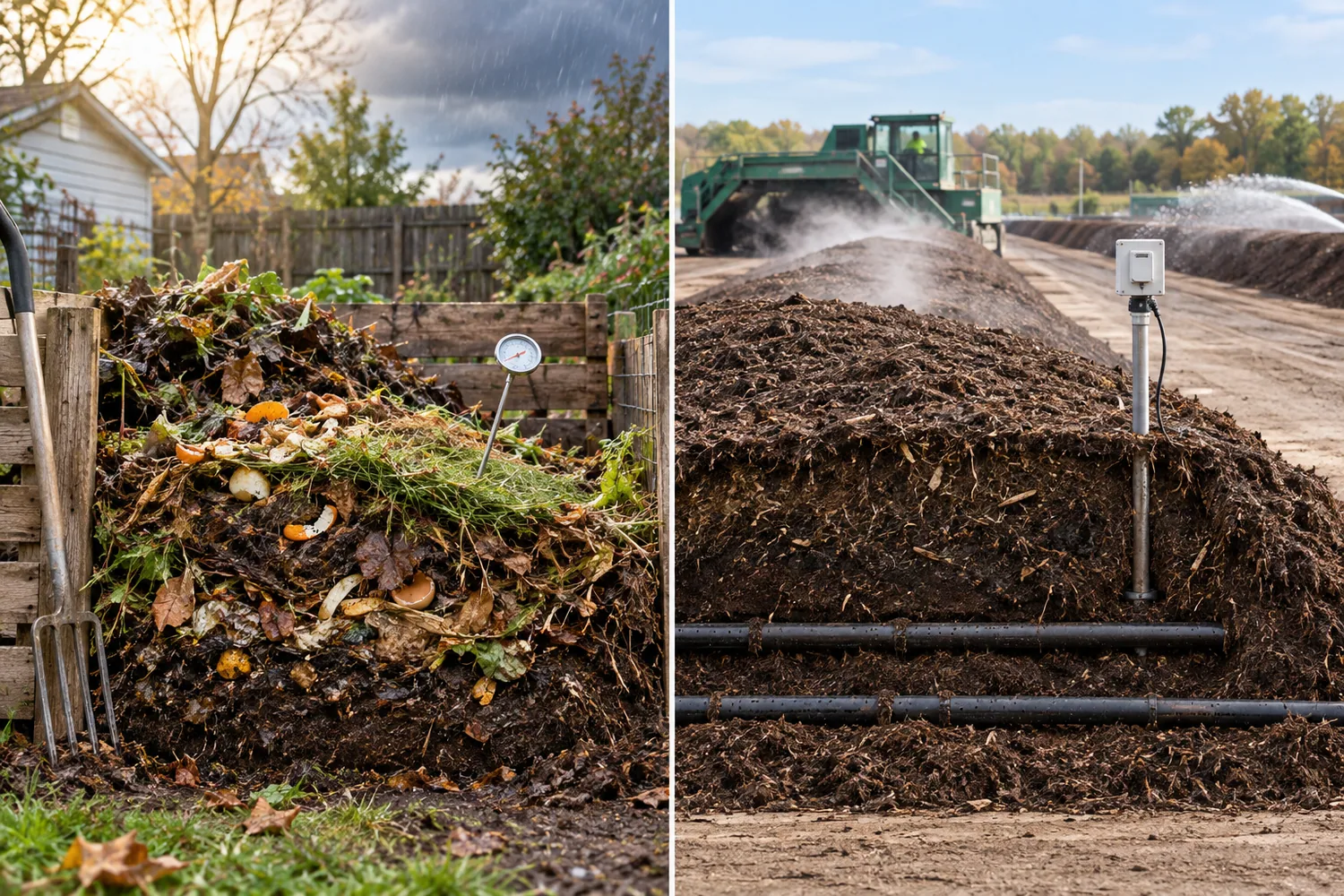
| Temperature | Generally lower and less stable; affected by pile size, climate, season and management. | Higher and deliberately managed within the facility's process. |
| Aeration and moisture | Controlled by the household through turning, mixing and watering; consistency varies. | Monitored and managed through operating procedures, equipment and feedstock control. |
| Timeframe | Usually slower because biological activity is less consistently optimized. | Designed around a defined processing cycle, although actual facility methods differ. |
| Certification evidence | Requires a home-compostability standard or scheme applicable to the target market and product. | Common frameworks include certification based on ASTM D6400 or EN 13432, depending on market and scheme. |
| Acceptance decision | The user must follow the home-composting instructions and manage the pile appropriately. | The collector and facility decide which certified formats and feedstocks they accept. |
| Unsafe assumption | “Bio-based” or “industrial compostable” means it will break down in any garden pile. | “Certified compostable” means every local facility will accept the item. |
What “Home Compostable” Really Means
A home-compostability claim should be supported for a defined home-composting environment. It does not mean that the package disappears when left on soil, thrown into nature, placed in a landfill or stored in a cold, inactive bin. A home compost pile still needs a useful balance of carbon-rich and nitrogen-rich materials, moisture, oxygen and active management.
Lower Temperature Makes Home Composting a Separate Claim
European Bioplastics distinguishes home composting from industrial composting because household piles normally run at lower, less stable temperatures and are influenced by climate and management. BPI's current certification information illustrates the difference with separate home and commercial assessment conditions rather than one interchangeable test. Buyers should therefore request the home-compost certificate or official listing itself, not a supplier statement that an industrial result is “close enough.”
Home-Compost Certification Is Market- and Scheme-Specific
Unlike industrial packaging assessment under EN 13432, there is no single harmonized European home-compostability standard that automatically covers every market. National standards and certification programs exist, including schemes such as OK compost HOME and BPI's Home Compostability Certification. The relevant evidence depends on where the packaging will be sold, how the claim will be worded and which certification mark is proposed.
Home Compostable Does Not Mean “Leave It Anywhere”
Home-compostability evidence is tied to defined composting conditions. It is not evidence for littering, uncontrolled soil degradation, marine biodegradation, landfill breakdown or disappearance in every climate. Disposal instructions should name the intended system and any management requirements instead of using a broad “biodegradable” shortcut.
What “Industrial Compostable” Really Means
Industrial composting is a managed biological process. Facilities may use windrows, aerated static piles, enclosed systems or other technologies, but the common feature is operational control over feedstock, oxygen, moisture, temperature and time. Industrial certification assesses performance under defined conditions; it does not promise identical behavior in every real-world pile.
ASTM D6400, EN 13432 and Certification Schemes
ASTM D6400 addresses plastics and products designed for aerobic composting in municipal or industrial facilities. BPI uses ASTM D6400 as the base standard for its Commercial Compostability Certification program. EN 13432 is the European framework for packaging recoverable through composting and biodegradation, and the Seedling mark identifies industrially compostable products certified under its scheme. Buyers comparing materials can use the broader PET vs PLA buyer guide to keep the material decision separate from the end-of-life evidence.
Facility Acceptance Is Not Guaranteed by a Logo
A certified item may still be rejected by a local program. Facilities choose their accepted feedstocks according to their equipment, contamination risk, process duration, market requirements and local contracts. Buyers should confirm acceptance with both the collection program and the receiving processor before printing disposal instructions or promising a closed-loop program.
Industrial Certification Does Not Prove Home Compostability
The direction of evidence matters. Higher, controlled industrial temperatures can support breakdown that may not occur within the required time under cooler home conditions. Therefore an ASTM D6400, EN 13432, BPI Commercial or OK compost INDUSTRIAL result should not be restated as home compostability. A separate home-compostability assessment is needed for that separate claim.
| Evidence shown | What it may support | What it does not automatically support |
|---|---|---|
| Industrial or commercial compostability certificate | The defined certified product under the stated industrial scheme and scope. | Home composting, soil, marine, landfill or universal facility acceptance. |
| Home-compostability certificate | The defined certified product under the stated home scheme and instructions. | Uncontrolled disposal, littering or claims for unlisted product variants. |
| Compostable resin certificate | Evidence concerning the identified input material. | Automatic certification of the converted cup, lid, print, label or complete package. |
| Supplier declaration | A statement to investigate and connect to supporting evidence. | Independent product certification or licensed use of a certification mark. |
Verify the Exact Finished Package, Not Only the Material
“Made from PLA” identifies a material family; it does not establish that every finished article has been certified for the same composting environment. Conversion introduces thickness, shape, pigments, printing inks, adhesives, labels and other components that can affect scope. A buyer reviewing a 12 oz PLA cup format, for example, should connect the ordered item number and construction to the applicable certificate or product listing rather than approve it from the nominal capacity alone.
Cup, Lid and Accessories Need Scope Control
A cup certificate does not automatically cover every lid, straw, label or sleeve used with it. When a program includes PLA cups and matching lids, buyers should verify the documentation and product identity for each claimed component. They should also confirm physical compatibility and service performance separately from compostability.
Printing and Private-Label Changes May Affect Approval
Custom printing can change the certified construction or the authorization needed to display a certification mark. Before approving a custom printed cup program, submit the ink system, coverage, artwork and private-label relationship for scheme-specific review. Do not copy a supplier's certification logo onto customer artwork without documented permission and product coverage.
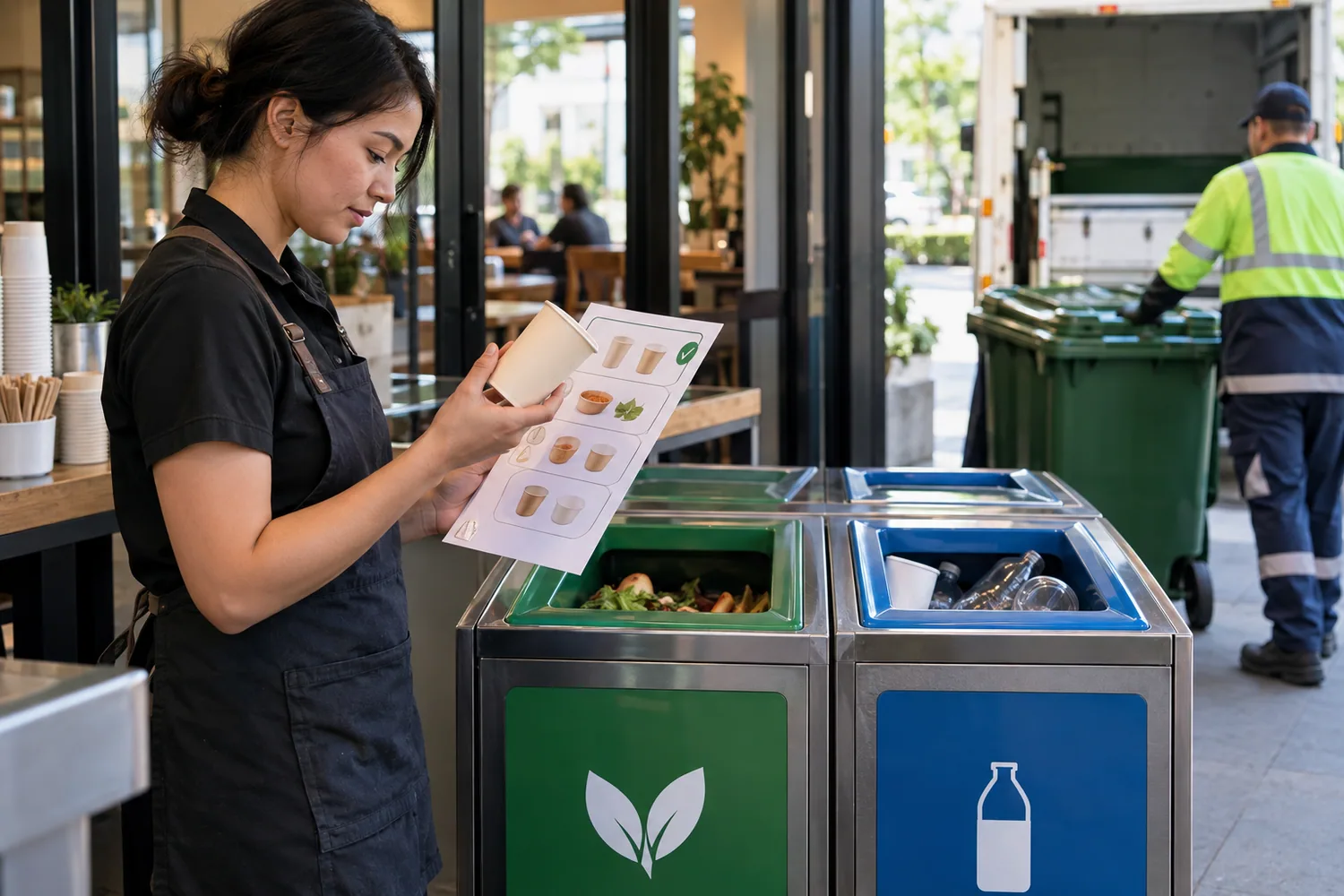
Build the Disposal Pathway Before Approving the Claim
Certification describes product performance under defined assessment conditions. A successful packaging program also needs a route from the point of use to an accepting processor. Without that route, a certified cup may still go to landfill, incineration or a recycling stream where it is unwanted.
- Define the use location. Identify the country, city, venue type and whether consumption is controlled on-site or dispersed through takeaway service.
- Ask the collector. Confirm which bin, bag and contamination rules apply to compostable foodservice packaging.
- Ask the processor. Verify that the receiving facility accepts the exact product category and certification scheme.
- Design the sorting system. Use clear bins, staff training and instructions that help separate organics from conventional plastic.
- Audit the result. Check contamination, rejected loads and whether the promised route is still operating after launch.
Facilities and collection programs can change their acceptance policies. Procurement should therefore treat acceptance as a dated operational record, not a permanent assumption. The same discipline applies when following a broader PLA cold-drink program selection process.
Write Compostable Packaging Claims That Match the Evidence
Claims should state the composting environment clearly. “Industrially compostable where accepted” and “certified for home composting under [scheme]” communicate different facts. Broad wording such as “100% biodegradable,” “earth friendly” or “composts anywhere” can imply unsupported disposal outcomes.
The U.S. Federal Trade Commission's Green Guides state that marketers need competent and reliable scientific evidence for compostable claims and should qualify claims when a product cannot be composted safely or in a timely way at home. They also address limited availability of municipal or institutional facilities. Other destinations have their own laws, standards and enforcement approaches, so claim review must be market-specific.
Keep Four Approval Files Separate
Compostability evidence answers an end-of-life claim. It does not replace food-contact testing, functional performance, or local claim review. Maintain separate approval records for compostability, food-contact compliance, product performance and destination-market artwork.
Buyer Evidence Checklist
- Exact claim: Is the requested wording home compostable, industrially compostable, commercially compostable or another defined statement?
- Environment: Does the evidence address the same composting environment named in the claim?
- Standard and scheme: Which technical standard and certification program were used?
- Certificate holder: Is the supplier, converter or brand relationship traceable?
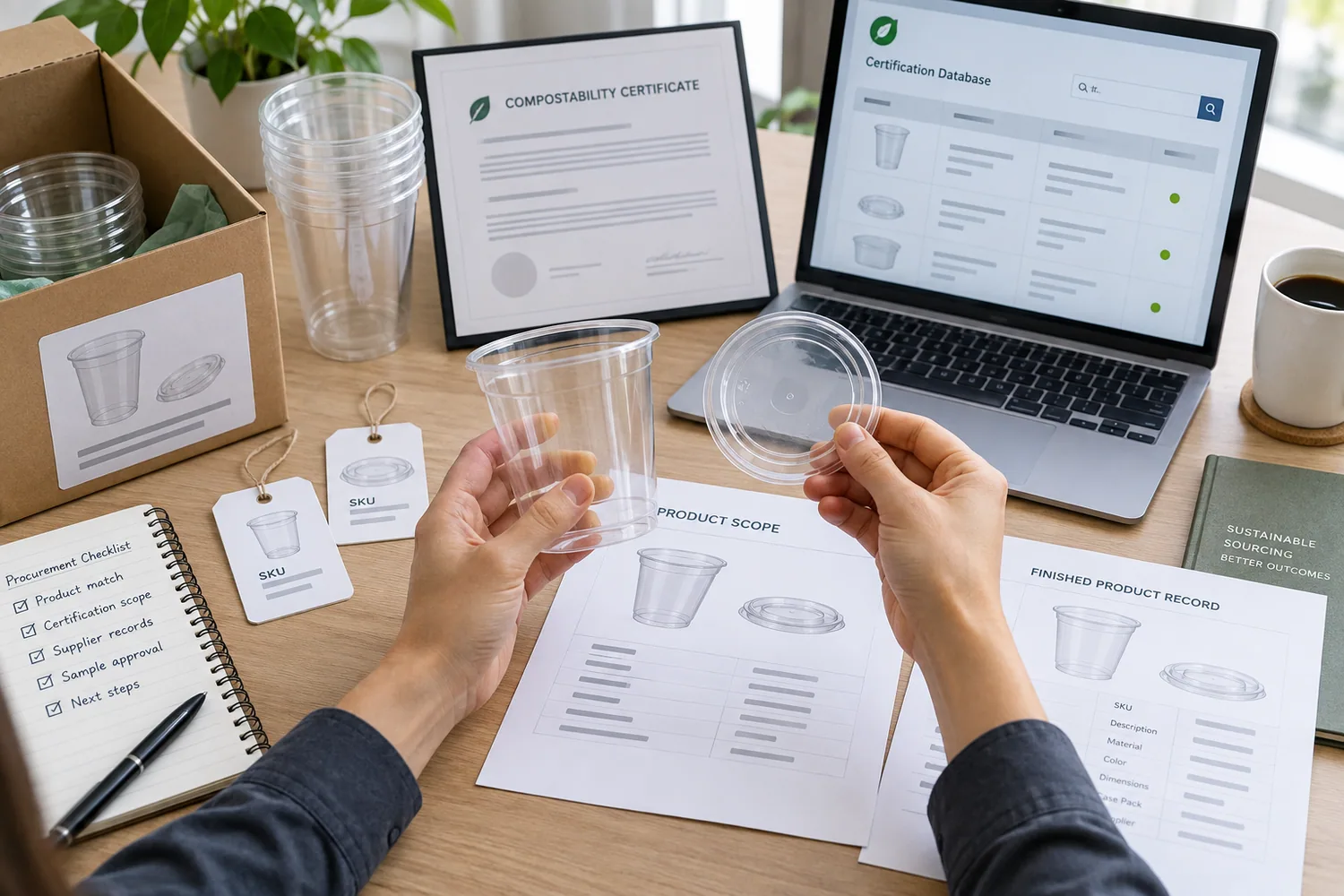
- Product scope: Are the exact finished SKU, maximum thickness, color, print and components covered?
- Validity: Is the certificate current, and does an official database or product annex confirm the listing?
- Mark permission: Is the proposed brand authorized to use the certification mark on the approved artwork?
- Local acceptance: Have the collector and receiving facility confirmed acceptance of the packaging format?
- Other compliance: Are food-contact, labeling and destination-market requirements documented separately?
- Change control: Will changes in resin, supplier, thickness, ink, adhesive or artwork trigger a new review?
Complete the checklist before commercial artwork approval and retain the verified sample with the evidence file. A structured packaging sample approval process helps keep later production aligned with the reviewed construction.
Final Recommendation
Choose the composting claim only after defining the real disposal system. If the project depends on home composting, obtain evidence specifically covering home conditions and the exact finished package. If it depends on industrial composting, verify current certification, local collection and processor acceptance. In both cases, control the cup, lid, print and artwork as one documented program rather than relying on a resin name or a generic logo.
The strongest procurement file connects five elements: the exact product, the correct composting environment, current third-party evidence, accurate market-specific communication and an available end-of-life route. If one element is missing, the buyer should pause the claim even when the package itself has already passed normal quality testing.
Frequently Asked Questions
Is industrially compostable packaging also home compostable?
Not automatically. Industrial composting uses higher and more controlled temperature, moisture and aeration conditions than a typical home pile. A product carrying industrial evidence such as certification based on ASTM D6400 or EN 13432 needs separate home-compostability evidence before it is marketed for home composting.
Are all PLA cups home compostable?
No. PLA identifies a material family, not one universal disposal performance. Some finished PLA products may have industrial-compostability certification, while home compostability requires separate evidence. Verify the exact finished cup, lid, construction, certification scheme and official product scope.
Does EN 13432 prove home compostability?
No. EN 13432 is associated with packaging recoverable through industrial composting and biodegradation under defined conditions. It should not be used by itself to support a home-compostability claim. Buyers should request evidence under an applicable home-composting standard or certification scheme.
Will every commercial composting facility accept certified packaging?
No. Facilities set their own accepted-feedstock policies according to equipment, process duration, contamination risk, contracts and local requirements. Confirm acceptance with the collector and the receiving processor before launch, even when the package has a recognized certification.
What documents should a compostable packaging buyer request?
Request the current certificate, certification scheme and standard, official product listing or scope annex, exact SKU and construction details, mark-use authorization where relevant, and separate food-contact documentation. Also retain written confirmation of local collection and facility acceptance for the intended packaging format.
References
- Biodegradable Products Institute — Commercial and Home Compostability Certification
- Biodegradable Products Institute — Comparison of Commercial and Home Certification Conditions
- European Bioplastics — Composting, Industrial Composting and Home Composting Glossary
- European Bioplastics — Seedling Logo for Industrially Compostable Products
- U.S. Environmental Protection Agency — Composting at Home
- U.S. Environmental Protection Agency — Composting Systems and Facility Acceptance
- U.S. Federal Trade Commission — Environmental Claims and Compostable Guidance
Do not treat “compostable” as one universal disposal claim
- Identify whether the claim is for home composting, municipal or industrial composting, or another defined environment.
- Match the claim to a current certification scheme and the exact finished SKU, including relevant lids, coatings, labels, inks and adhesives.
- Confirm what the target collection program and composting facility actually accept before approving disposal instructions.
- Keep compostability, food-contact compliance, product performance and environmental marketing claims as separate approval checks.
Buyer Checklist
- Write the exact proposed claim before requesting evidence from the supplier.
- Identify the composting environment, applicable standard, certification scheme and destination market.
- Verify the certificate holder, registration number, validity and official product listing.
- Confirm the exact cup, lid, thickness, color, print, coating, label and adhesive within the certified scope.
- Check whether a private-label customer is authorized to use the certification mark.
- Ask the local collector and processor whether they accept the exact packaging format.
- Approve clear disposal wording that distinguishes home from industrial composting.
- Retain the evidence file, approved artwork and current product specification for repeat orders.
Need Compostable Packaging Evidence for a Buyer Review?
Send Cupschina your target market, product format, required composting claim, artwork and order volume. We can help identify suitable PLA cup options and organize available product documentation for your review.


