
Quick Summary
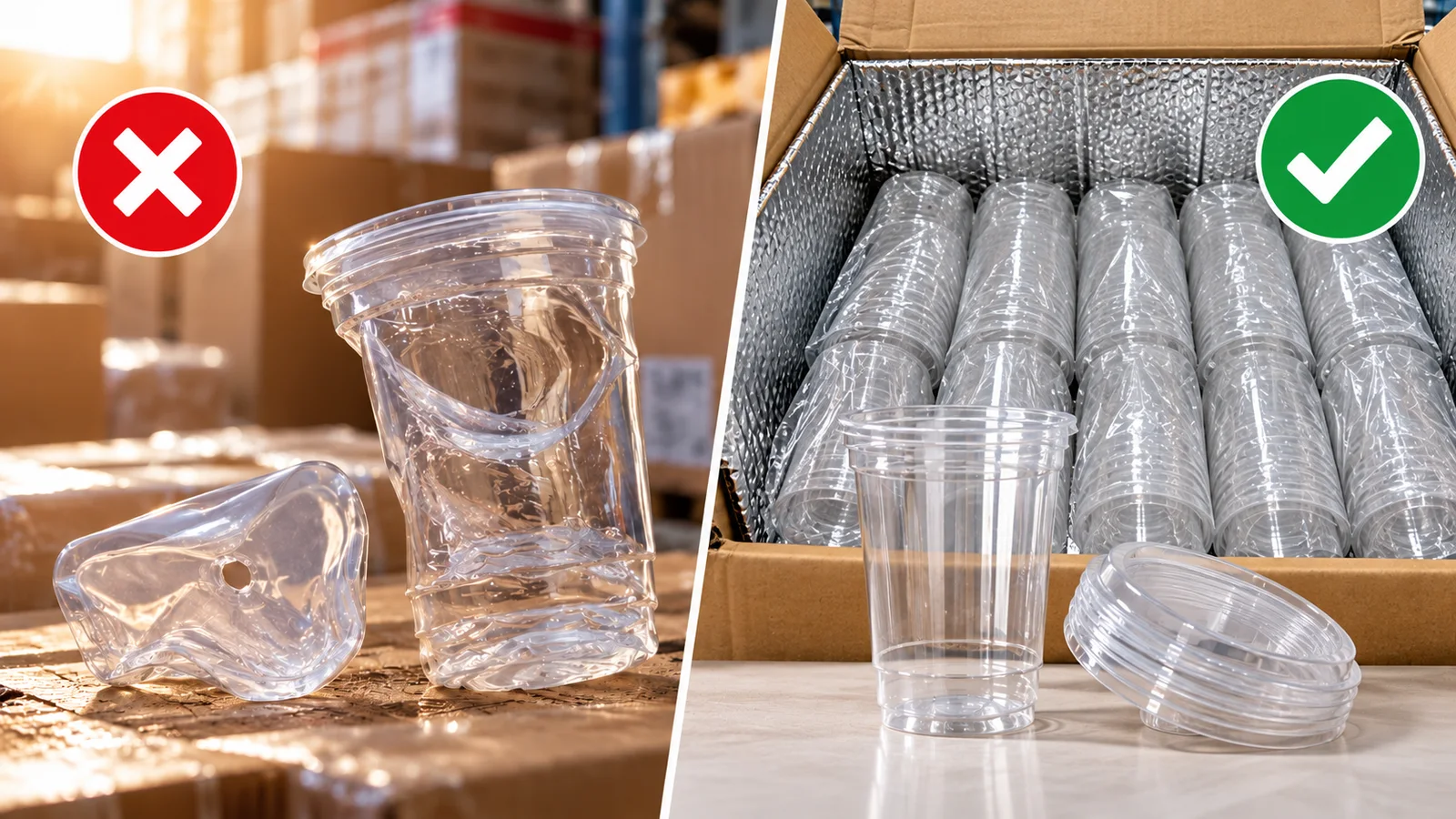
- A clear PLA cup can lose stiffness and dimensional stability before the polymer literally melts. Heat-deformation risk depends on the exact cup, exposure temperature and duration, mechanical load, packing, transport and storage conditions. Buyers should diagnose the exposure path and approve thermal protection as part of the packing specification when the route requires it.
If a clear PLA cup arrives soft, warped, shrunken or partly collapsed, the first question should not be “What is the melting point of PLA?” A thin thermoformed PLA cup can lose stiffness and dimensional stability before the polymer literally melts. For a buyer, the useful investigation is the full exposure path: the exact cup, heat level, exposure time, packing, stacking load, transport route and warehouse conditions.
Clear PLA cups are normally selected for cold-drink and cold-food applications. Their heat sensitivity therefore matters in two separate places: end use and the supply chain before the cup is ever filled. A shipment can be exposed to heat in a container, truck, loading area or warehouse even when the final beverage is cold.
This guide focuses on that second problem. It explains why PLA cups can become soft, what deformation patterns can tell you, what buyers should record when a shipment arrives damaged, and how packing and thermal-protection decisions should be built into procurement rather than treated as an afterthought.
Why Do PLA Cups Get Soft?
PLA is a thermoplastic. As temperature rises, the material can lose rigidity and become easier to distort under its own shape or under external load. A finished clear cup is especially sensitive to this change because its performance does not depend only on the resin name. Wall geometry, forming history, cup profile, rim design, stacking pressure and the duration of heat exposure all affect whether the cup keeps its shape.
This is why “PLA melting temperature” is the wrong number to use as a purchasing shortcut. A cup can become commercially unusable because the wall, bottom or rim has softened and changed shape even though the material has not reached a literal molten state.
For product selection, keep this heat limitation separate from compostability claims. A cup can be intended for an industrially compostable packaging program and still require strict cold-use, storage and shipping controls. Compostability does not make a clear PLA cup heat resistant.
If you are still deciding whether PLA is the right cold-cup material for the program, start with the PLA cup selection guide and then confirm the storage and logistics requirements for the exact product being shortlisted.
What Heat Deformation Can Look Like in a Real PLA Cup Shipment
Real heat-related damage does not always look like a cup “melting.” It may begin as a change in the rim, a wavy cup wall, a compressed bottom, a shortened body or cups that no longer separate and stack normally.
The photographs in this section come from a real customer-reported shipment in which PLA cups were received without thermal insulation and arrived visibly softened and deformed. The images are useful because they show the physical failure mode from several angles: the cup body has lost its original geometry, the bottom has distorted, and the lid has also changed shape.
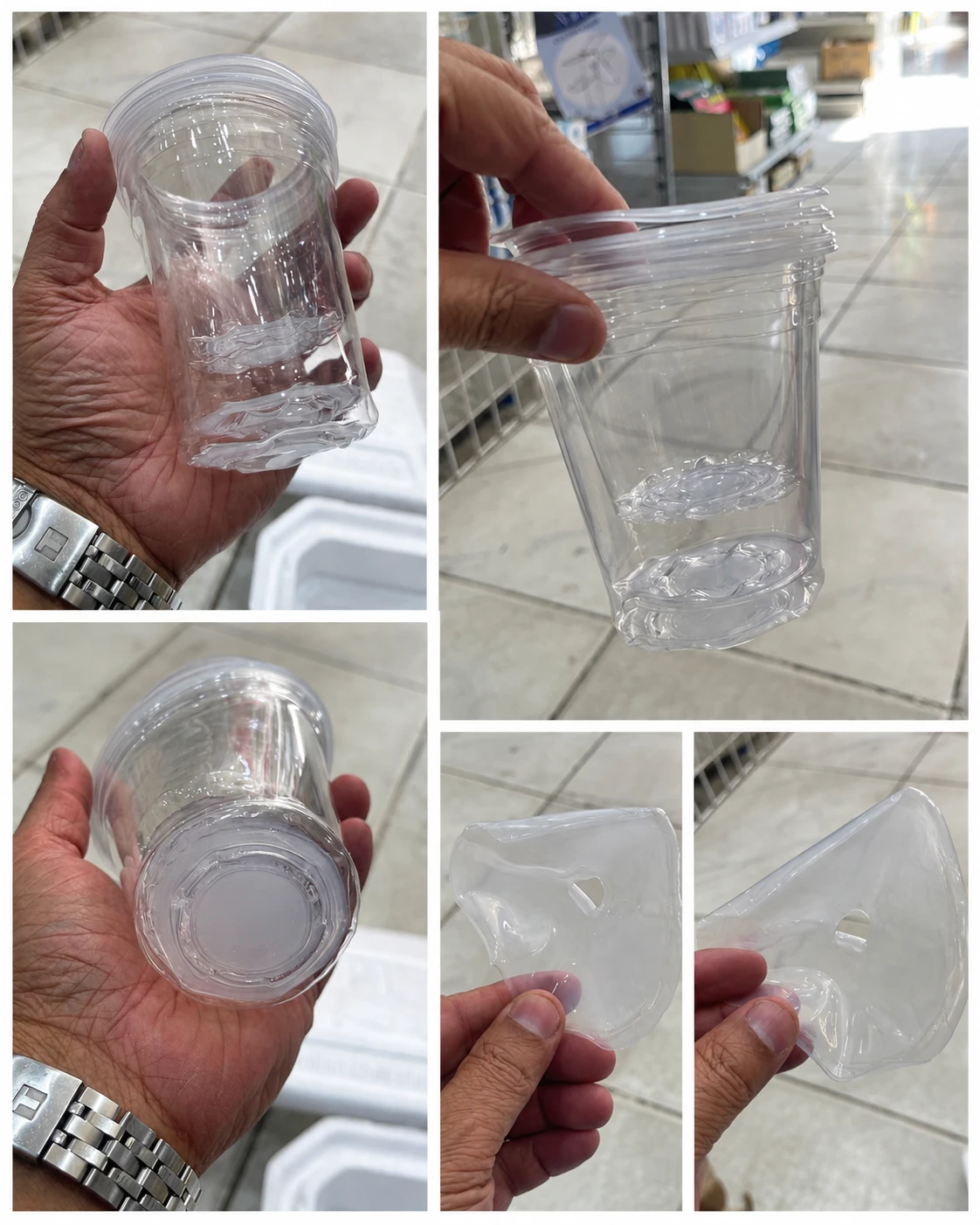
Real shipment evidence: multiple views of softened and deformed clear PLA cups and lids received without thermal insulation. The images show the condition of the products, not a universal temperature-rating test.
Softening, Warping, Shrinkage and Melting Are Not the Same Thing
When a buyer reports that the cups “melted,” the first technical task is to describe what actually changed. The observation matters because different failure patterns point to different questions.
| Observation | What the Buyer Sees | What to Investigate |
|---|---|---|
| Softening | The wall or rim feels less rigid and can be pushed out of shape more easily. | Heat level, exposure time, whether the cup was under load, and the exact cup specification. |
| Warping | The rim becomes oval, the wall bends, or the cup no longer stands or nests normally. | Heat exposure combined with stacking, carton pressure, body geometry or local hot spots. |
| Shrinkage / dimensional change | Height, diameter or body profile changes compared with an unaffected reference cup. | Thermal history, affected-carton pattern, batch identity and storage/transport conditions. |
| Collapse under compression | Cups or stacks are flattened, dented or permanently compressed. | Whether the material softened first and then deformed under carton or pallet load. |
| Literal melting | Material shows true melt-like flow rather than only a softened or distorted shape. | Severe heat source, misuse or an event outside normal cold-cup storage and handling conditions. |
This distinction is important in after-sales communication. “Melted” is a useful description of the customer’s concern, but it is not yet a root-cause diagnosis. Photos, dimensions and shipment history should convert that description into an observable defect pattern.
What Temperature Can Cause PLA Cups to Deform?
There is no single temperature that should be presented as the universal storage limit for every clear PLA cup. Finished-product behavior depends on the exact PLA grade, cup design, forming conditions, wall geometry, exposure time and mechanical load. A material-property number is therefore not the same thing as an approved storage specification for a finished cup.
For procurement, temperature should be handled at three levels:
- Material behavior: PLA becomes less dimensionally stable as heat rises. This explains why heat exposure matters, but it does not approve a finished cup for a specific temperature.
- Finished-product specification: The exact cup should have defined use, storage and handling conditions from the supplier. Those conditions take priority over a generic internet temperature chart.
- Real logistics exposure: A shipment may experience heat for minutes, hours or longer while also carrying stacking load. Duration and pressure can change the result even when two shipments see similar peak temperatures.
Why Can PLA Cups Deform Even When No Hot Drink Is Used?
Hot filling is only one heat source. For exported PLA cups, the more difficult risk can occur before the cup reaches the café, distributor or foodservice operator.
Direct Sunlight and Loading Areas
Cartons left in direct sun, on a loading dock or beside a heat source can warm well above the surrounding indoor environment. The risk increases when exposure is prolonged and the cups are already carrying the weight of stacked product.
Shipping Containers and Trucks
A closed freight container or truck can become a heat-exposure environment, particularly when cargo sits for extended periods. The useful buyer question is not whether the outside air felt acceptable; it is whether the cartons and cups experienced prolonged internal heat during the route.
Warehouse Hot Spots
Warehouses are rarely thermally uniform. Cartons close to a roof, window, external wall or poorly ventilated zone may experience different conditions from cartons stored deeper inside the building.
Heat Plus Mechanical Load
Heat deformation and compression often interact. Once the cup wall or rim becomes less rigid, carton stacking pressure, nesting pressure and pallet load can turn temporary softness into a permanent dimensional change.
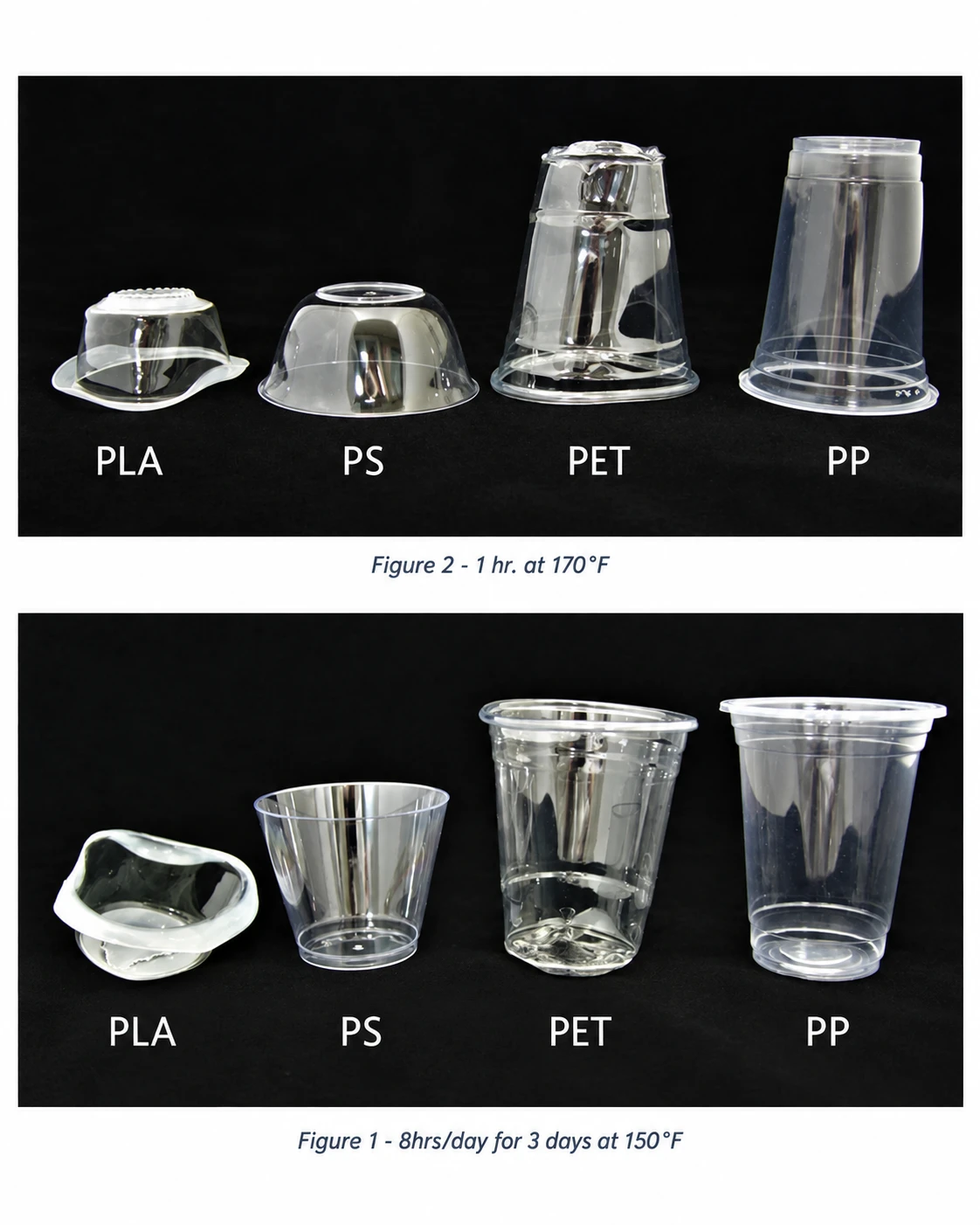
Illustrative heat-exposure comparison of PLA, PS, PET and PP cup forms. The conditions shown in the source comparison are not a Cupschina product qualification test and should not be used as a universal temperature rating.
Why Are Only Some Cartons or Some Cups Deformed?
Partial damage does not automatically prove or disprove a material problem. Heat distribution, stacking pressure and exposure history are rarely identical throughout a shipment.
| Pattern | Questions to Ask |
|---|---|
| Only cartons in one area are affected | Where were those cartons positioned in the container, truck, pallet or warehouse? |
| Top or edge cartons show more damage | Were they closer to a roof, wall, sunlight or a different load condition? |
| Cups are compressed in a consistent direction | Was the product softened while carrying stacking or side pressure? |
| Several cartons across one batch show the same dimensional issue | Do unaffected reference cups and pre-shipment records show the same geometry? |
| Damage appears after destination storage | What happened between unloading and the time the defect was discovered? |
This is why carton position, pallet position and time of discovery matter. A useful investigation maps the damaged quantity instead of treating “one shipment” as one uniform thermal event.
Manufacturing Defect or Heat Exposure? How Buyers Should Screen the Cause
A buyer should not determine responsibility from one photograph or one temperature assumption. The first step is to separate possible manufacturing, packing, transport and storage factors, then compare the evidence.
| Evidence Pattern | Investigation Direction |
|---|---|
| Similar dimensional distortion is documented before shipment | Review forming, dimensional QC and packing before release. |
| Products were documented in normal condition before loading but selected cartons arrive heat-deformed | Review transport, container position, unloading and destination storage history. |
| Damage follows carton compression or stack direction | Review the interaction between heat exposure and mechanical load. |
| Problem occurs during hot filling or another elevated-temperature use | Check whether the application is outside the intended cold-use conditions of the exact cup. |
| Random out-of-shape cups appear under controlled storage with no clear heat event | Review product/batch consistency and dimensional QC. |
For a broader pre-shipment inspection framework, use the Plastic Cup Quality Control Guide. The more clearly the approved cup and packing condition are recorded before shipment, the easier it is to investigate a later deformation complaint.
How Bioleader Cups Protects PLA Cups During Export Shipping
For PLA cups, heat protection should be treated as part of the packaging system. Bioleader Cups uses a two-level thermal-protection approach for PLA shipments when that protection is specified for the route and packing plan: insulated protection at carton level and thermal insulation at container level.
Carton-Level Thermal Protection
PLA cup sleeves are packed inside the agreed export carton, with an insulating liner or bag used to create an additional barrier between the product and external heat. The purpose is to reduce direct heat transfer to the cups during handling, staging and transport.
Container-Level Thermal Protection
For container shipping where heat exposure is a concern, a larger thermal-insulation layer can be used around the cargo area as part of the loading plan. This addresses the longer-duration exposure that can occur during international transport.
The practical lesson from heat-deformation cases is that thermal protection should not be left as an informal assumption. If the route, season or destination creates a meaningful heat risk, the required protection should be agreed before loading and treated as part of the approved packing specification.
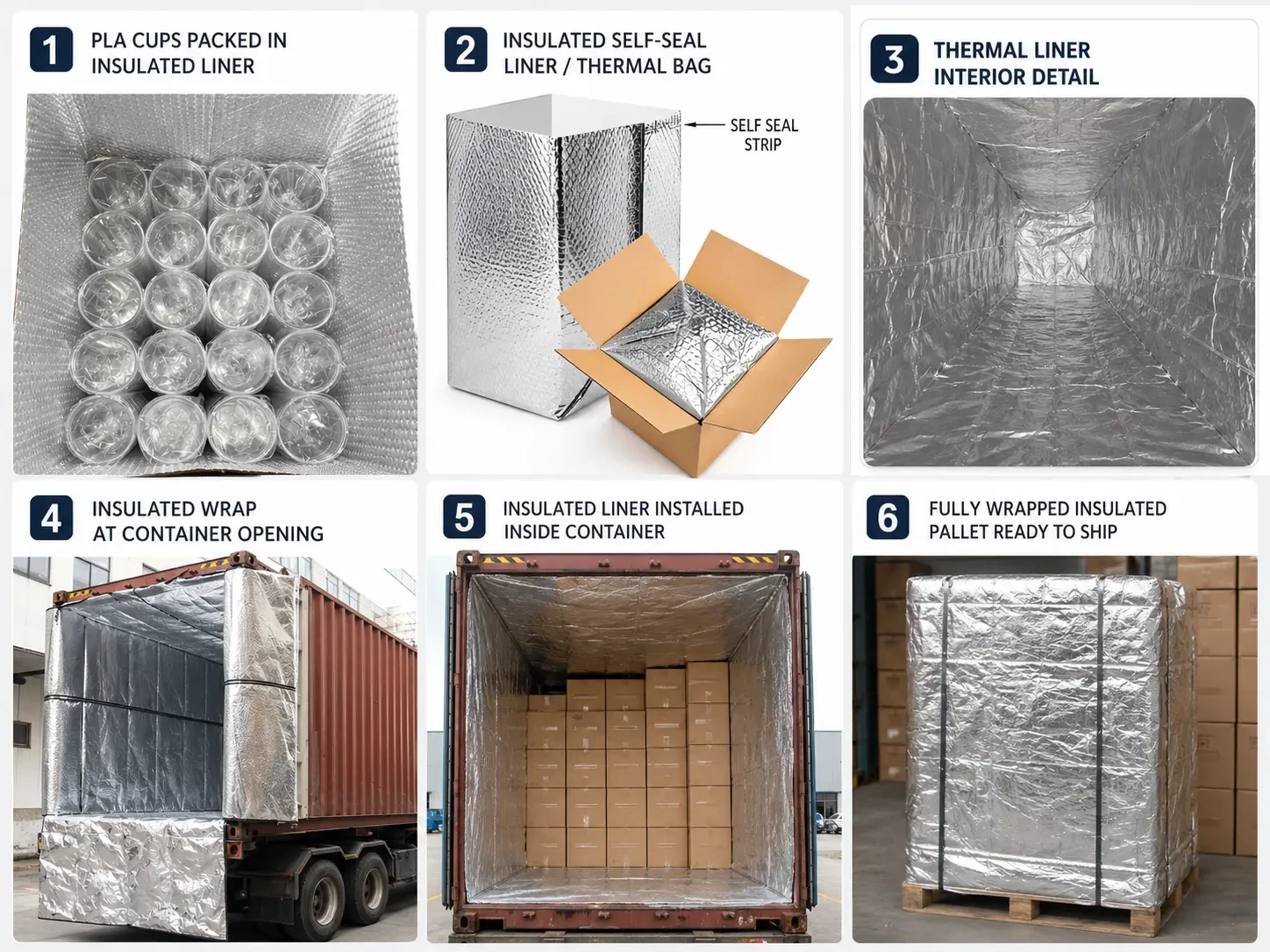
Bioleader Cups PLA export protection: insulated protection inside the carton and container-level thermal insulation for routes where heat exposure requires additional control.
Buyers sourcing clear PLA cups can review the current PLA cup range, but the cup choice and the shipping-protection choice should be approved together when the destination or logistics route is heat-sensitive.
How to Prevent PLA Cup Heat Deformation
Prevention is more reliable when heat risk is managed at several points instead of relying on one warehouse instruction.
Before Ordering
- Confirm that the application is compatible with a clear PLA cold-cup system.
- Identify the exact cup rather than approving only the material name “PLA.”
- Ask for the product-specific storage, handling and use limitations.
- Tell the supplier the destination, shipping route and expected storage environment when heat exposure may be significant.
- Decide whether carton-level or container-level thermal protection needs to be part of the quotation and packing specification.
Use the PLA cup sizes guide to shortlist a capacity, then confirm the exact cup and its handling requirements.
Before Shipment
- Lock the approved cup, carton and protection method before loading.
- Confirm how cartons will be stacked and protected from unnecessary compression.
- Make the thermal-protection requirement visible in the order or packing record rather than relying on verbal instructions.
- Keep a clear reference for the approved condition of the cup and packing before release.
After Arrival
- Move PLA cartons into a cool, dry, ventilated storage area away from direct sunlight and strong heat sources.
- Avoid leaving cartons for prolonged periods in hot trucks, loading areas or other uncontrolled locations.
- Use practical stock rotation rather than holding older cartons indefinitely in warm storage.
- Inspect suspect cartons before distributing them further if heat exposure is believed to have occurred.
When the exact cup or packing configuration still needs approval, use a documented physical sample process. The Plastic Cup Sample Approval Guide explains how to keep an approved reference instead of relying on a generic product description.
What Evidence Should Buyers Collect If PLA Cups Arrive Soft or Deformed?
Do not discard the cartons or mix the affected stock with normal stock before documenting the condition. A useful root-cause review needs traceability from the order to the affected location in the shipment.
- Order, invoice or purchase reference.
- Exact product code or cup reference.
- Batch, lot or carton identification where available.
- Total quantity received and affected quantity observed.
- Clear photos of the cup body, rim, base and lid from several angles.
- Video showing nesting, separation, standing stability or other visible functional changes.
- Photos of outer cartons and any heat or compression damage.
- Pallet/carton position and container position if known.
- Transport route, arrival timing and any known delay or prolonged staging.
- Warehouse location and storage conditions before the problem was discovered.
- An unaffected reference cup from the same order or an approved sample for dimensional comparison.
The goal is to turn “the cups are soft” into evidence that can distinguish product geometry, packing, transport and storage factors. When sourcing internationally, that evidence should also be consistent with the broader supplier and shipment approval workflow described in the plastic cup sourcing guide.
When Should a Buyer Compare PET Instead?
PLA is not the right answer for every cold-cup supply chain. If the program cannot reliably control prolonged heat exposure during transport or storage, the material decision should be reopened rather than assuming that more insulation will solve every risk.
That does not mean PET is automatically “better.” It means the buyer should compare the materials against the actual operating conditions: beverage use, destination climate, storage controls, transport route, sustainability target and required end-of-life program.
The PET vs PLA Cups buyer guide is the better next step when material selection itself is still open. If PLA remains the preferred material, treat its thermal sensitivity as a logistics design constraint and approve the protection plan accordingly.
Buyer Checklist for PLA Storage and Shipping
- Exact cup: Is the specific cup reference confirmed, not only “PLA cup” as a material description?
- Application: Is the cup being used within its intended cold-use conditions?
- Storage guidance: Have the supplier’s product-specific handling and storage limitations been obtained?
- Route: Does the destination, shipping season or transit plan create prolonged heat exposure?
- Packing: Is the agreed carton configuration recorded?
- Thermal protection: Is carton-level and/or container-level insulation required for this shipment?
- Stacking: Could heat and mechanical compression act together?
- Traceability: Can affected cartons be traced to batch, pallet and shipment position?
- Receiving inspection: Will the buyer document cup condition before suspect stock is distributed?
- Reference sample: Is there an approved sample or unaffected reference for comparison?
Final Recommendation
Do not diagnose a soft PLA cup from the melting point alone. Start with the physical symptom, then reconstruct where the cups were exposed to heat, for how long, and under what mechanical load. Compare affected cartons with unaffected stock, packing records and the approved cup reference before deciding whether the dominant issue is product quality, packing, logistics, storage or end use.
For future orders, approve PLA as a complete supply-chain system: exact cup → intended cold use → carton packing → thermal protection → transport route → warehouse condition → receiving inspection. If the route cannot control heat risk adequately, reconsider the material choice before bulk ordering.
Frequently Asked Questions
Why do PLA cups get soft?
Clear PLA cups can lose stiffness when exposed to elevated heat. Once the cup becomes less rigid, its wall, rim or base can distort under its own geometry, nesting pressure, carton pressure or stacking load. The result can be softening, warping, shrinkage or collapse without the polymer literally becoming molten.
Are soft PLA cups actually melting?
Not necessarily. Buyers often use “melted” to describe a cup that has lost shape, but softening, warping and dimensional deformation can occur before literal melting. The physical condition should be documented before the root cause is classified.
What temperature should PLA cups be stored at?
There is no universal storage maximum that should be applied to every PLA cup. Store clear PLA cups in a cool, dry, ventilated environment away from direct sunlight and strong heat sources, and follow the storage and transport limitations for the exact product specification. Route, exposure time and stacking load also matter.
Can PLA cups deform during ocean shipping?
Yes, prolonged heat exposure during international transport can create deformation risk for heat-sensitive clear PLA cups, especially when heat is combined with carton or stacking pressure. For routes where this risk is significant, the packing plan may require insulated carton protection and container-level thermal protection.
What should buyers do if PLA cups arrive soft or deformed?
Separate and document the affected stock before distribution. Record the product reference, batch or carton information, affected quantity, photos and videos, carton/pallet position, transport history and storage conditions. Compare the affected cups with an approved or unaffected reference, then review manufacturing, packing, logistics and storage evidence before assigning a cause.