
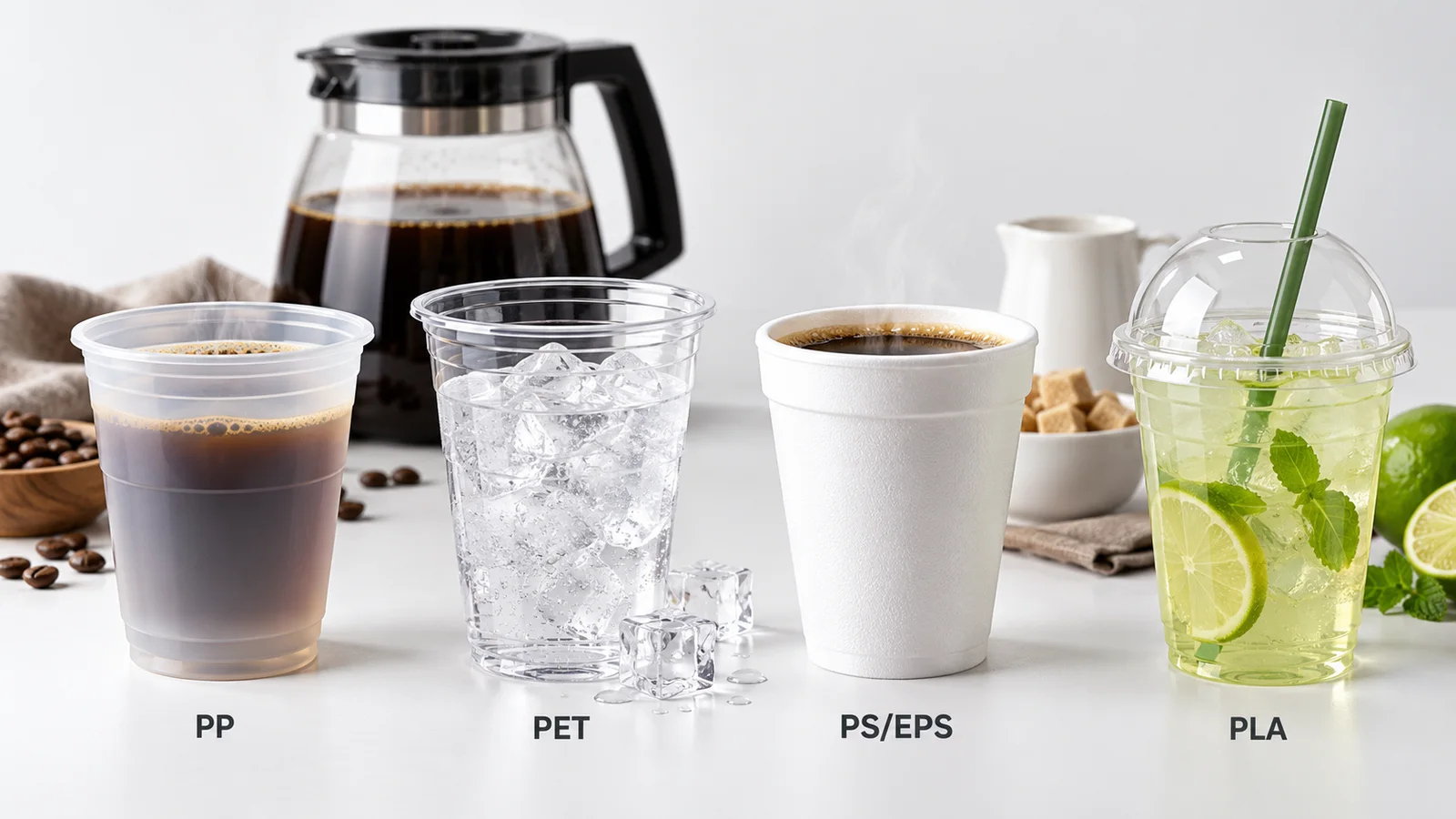
Quick Summary
- Hot-coffee suitability depends on both the plastic material and the exact finished cup. PP is often the first plastic to evaluate for direct hot-coffee service; standard clear PET and clear PLA cups are mainly cold-drink products; PS depends on cup format. A PET cup may sometimes be used for an iced-coffee process when substantial ice is added first, but that method must be trialed with the exact cup and should not be treated as a general PET hot-fill approval.
Yes, but only some plastic cups are suitable for hot coffee. The first check is the cup material, and the second is the exact finished cup's intended use. Polypropylene (PP) is often the first plastic to evaluate for direct hot-coffee service. Standard clear PET and clear PLA cups are mainly cold-drink products, while polystyrene (PS) depends strongly on the finished cup format.
Direct answer: "Plastic" is not a hot-coffee specification. Identify the material first, then verify the exact cup's intended hot-beverage use. Material narrows the choice; the finished-cup specification approves the application.
This article is about pouring already-hot coffee into a cup. That is different from heating the beverage while it is inside the cup. Cupschina's microwave guide treats microwave suitability as a separate use condition and recommends checking the exact finished product rather than deciding from a resin code alone.[1]
Can You Put Hot Coffee in a Plastic Cup?
Sometimes. The correct answer depends on the polymer family, cup construction and intended service condition. A cup can be made from a plastic with relatively good thermal performance and still be the wrong finished product for hot coffee. Conversely, some plastic cup formats are specifically designed for hot beverage use.
| Cup material | Hot coffee suitability | Practical decision |
|---|---|---|
| PP (polypropylene) | Often suitable | Usually the first plastic material to evaluate for direct hot-coffee service, but the exact cup still needs product-level confirmation. |
| PET clear cold cup | Generally not for direct hot fill | Standard clear PET cold cups should not be treated as hot-coffee cups. |
| PS / EPS | Depends on format | Some insulated EPS foam cups are specifically made for hot beverages; rigid PS cup formats should be checked separately. |
| PLA clear cup | Generally not suitable | Standard clear PLA cups are primarily cold-drink serviceware; high-heat PLA systems are a different product class. |
| Unknown plastic | Do not assume | Identify the material and exact cup specification before using it with hot coffee. |
Braskem's polypropylene foodservice documentation describes disposable PP cups as suitable for use with hot liquids because of the material's thermal and impact performance, which is one reason PP is commonly evaluated for hotter foodservice conditions.[2] That material-level capability does not remove the need to confirm the exact finished cup.
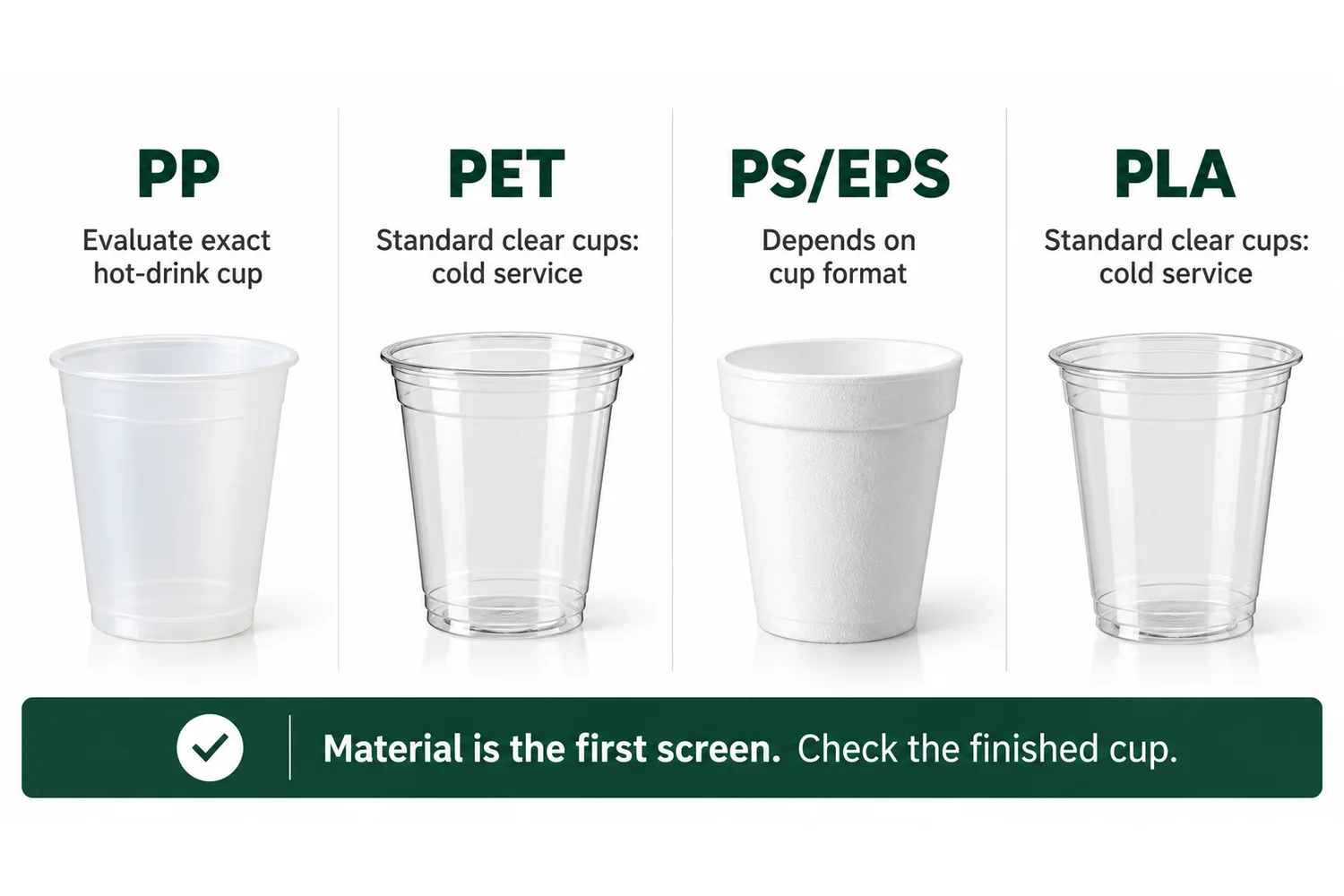
Can You Put Hot Coffee in a PP Cup?
Often yes, if the exact PP cup is designed and documented for hot beverage service. PP is one of the most practical plastic families to investigate when the application involves hotter liquids. Braskem's disposable-cup material guide states that PP's thermal resistance helps it avoid undesirable deformation when used with hot liquids.[2]
The material name still does not approve every finished product. A #5 PP mark identifies polypropylene, but it does not tell the buyer the exact wall construction, cup geometry, forming process, lid system or service instructions. Two cups made from PP can be designed for different applications.
Practical rule: If a buyer specifically wants a plastic cup for direct hot coffee, PP is usually the first material family to review. Approval should still be tied to the exact cup SKU and supplier documentation.
What Should Buyers Check on a PP Hot Cup?
- Confirm the exact PP cup code rather than buying only by resin number.
- Check whether the supplier positions that finished cup for hot beverages.
- Confirm the lid material and lid fit for the same service condition.
- Review filled-cup handling, sidewall stability and rim behavior during normal service.
- Do not transfer a use statement from one PP cup to another without confirmation.
For a broader comparison of PP against PET in cold-drink and foodservice packaging, see the PET vs PP scientific material guide.
Can You Put Hot Coffee in a PET Cup?
Generally no for a standard clear PET cold cup. This is the most important distinction for many cafés and beverage shops. Clear PET cups can look rigid and premium at room temperature, but appearance does not make them hot-coffee cups.
Cupschina's current PET cup range is positioned for iced coffee, juice, smoothies, bubble tea and other cold or chilled applications, and the material guide states that these standard PET cups are not recommended for hot drinks.[3]
That does not mean every PET package is inherently limited to cold use. Specialized PET systems exist for hot-fill packaging. Eastman, for example, markets PET materials specifically optimized for hot-fill or heat-set food and beverage applications.[4] Those engineered PET bottle and packaging systems should not be confused with an ordinary clear thermoformed cold cup.
Do not generalize from the polymer name. "PET" can describe different grades and package constructions. For Cupschina-style clear cold cups, the practical recommendation remains: do not pour hot coffee directly into an empty PET cup unless that exact cup has been specifically approved for the use.
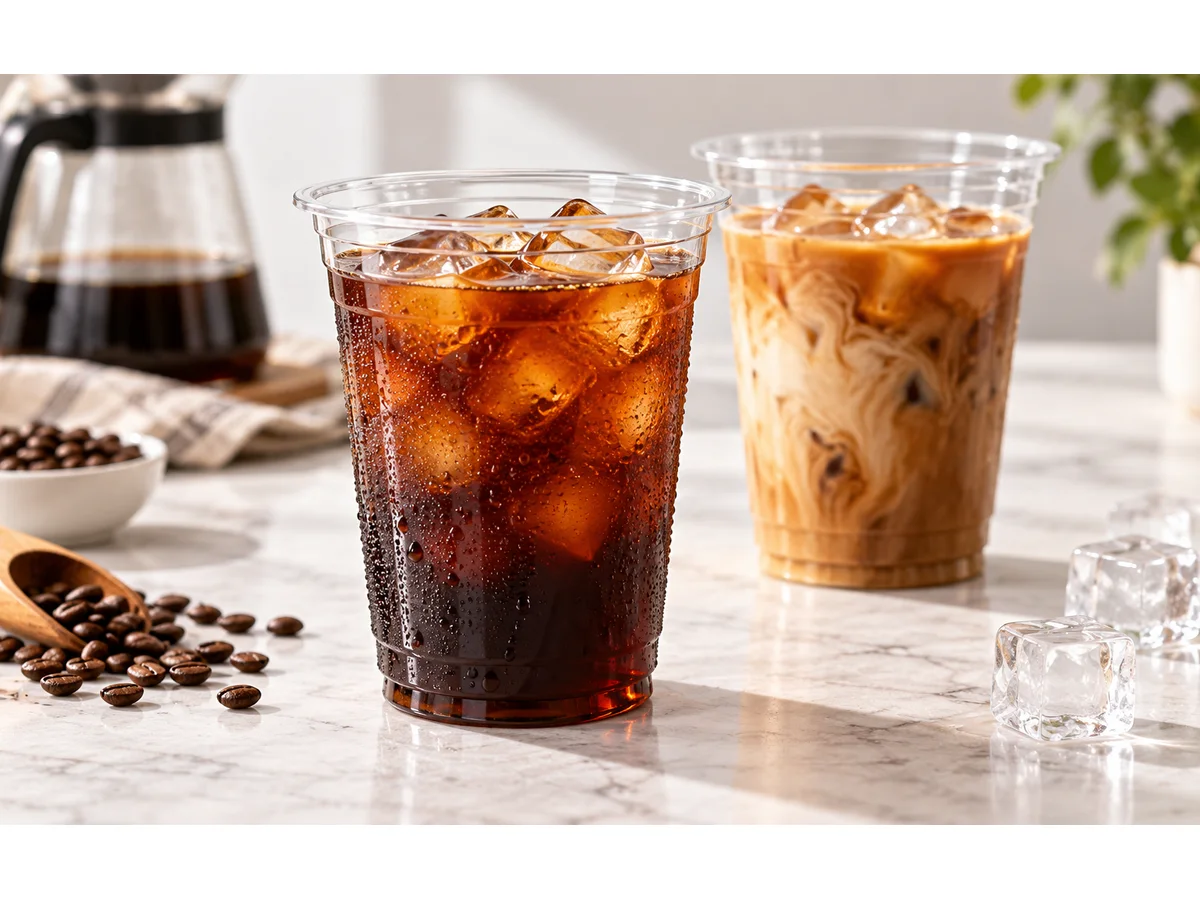
Can You Pour Hot Coffee Over Ice in a PET Cup?
This can be workable as a specific iced-coffee preparation method, but it should be treated as an operator trial—not as a general PET hot-drink approval. The process is different from pouring hot coffee directly into an empty PET cup because a substantial quantity of ice is already present before the hot coffee enters the cup.
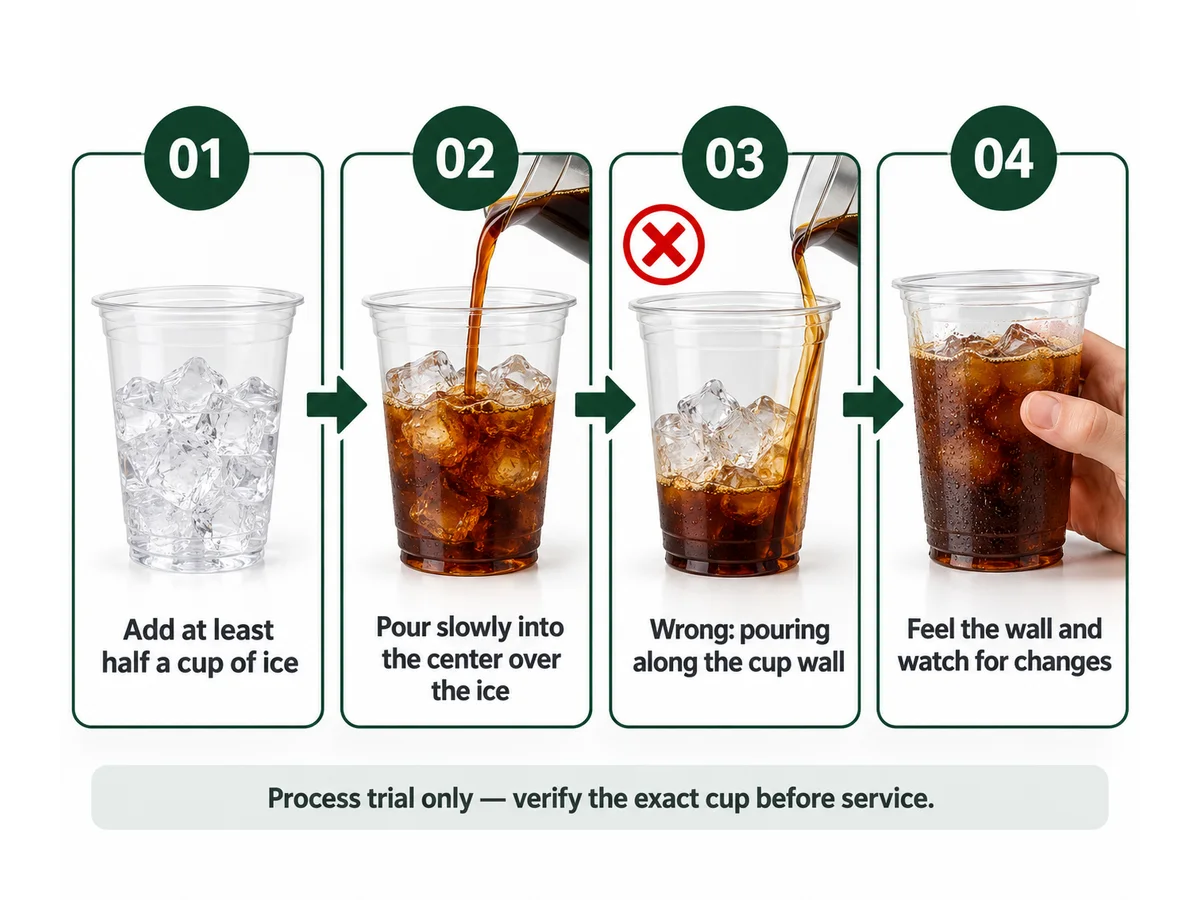
In practical beverage preparation, Cupschina recommends starting the trial with at least about half a cup of ice, then introducing the hot coffee slowly into the center of the ice. The ice absorbs heat as it melts, reducing the immediate thermal load on the cup compared with direct contact between freshly hot coffee and an empty PET sidewall.
Experience-based operating point: the goal is to make the hot coffee hit the ice first. Do not intentionally run the hot stream down the inside wall of the PET cup. Direct wall contact can soften the cup locally before enough cooling has occurred.
This method is still dependent on the exact cup, ice quantity, coffee condition, pour rate, cup geometry and handling time. It should therefore be validated with the exact cup used in the shop. A method that works with one PET cup should not automatically be transferred to a different cup simply because both are PET.
Four-Step PET Iced-Coffee Trial
- Add at least about half a cup of ice. Use the real ice quantity that the shop intends to use in normal iced-coffee preparation.
- Pour the hot coffee slowly into the center. Aim the stream at the ice so the coffee is cooled before prolonged contact with the PET wall.
- Avoid pouring along the cup wall. Do not deliberately let the hot stream run down the inner sidewall because local heat exposure can soften the cup faster.
- Check the cup by touch and by sight. Carefully feel the outside wall, observe whether the sidewall softens or changes shape, and check whether the rim and lid fit remain stable. Stop the trial if the cup becomes difficult to handle or visibly deforms.
This is a process-validation method, not a material certification. Do not publish a universal claim such as "PET cups are safe for hot coffee" based on this workflow. The result applies only to the exact cup and preparation process that was actually tried.
Can You Put Hot Coffee in a PS Cup?
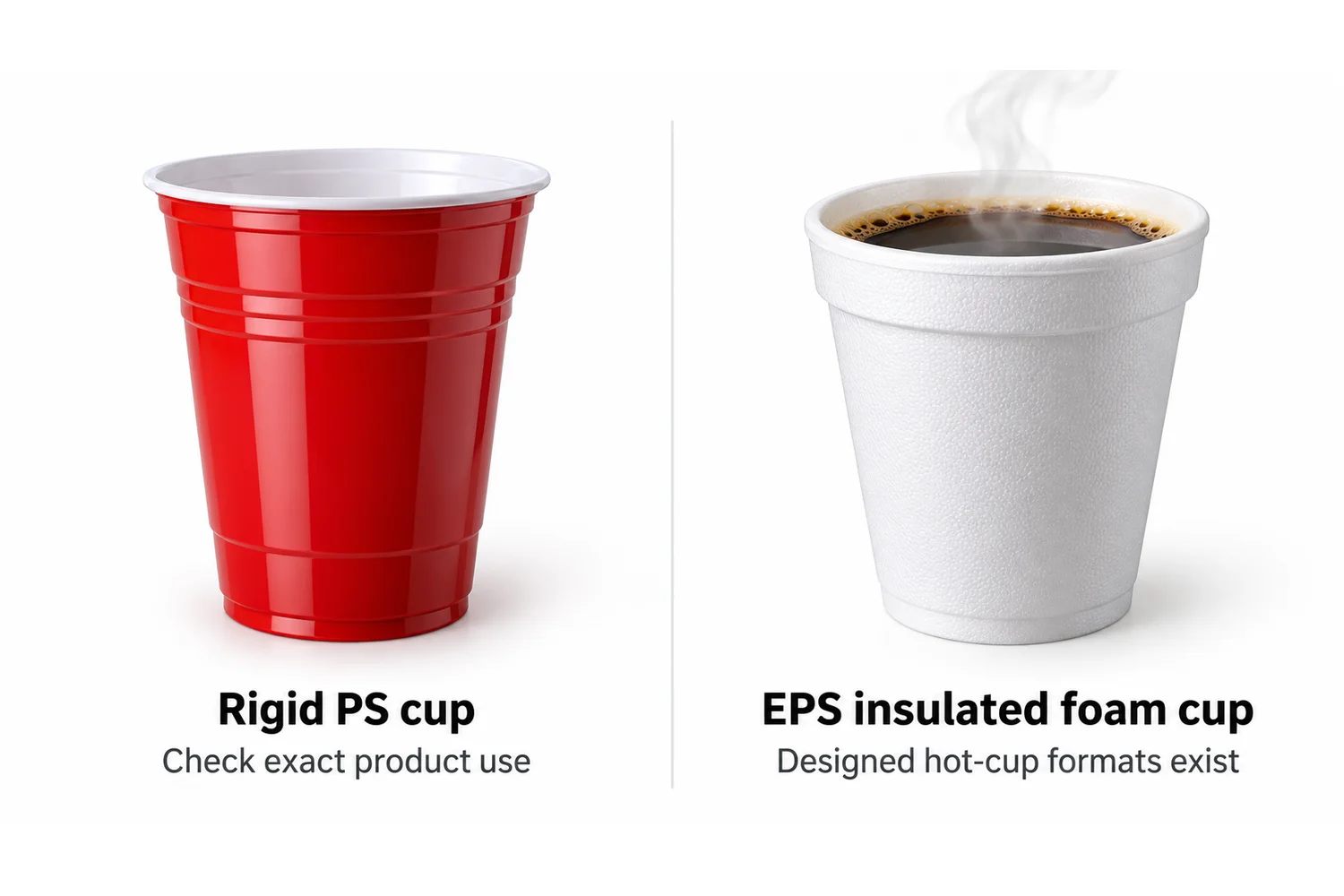
It depends on the finished PS format. A rigid PS party-style cup and an expanded-polystyrene (EPS) insulated foam cup should not be treated as the same hot-beverage product.
Some EPS foam cups are specifically designed for hot and cold beverages. Dart, for example, markets insulated EPS cups for coffee, cappuccino, tea, hot chocolate and other drinks, and lists particular foam-cup products for hot-and-cold use.[5]
That does not mean every cup marked #6 PS is suitable for hot coffee. Buyers should identify whether the product is a rigid PS cup, EPS foam cup or another polystyrene format, then follow the exact product specification.
Practical rule: for PS, cup format matters as much as resin identity. An insulated EPS hot cup is a different application from a generic rigid PS cup.
Can You Put Hot Coffee in a PLA Cup?
Generally no for a standard clear PLA cold cup. Cupschina's current commercial positioning focuses on clear PLA cups for cold beverages and desserts rather than direct hot-coffee service.[6]
The PLA family also requires a technical distinction. Standard clear PLA cold cups are not the same product class as modified or crystallized high-heat PLA systems. NatureWorks describes high-heat PLA compounds engineered specifically for disposable foodservice applications where higher thermal performance and dimensional stability are required.[7]
Do not transfer high-heat PLA claims to a clear PLA cold cup. The existence of higher-heat PLA technology does not make an ordinary transparent PLA beverage cup suitable for hot coffee.
For handling before use, review the PLA storage and shipping guide alongside the exact cup specification.
For buyers considering Cupschina's current PLA range, the practical application remains cold beverages such as iced coffee, smoothies, juice and similar cold-drink programs.
Why the Plastic Number Alone Is Not Enough
A resin identification number tells you the polymer family. It does not fully describe the finished product's thermal application. The number on the base of the cup cannot tell you all of the following:
- the exact resin grade or formulation;
- the cup wall construction and geometry;
- the forming or molding process;
- the intended hot- or cold-service condition;
- the lid material and matching system;
- the expected holding time after filling;
- whether the finished cup was actually approved for hot beverage use.
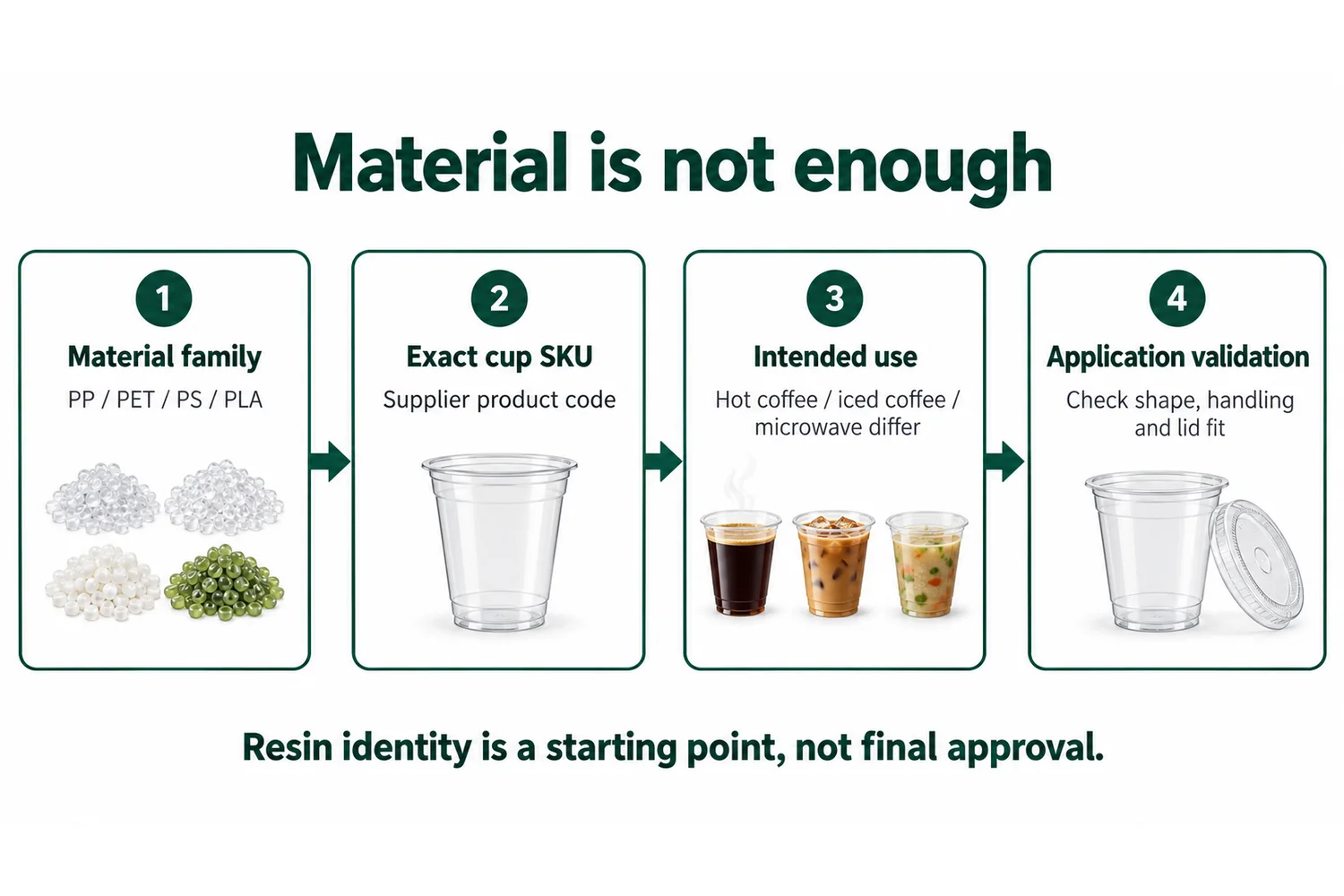
For procurement, the better sequence is material family → exact cup SKU → intended use → application validation where needed. This prevents a common mistake: assuming that every cup made from a higher-temperature polymer has the same finished-product performance.
Hot Coffee Is Not the Same as Microwaving the Cup
Hot-coffee service and microwave heating are different exposure conditions. They should not be combined into one yes-or-no material rule.
| Use condition | What happens | What must be confirmed |
|---|---|---|
| Direct hot coffee | Already-hot coffee is poured into the cup. | Finished-cup suitability for hot beverage service. |
| Hot coffee over ice | The hot stream is cooled by a substantial quantity of ice during filling. | The exact PET cup and actual preparation process must be trialed. |
| Microwave heating | The contents are heated while inside the cup. | Product-specific microwave instructions or approval. |
A hot-beverage cup is not automatically a microwave-safe cup. For that separate question, use the Cupschina microwave guide.
What Should Buyers Verify Before Ordering Plastic Cups for Hot Coffee?
For importers, distributors, cafés and beverage chains, the material name should start the review, not finish it. The exact cup and actual service process determine whether the packaging system is appropriate.
| Verification point | Why it matters |
|---|---|
| Exact polymer | PP, PET, PS and PLA have different thermal behavior and common foodservice applications. |
| Exact cup SKU | The same resin family can be used in finished cups with different constructions and intended uses. |
| Intended service | Direct hot coffee, iced coffee, hot fill and microwave heating are different use conditions. |
| Lid system | The lid must be checked for the same cup and service application rather than selected only by nominal size. |
| Filled-cup handling | Sidewall stability, grip, rim shape and lid fit affect real service reliability. |
| Trial method | Borderline applications such as hot coffee over ice in PET should be validated with the exact process before rollout. |
| Destination-market documents | Food-contact documentation and use claims should match the exact product and intended market where required. |
If the actual application is iced coffee rather than hot coffee, the Iced Coffee Cups Buying Guide covers cold-cup selection, lids, ice and branding in more detail.
Buyer Checklist
- Identify the exact cup material before discussing hot-coffee suitability.
- Use PP as a common starting point for plastic hot-beverage cup evaluation, not as an automatic approval.
- Do not pour hot coffee directly into a standard clear PET cold cup unless the exact product is approved for that use.
- For PET iced coffee, add a substantial quantity of ice first and trial the exact center-pour process before service.
- Do not deliberately pour hot coffee down the PET sidewall during the ice-first trial.
- For PS, distinguish rigid PS cups from insulated EPS hot-beverage cups.
- Do not use a standard clear PLA cold cup for hot coffee.
- Keep hot-coffee service and microwave suitability as separate approval questions.
- Confirm the lid and filled-cup handling together with the cup body.
Final Recommendation
If you need a direct material-selection rule, use this one: PP is often the first plastic to evaluate for direct hot coffee; standard clear PET and clear PLA cups should be treated as cold-drink systems; PS must be judged by its exact format, especially whether it is an insulated EPS hot cup.
PET has one useful practical exception for iced-coffee preparation: add a substantial amount of ice first, then pour the hot coffee slowly into the center over the ice rather than along the cup wall. That technique can reduce immediate heat exposure to the PET cup, but it must be treated as an experience-based process trial for the exact cup, not as proof that PET is generally suitable for hot coffee.
The most reliable question is therefore not simply "Can plastic hold hot coffee?" It is: Which plastic, which exact cup and under which real serving condition?
Frequently Asked Questions
Can you put hot coffee in any plastic cup?
No. Some plastic cups are designed for hot beverages, while many disposable clear cups are intended only for cold drinks. Check both the material and the exact finished cup's intended-use specification.
Is PP a good plastic for hot coffee?
PP is commonly one of the first plastic materials to evaluate for hot beverage use because suitable PP foodservice cups can offer useful thermal performance. The exact cup still needs confirmation for direct hot-coffee service.
Can you pour hot coffee directly into a clear PET cup?
Generally not into a standard clear PET cold cup. Specialized hot-fill PET packaging exists, but that is a different product class from an ordinary thermoformed clear cold-drink cup.
Can you pour hot coffee over ice in a PET cup?
It can be tested as an iced-coffee preparation method. Start with at least about half a cup of ice, pour the hot coffee slowly into the center over the ice rather than along the cup wall, then check the exact cup for softening, deformation and rim stability before approving the process for service.
Is a microwave-safe plastic cup automatically suitable for hot coffee?
No. Microwave heating and direct hot-beverage service are different use conditions. Each application should be confirmed from the exact finished-product instructions rather than inferred from the material name alone.
References
- Cupschina — Can You Microwave Plastic Cups? PET, PP, PLA & Microwave-Safe Labels Explained. Distinguishes microwave suitability from general material identity and other thermal use conditions.
- Braskem — Thermoformed and Disposable Packaging. Describes polypropylene disposable-cup applications and PP performance with hot liquids.
- Cupschina — PET Cups. Current Cupschina PET range positioning for cold drinks and chilled applications; standard PET cups are not recommended for hot drinks.
- Eastman — PET Renew. Example of PET materials engineered for hot-fill food and beverage packaging, illustrating that specialized hot-fill PET differs from standard clear cold cups.
- Dart Container — 10 oz EPS Foam Cup. Example of an EPS cup specifically marketed for hot and cold beverage use.
- Cupschina — PLA & PET Cup Manufacturer. Current Cupschina commercial positioning for clear PLA and PET cold-beverage cup systems.
- NatureWorks — High Heat Technology. Example of modified PLA compounds engineered for higher-heat foodservice applications, distinct from standard clear PLA cold cups.