
Quick Summary
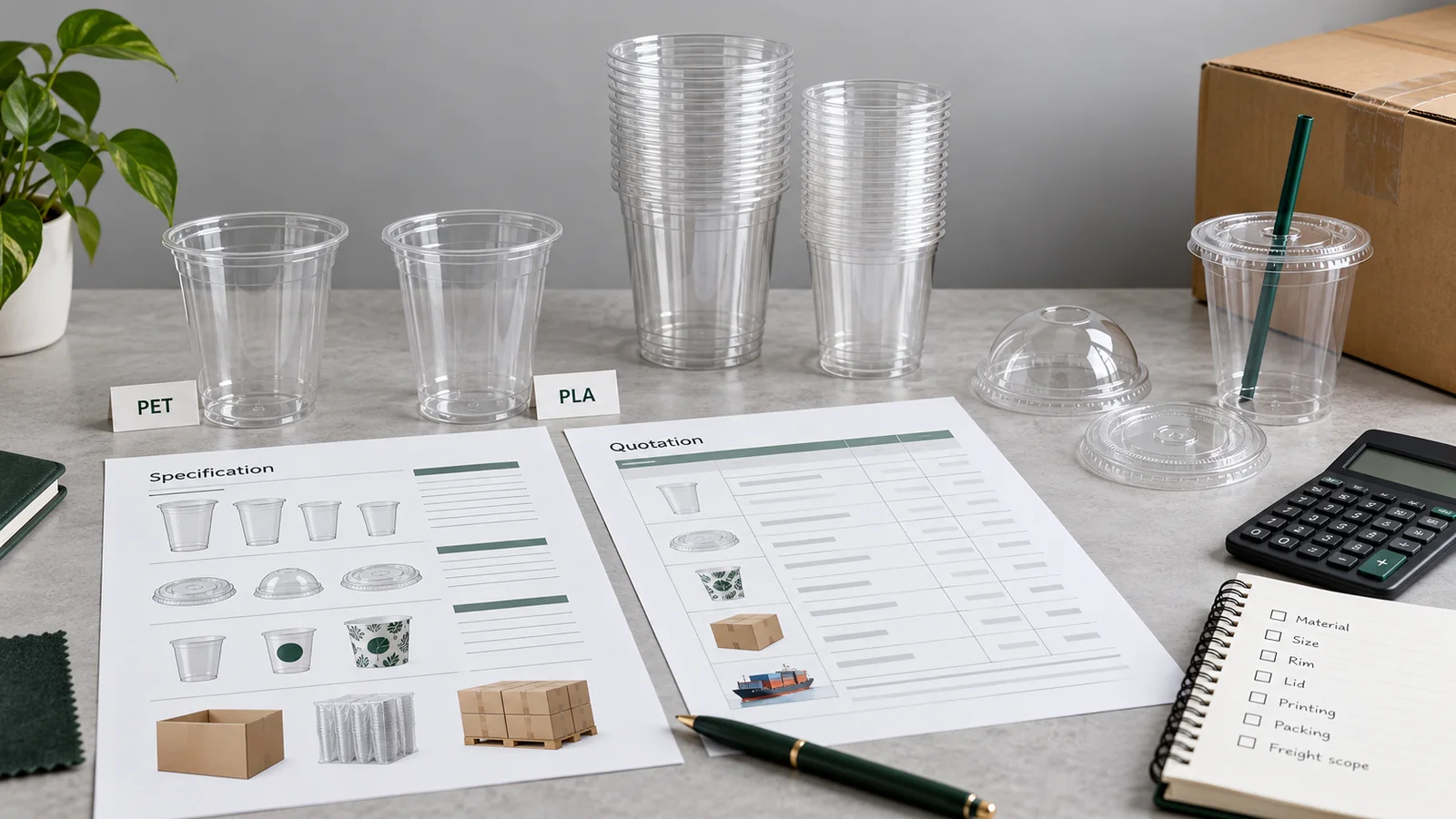
- Bulk plastic cup prices only become comparable after the buyer normalizes the exact product behind each quotation. Start with material and exact cup specification, then compare rim and lid system, printing, packing, quantity and freight scope. Cupschina's published PET and PLA product pages provide current reference-price examples, but they are cup-only references rather than universal fixed prices.
How much do plastic cups cost in bulk? On Cupschina product pages reviewed in October 2026, selected standard PET cold-cup examples range from about USD 15.44 to USD 41.03 per 1,000 cups, while selected PLA clear cold-cup examples range from about USD 31 to USD 84 per 1,000 cups. These ranges summarize specific 7 oz, 16 oz and 24 oz product examples. They are not a universal PET or PLA price list.
Each referenced product page states that the listed figure is a reference carton price for cups, that lids are not included, that the final price depends on quantity and customization, and that sea freight is quoted separately according to shipment factors and destination.[1][2][3][4][5][6]
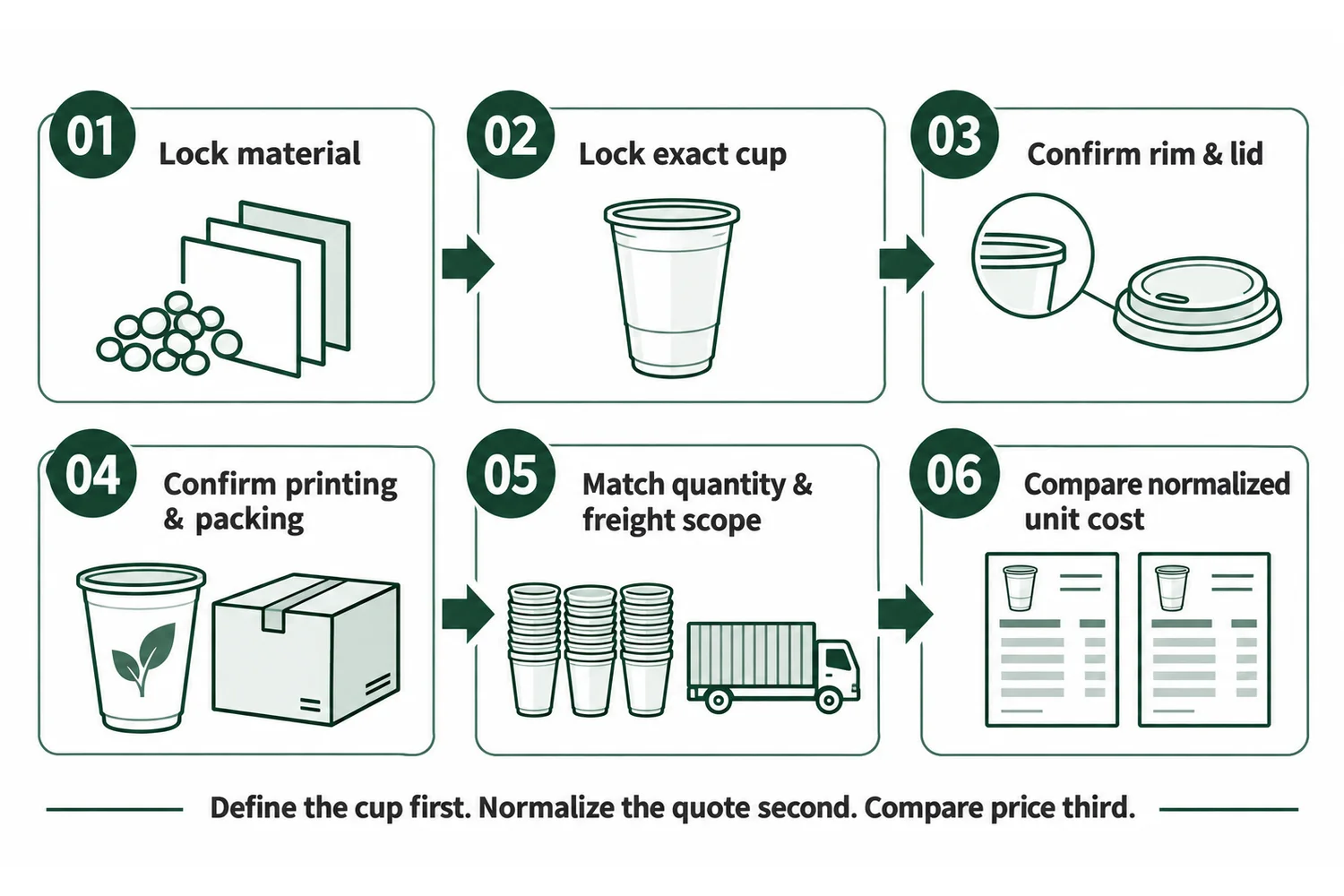
The purchasing rule: a plastic cup price is not comparable until the product specification behind the quote is comparable. Define the cup first, normalize the quotation second, and compare price third.
Bioleader Cup Prices: Current Public Reference Examples
The table below uses currently published Cupschina product pages as concrete B2B reference points. The selected examples cover ordinary clear cold-cup formats from 7 oz to 24 oz. Each row identifies the exact material, listed capacity and current selected rim format behind the public reference price.
| Published cup example | Current selected specification | Reference carton price | Approx. cup-only price |
|---|---|---|---|
| 7 oz PET cup[1] | 210 ml, 78 mm rim | USD 15.44–20.44 / 1,000 pcs | About 1.54–2.04¢ per cup |
| 16 oz PET cup[2] | 500 ml, 90 mm rim | USD 33.46–38.46 / 1,000 pcs | About 3.35–3.85¢ per cup |
| 24 oz PET cup[3] | 660 ml, 90 mm rim | USD 36.03–41.03 / 1,000 pcs | About 3.60–4.10¢ per cup |
| 7 oz PLA cup[4] | 200 ml listed selection, 78 mm rim | USD 31–36 / 1,000 pcs | About 3.10–3.60¢ per cup |
| 16 oz PLA cup[5] | 500 ml, 90 mm rim | USD 62–67 / 1,000 pcs | About 6.20–6.70¢ per cup |
| 24 oz PLA cup[6] | 660 ml, 90 mm rim | USD 79–84 / 1,000 pcs | About 7.90–8.40¢ per cup |
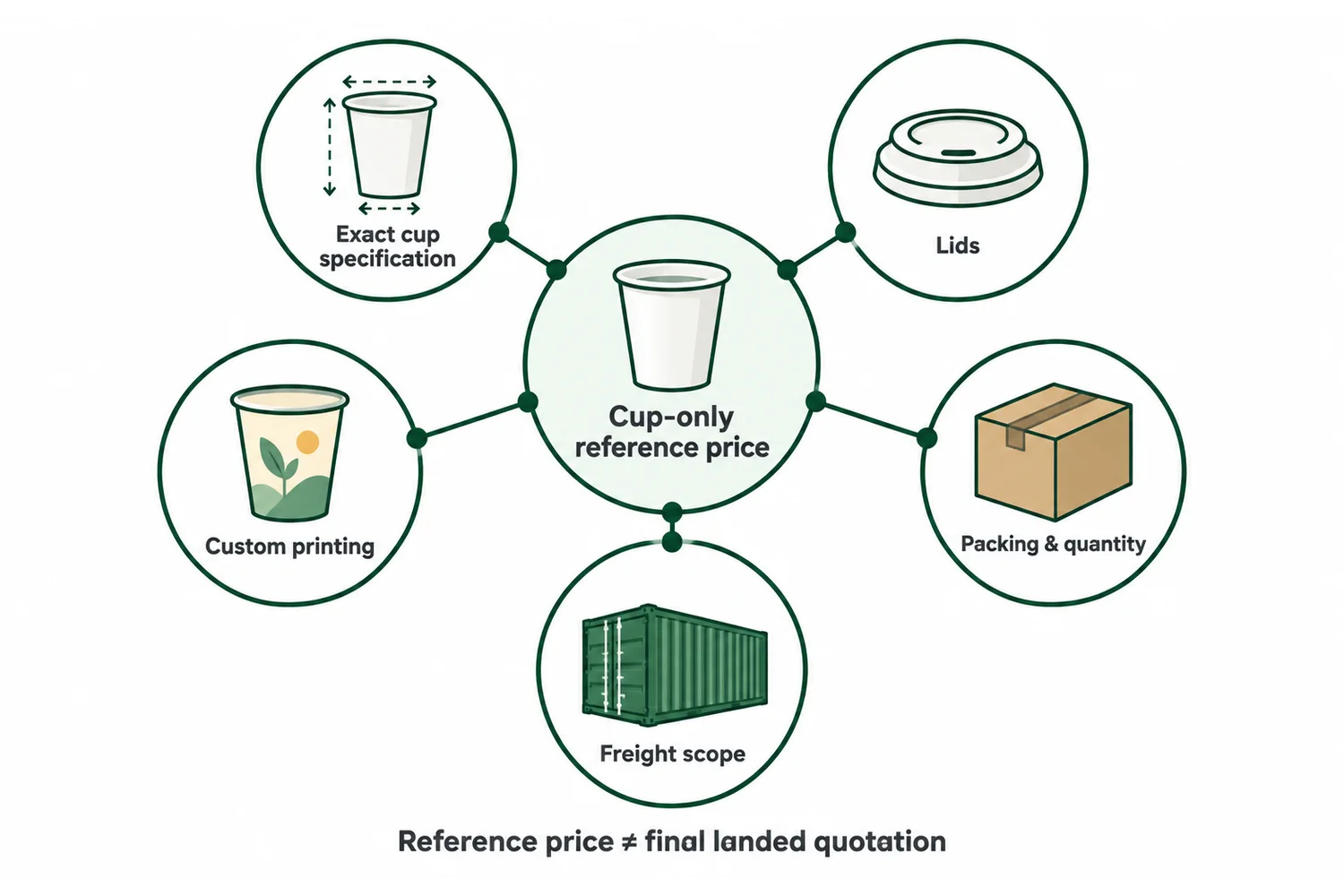
Do not convert this table into a fixed price list. These are current published reference examples for the selected variants shown on their product pages. Other rim options, wide-mouth formats, different packing bases, lids, custom printing, order quantities and freight scopes can produce a different quotation. The per-cup figures above are simple carton-price calculations, not separate supplier offers.
What Changes the Cost of a Plastic Cup?
A buyer can ask five suppliers for “16 oz clear plastic cups” and receive five different numbers without any supplier necessarily quoting the same product. The useful comparison starts by identifying which variables sit behind the number.
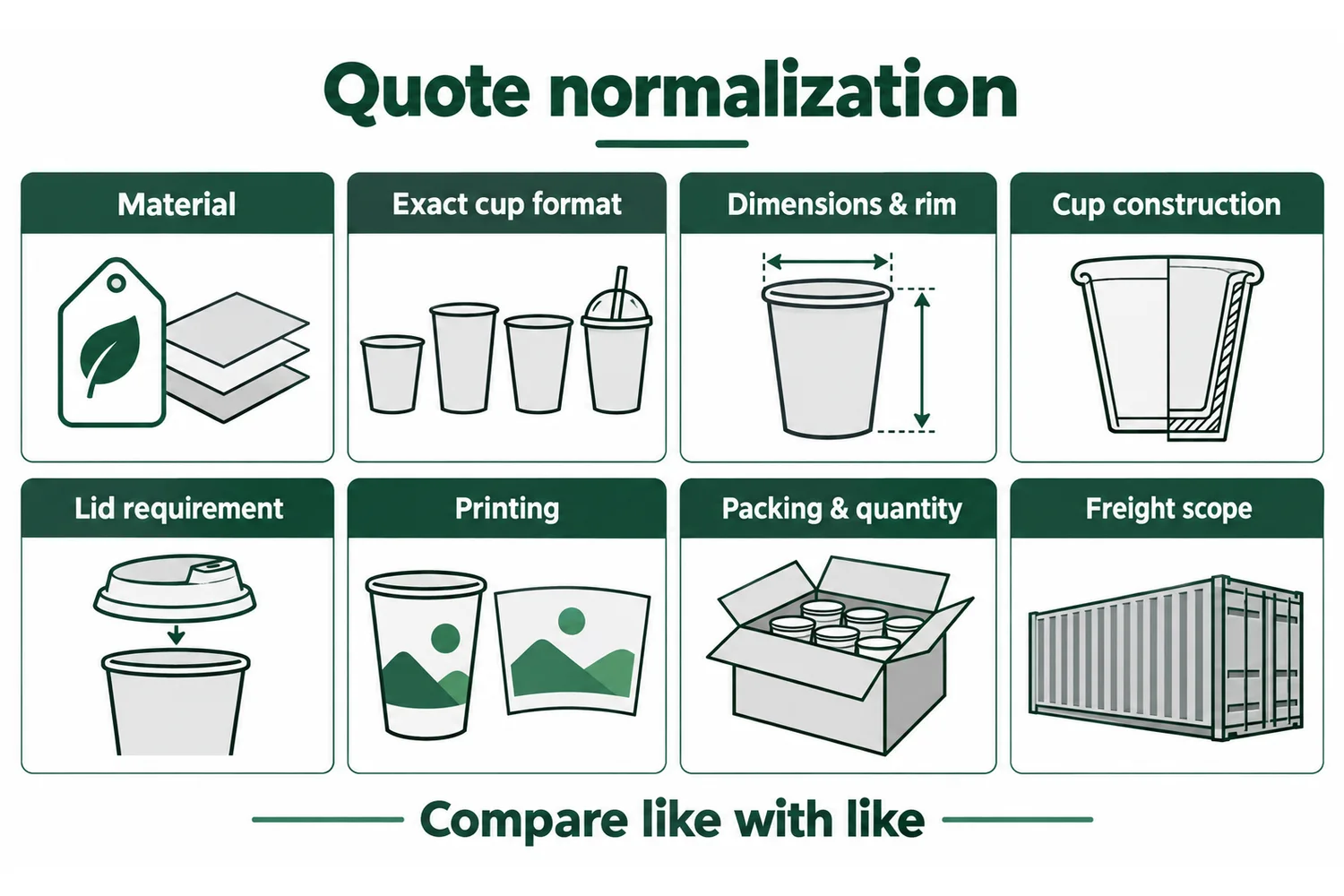
| Quote variable | Why it changes the commercial comparison | What the buyer should normalize |
|---|---|---|
| Material | PET and PLA are separate material programs with different product and sourcing economics. | Confirm the exact material before comparing suppliers. |
| Exact cup format | The same nominal capacity can exist in regular, U-shape, wide-mouth or other profiles. | Use the exact SKU or controlled specification, not only the ounce label. |
| Dimensions and rim | Top diameter, bottom diameter, height and profile affect the physical product and matching components. | Compare the dimensions that matter to lids, holders, carriers and packing. |
| Cup construction | Two cups with the same capacity do not automatically use the same construction or material amount. | Compare the supplier's exact product specification and unit weight where it is an agreed purchasing variable. |
| Lid requirement | A cup-only quote and a cup-plus-lid quote cover different packaging systems. | Identify the exact lid style and lid SKU, then separate cup and lid pricing when needed. |
| Printing | Plain cups and custom printed cups do not have the same production scope. | Lock the cup, artwork, print requirement and approval basis before comparing printed-cup quotations. |
| Packing | Carton quantity, sleeve arrangement and carton dimensions affect handling and freight economics. | Compare the same packing basis or recalculate to a common unit. |
| Order quantity | The published Cupschina pages explicitly state that final price depends on quantity. | Request quotations for the same quantity and the same size mix. |
| Freight scope | A cup-only reference price and a quotation including international transport do not cover the same cost boundary. | Separate product cost from freight and destination charges before comparing totals. |
The plastic cup dimensions guide is useful when two quotes use the same ounce description but different heights, top diameters, bottom diameters or rim systems. Capacity narrows the choice; dimensions help determine whether the products are actually equivalent.
Why Two 16 oz Plastic Cup Quotes Can Be Different
“16 oz” is a commercial size description, not a complete quotation specification. Cupschina's current 16 oz PET page lists several variants across 90 mm, 95 mm, 98 mm and 117 mm rim formats, including regular and U-shape options.[2] The current 16 oz PLA page also lists multiple 90 mm, 95 mm, 98 mm and 117 mm formats.[5]
That means a buyer can send the same words—“16 oz clear cups”—to two suppliers while leaving the cup profile, rim system, lid family and packing basis undefined. The quotations can look directly comparable even when the products are not.
A Current 16 oz Price Example
The current selected 16 oz PET product page shows a 500 ml, 90 mm-rim cup with listed main dimensions of 90 mm top diameter, 56 mm bottom diameter and 135 mm height, at a reference carton price of USD 33.46–38.46 per 1,000 cups.[2] The current selected 16 oz PLA page also shows a 500 ml, 90 mm-rim cup with the same listed main dimensions, at USD 62–67 per 1,000 cups.[5]
This pair shows that material selection can materially change a current supplier reference price even when the published headline dimensions are similar. It does not establish a universal PET-to-PLA price premium. Final quotations still depend on the exact variant, construction, lid requirement, printing, packing, quantity and freight scope. Buyers who have not yet chosen the material should use the PET vs PLA cups buyer guide before treating price as the deciding variable.
Better RFQ language: instead of requesting “16 oz clear cups,” identify the material, exact cup or target dimensions, rim family, required lid, plain or printed status, order quantity, packing expectation and destination. The quotation then has a much better chance of describing the same purchasing problem across suppliers.
PET Cup Pricing: Choose the Exact PET Cup Before Comparing Quotes
If the application has already been approved for PET, keep the pricing exercise inside the PET product program until the exact format is clear. Start from the PET plastic cup range, then move to the specific size and rim family that fits the beverage, lid and operating setup.
Current PET Reference Price Examples
The selected public examples in this article show a wide spread even inside one material: the 7 oz PET page lists USD 15.44–20.44 per 1,000 cups, the selected 16 oz PET page lists USD 33.46–38.46, and the selected 24 oz PET page lists USD 36.03–41.03.[1][2][3]
The useful inference is not a fixed “price per ounce.” The three products use different capacities and physical formats. A buyer should not extrapolate a 20 oz or 32 oz quotation from the 7 oz or 16 oz price. Open the relevant product page, identify the exact selected variant, and request the quote against that product.
PET Commercial Path
- Use the PET cup category to choose the required serving class.
- Use the 16 oz PET product family when 500 ml-class clear cold cups are relevant.
- Use the 24 oz PET product family when the program needs a larger cold-drink format.
- Confirm the exact rim and lid before treating the product page as quotation-ready.
PLA Cup Pricing: Keep the PLA Quote on Its Own Specification Path
If the program requires PLA, compare suppliers against the same PLA cup format instead of comparing a generic “compostable cup” description with a generic PET quote. Start from the PLA clear cup range, then choose the exact capacity, rim and lid system.
Current PLA Reference Price Examples
The selected public examples show USD 31–36 per 1,000 cups for the 7 oz PLA page, USD 62–67 for the selected 16 oz PLA page, and USD 79–84 for the selected 24 oz PLA page.[4][5][6]
These figures should be used as current public reference examples, not as a promise that every PLA cup in that ounce class has the same price. The 16 oz and 24 oz product families contain multiple rim and body formats. A different selected variant can reopen the lid, packing and quotation review.
PLA Commercial Path
- Use the PLA cup category to select the relevant cold-cup program.
- Use the 16 oz PLA product family for the current 500 ml-class options.
- Use the 24 oz PLA product family for larger clear cold-cup options.
- Confirm any required material documentation separately from the price comparison; one price number does not establish the document scope for every SKU.
Lids Change the Complete Cup-System Cost
The public reference prices above are cup-only examples. That distinction matters because many wholesale programs are purchased as a cup-and-lid system. A quote that includes a lid should not be compared directly with a cup-only reference price.
Do not normalize the lid by capacity name alone. A 16 oz cup does not automatically take one universal 16 oz lid. Use the exact rim family and matching lid reference. The cup and lid compatibility guide explains why nominal diameter is a screening variable rather than final proof of fit.
For price comparison, record the cup and lid as separate controlled components where possible. That makes it easier to see whether one supplier is quoting cups only, cups plus flat lids, cups plus dome lids, or a mixed lid program. It also reduces ambiguity when a repeat order changes only the lid requirement.
Custom Printing Changes the Quote Only After the Cup Is Locked
A plain-cup reference price should not be used as the final price for a printed cup project. Printing adds another specification layer: exact cup, artwork revision, printable area, color requirement, production route, proof or sample approval, and order quantity.
The correct sequence is the same one used elsewhere in Cupschina's printing guidance: lock the cup before you lock the artwork. Select the PET or PLA product first, then prepare the artwork for that exact cup. The custom cup printing guide covers artwork, color, print area and sample approval, while the custom printed cup page is the commercial path when the buyer is ready to quote a branded program.
When comparing printed-cup quotations, ask whether each supplier's number includes the same print scope. A one-color logo, a more complex artwork program and a plain stock cup are not equivalent purchasing specifications even when they start from the same cup size.
Quantity, Packing and Freight Can Change the Buying Decision
Cupschina's current product pages explicitly state that final price depends on quantity, while sea freight is quoted separately according to shipment cube, weight and destination.[1][3][5]
Compare the Same Quantity and Size Mix
A quote for one size at one volume should not be compared directly with a mixed-size program at another volume without separating the items. If the project combines several capacities, ask for the line-item basis by size. The buyer can then identify whether a price difference comes from the cup itself or from the order structure.
Compare the Same Packing Basis
Carton quantity and carton dimensions affect receiving, warehousing and shipment cube. A lower cup price can lose some of its advantage if the selected packing creates materially different logistics. For distributor programs, packing is therefore part of the purchasing specification rather than an afterthought.
Separate Product Cost From Freight Scope
A cup-only reference price and a freight-inclusive supplier quotation are not the same commercial number. Before ranking suppliers, identify which costs are included in each quote and which remain outside it. For international sourcing, compare the same product specification at the same quotation boundary before calculating the buyer's final landed purchasing cost.
How to Normalize Two Plastic Cup Supplier Quotes
The fastest way to make a price comparison useful is to convert both offers into the same specification checklist. The table below is an illustrative normalization framework; it does not describe two actual suppliers.
| Normalization check | Quote A | Quote B | Can price be compared yet? |
|---|---|---|---|
| Material | Exact material confirmed | Exact material confirmed | Only if the buyer intends to compare that material basis |
| Exact cup SKU / variant | Confirmed | Only “16 oz clear cup” | No |
| Capacity and dimensions | Specified | Capacity only | No |
| Rim and matching lid | 90 mm cup, lid quoted separately | Lid included but exact lid unspecified | No |
| Printing | Plain cup | Printed cup | No |
| Packing basis | Defined carton pack | Different carton basis | Recalculate first |
| Order quantity | Same requested volume | Same requested volume | Yes for this variable |
| Freight scope | Product only | Product plus freight | No |
If even one major row is unresolved, the buyer should correct the RFQ before choosing the “cheaper” supplier. The plastic cup sourcing guide continues this process into supplier review, samples, QC and order approval.
What to Send a Supplier for a Comparable Plastic Cup Price
A good RFQ reduces the number of assumptions hidden inside the quotation. Send what is already known and mark what still requires supplier recommendation.
- Required material, or a request to compare clearly separated PET and PLA alternatives.
- Nominal capacity and the exact product reference where one has already been selected.
- Critical dimensions or rim family when the cup must match an existing lid, holder, carrier or dispenser.
- Required lid style and exact lid reference where applicable.
- Plain or custom printed requirement.
- Artwork status for printed projects.
- Requested quantity by size and design.
- Required carton or distributor packing conditions where they matter operationally.
- Destination and the freight scope the buyer wants the supplier to quote.
- Any sample, QC or repeat-order reference that the bulk product must match.
If a cup is not yet selected, start with the PET range or PLA range. If the material itself is still undecided, resolve that decision before treating PET and PLA price numbers as interchangeable alternatives.
Buyer Checklist: Compare Plastic Cup Prices Without Comparing Different Products
- Confirm whether every quote uses the same material.
- Identify the exact cup SKU or variant instead of relying on the ounce label.
- Compare capacity together with top diameter, bottom diameter, height and body profile where relevant.
- Confirm the rim family and the exact matching lid.
- Separate cup-only price from cup-plus-lid system cost.
- Separate plain-cup pricing from custom-print pricing.
- Compare the same order quantity and size mix.
- Normalize carton packing before comparing logistics-sensitive programs.
- Identify which freight and destination costs are included or excluded.
- Use public Cupschina prices as reference examples, not as a substitute for the current quotation on the exact order.
- Retain the approved specification and sample reference so a repeat order can be compared with the same product definition.
Final Recommendation
Use public price ranges to understand the order of magnitude, not to skip specification work. Cupschina's currently published examples show that selected PET cold cups can sit roughly in the USD 15.44–41.03 per 1,000-cup range across the 7 oz, 16 oz and 24 oz examples used here, while the selected PLA examples sit roughly in the USD 31–84 range. Those figures are useful because they answer the searcher's first question with real supplier data.
The buying decision starts after that first answer. Choose the material, exact cup, rim and lid system; separate plain and printed requirements; normalize packing, quantity and freight scope; then compare quotations. A lower number attached to a different cup is not a lower price for the same product.
For a current project, shortlist the required cup from the PET cup range or PLA cup range, then request the quotation using the exact size, lid, printing, quantity, packing and destination requirements. If branding is part of the program, move to custom printed cups only after the base cup is locked.
Frequently Asked Questions
How much do plastic cups cost in bulk?
There is no single wholesale price for a plastic cup. In Cupschina's selected current public examples, 7 oz to 24 oz PET cups range from about USD 15.44 to USD 41.03 per 1,000 cups, while selected PLA examples range from about USD 31 to USD 84 per 1,000. These are cup-only reference examples; exact variant, lids, printing, quantity and freight still affect the final quotation.
Why can two 16 oz plastic cups have different prices?
“16 oz” does not define one physical product. Two 16 oz cups can use different materials, capacities, rim systems, heights, body profiles, lids, construction, printing and packing. Cupschina's current PET and PLA 16 oz families each contain several variants. Compare the exact SKU or controlled specification before deciding that one supplier is cheaper.
Are PLA cups always more expensive than PET cups?
The current Cupschina examples in this article show higher reference prices for the selected PLA products than for the selected PET products, including the current 16 oz and 24 oz examples. That should not be converted into a universal percentage premium. The exact cup variant, construction, quantity, printing, packing and freight scope still need to be normalized before interpreting the price difference.
Does the published plastic cup price include lids and printing?
The Cupschina product pages referenced in this article state that their reference carton prices cover cups and do not include lid pricing. They also state that final price depends on quantity and customization, while sea freight is quoted separately. Buyers should therefore request lids, custom printing and freight as clearly identified parts of the commercial quotation.
What should I compare before choosing the lowest plastic cup quote?
Confirm the material, exact cup SKU, capacity and dimensions, rim and lid system, printing status, packing basis, order quantity and freight scope. If those variables are not aligned, the quotations may describe different products or different commercial boundaries. Normalize the specification first, then compare the unit price and the final purchasing cost.
References
- Cupschina — 7 oz 210 ml Disposable PET Plastic Cups for Cold Drinks. Current product specification and published reference carton price used for the 7 oz PET example.
- Cupschina — 16 oz 500 ml Clear PET Plastic Cups. Current 16 oz PET variants, selected specification and published reference carton price.
- Cupschina — 24 oz Large Clear PET Plastic Cups. Current 24 oz PET variants, selected specification and published reference carton price.
- Cupschina — 7 oz PLA Clear Cups. Current product specification and published reference carton price used for the 7 oz PLA example.
- Cupschina — 16 oz PLA Clear Cups. Current 16 oz PLA variants, selected specification and published reference carton price.
- Cupschina — 24 oz PLA Clear Cups. Current 24 oz PLA variants, selected specification and published reference carton price.