
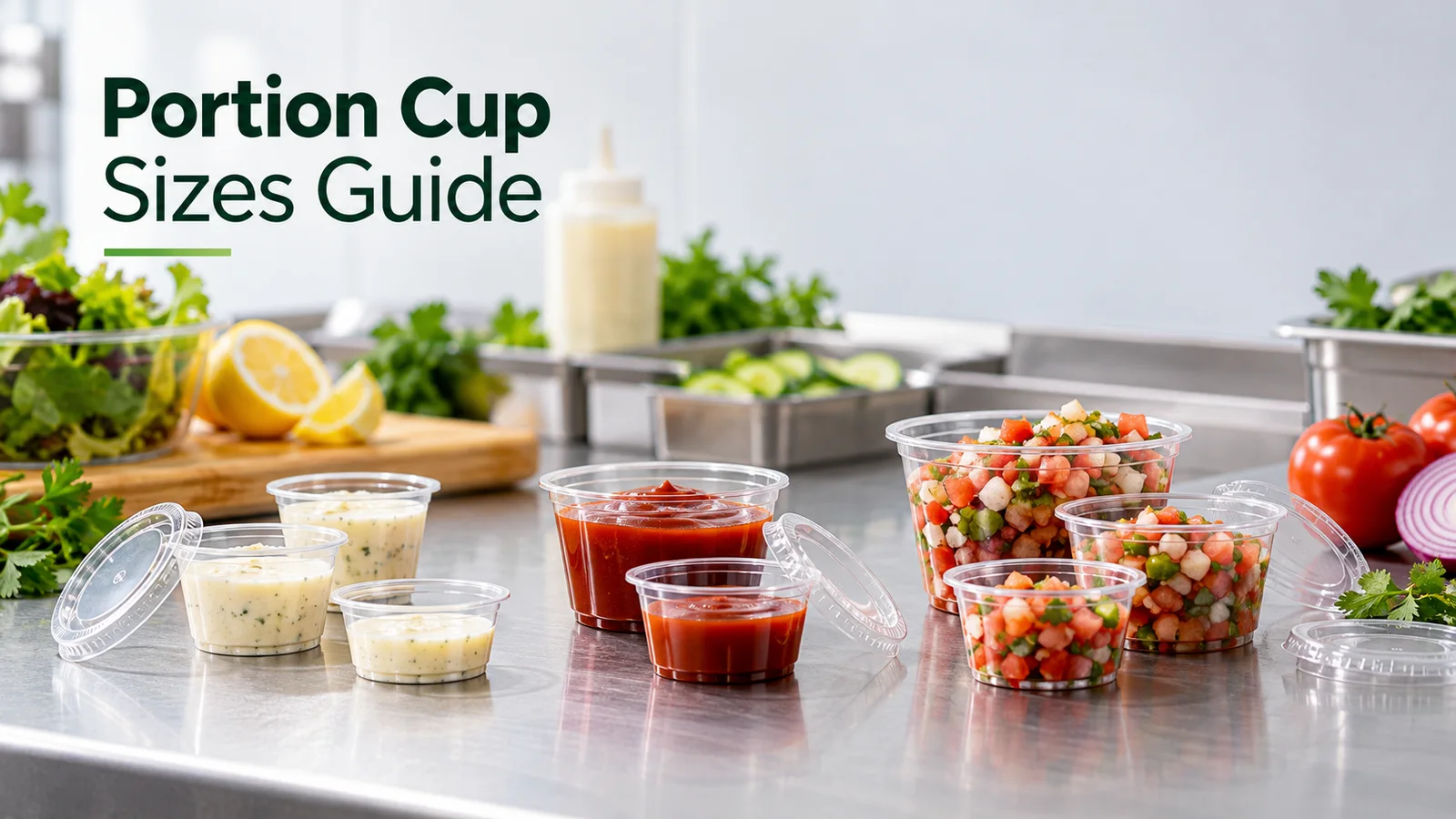
Quick Summary
- Choose the portion cup by the serving task and handling path first. Capacity narrows the shortlist; fill level, headspace, rim, lid fit and real handling approve the final format.
Portion cup sizes should be selected by the serving task first, not by the ounce label alone. A thin dressing, a thick dip, a chunky condiment and a tasting portion can occupy a similar nominal volume but need different working space once the cup is filled, closed, carried or packed into a takeaway order.
For restaurants, caterers, distributors and foodservice buyers, capacity is only the first filter. The final choice depends on the target portion, food texture, opening geometry, working headspace, lid system and handling path. The same logic also helps home users choosing small cups for meal prep, lunch boxes and party portions.
Decision rule: choose the portion cup by the serving task and handling path first. Nominal capacity narrows the options; the real fill, headspace, rim, lid and handling sequence approve the final format.
What Portion Cup Size Should You Start With?
A useful way to compare portion cup sizes is to work in test bands rather than treating a single ounce size as a universal answer. The bands below are practical starting points for sample evaluation. They are not fixed menu standards, because the actual cup shape, intended fill and lid can change the usable space.
| Test Band | Foodservice Starting Uses | Home & Meal-Prep Uses | Main Approval Question |
|---|---|---|---|
| About 1–2 oz | Controlled sauces, dressings, condiments and tasting portions | Lunch-box dressing, small dips and portion-controlled condiments | Can the normal serving be filled and closed without crowding the rim? |
| About 2–3 oz | Thicker dips, salsa, garnishes and more generous sauce portions | Meal-prep dips, snack portions and party tasting portions | Does the food need more surface area, spoon access or headspace? |
| About 3–4 oz | Composed toppings, small sides, samples and small desserts | Lunch sides, yogurt, cut fruit or larger meal-prep portions | Is the cup still functioning as a condiment cup, or is a small food container more suitable? |
| Above 4 oz | Larger sides, fruit portions and other small takeaway foods | Larger snacks or separated meal components | Would a wider or purpose-built food container handle the serving better? |
Use these ranges to decide what to test, not what to order automatically. Two cups with the same nominal capacity can differ in top diameter, height, body shape, rim geometry and usable fill level. For a more general explanation of those variables, see the plastic cup dimensions guide.
For sourcing: record the exact cup reference, stated capacity, dimensions, rim and intended lid. “2 oz sauce cup” is a useful search phrase, but it is not a complete procurement specification.
Why Sauce, Dressing and Dip Need Different Working Space
Capacity answers how much the cup is intended to contain under a stated measurement convention. It does not answer how easily staff can fill it, whether food reaches the rim, whether a spoon can enter the opening or whether the lid can be applied cleanly.
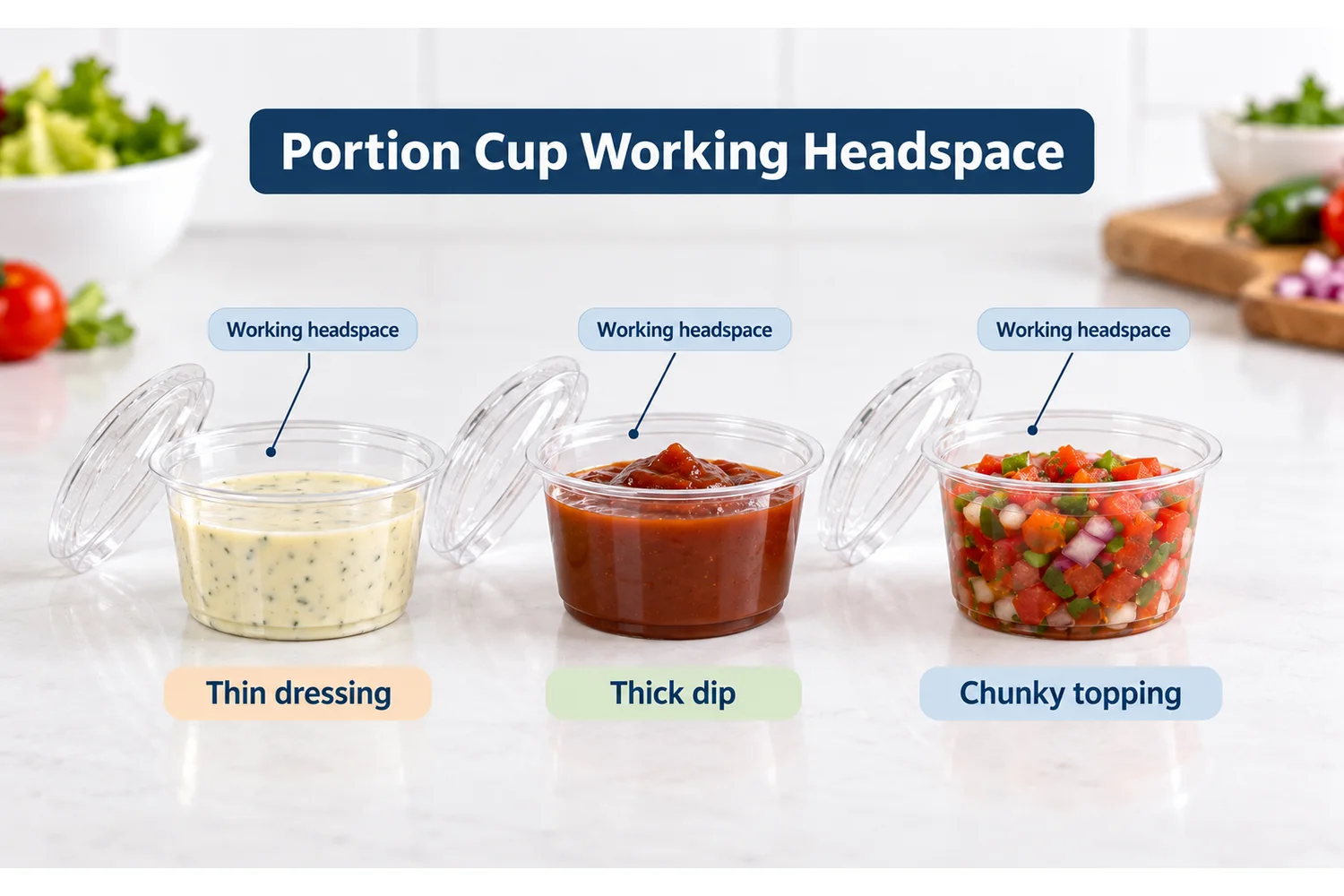
Thin Dressings and Sauces
Thin foods move quickly during dispensing and transport. If the working fill is too close to the rim, product can reach the closure area before the lid is fully applied. For this reason, the useful test is not “Can the cup hold the portion?” but “Can staff repeatedly fill and close the normal portion without contaminating the rim?”
Thick Dips and Spreads
Thick foods may mound instead of settling flat. A cup that looks large enough by volume can still leave too little space above the product. Test the real serving with the same spoon, pump, scoop or other dispensing method used in service because the tool changes the shape of the fill.
Chunky Condiments and Toppings
Salsa, chopped garnishes, pickled ingredients and other textured foods may need a wider opening for loading or utensil access. In these cases, nominal capacity can be less important than opening geometry. A taller, narrower cup and a shorter, wider cup can behave differently even when the stated volume is similar.
Buyer implication: capacity controls the quantity range; geometry controls how the food is actually handled. Approve the package with the real food and serving tool rather than selecting only from an ounce chart.
Dine-In, Takeaway and Delivery Change the Size Decision
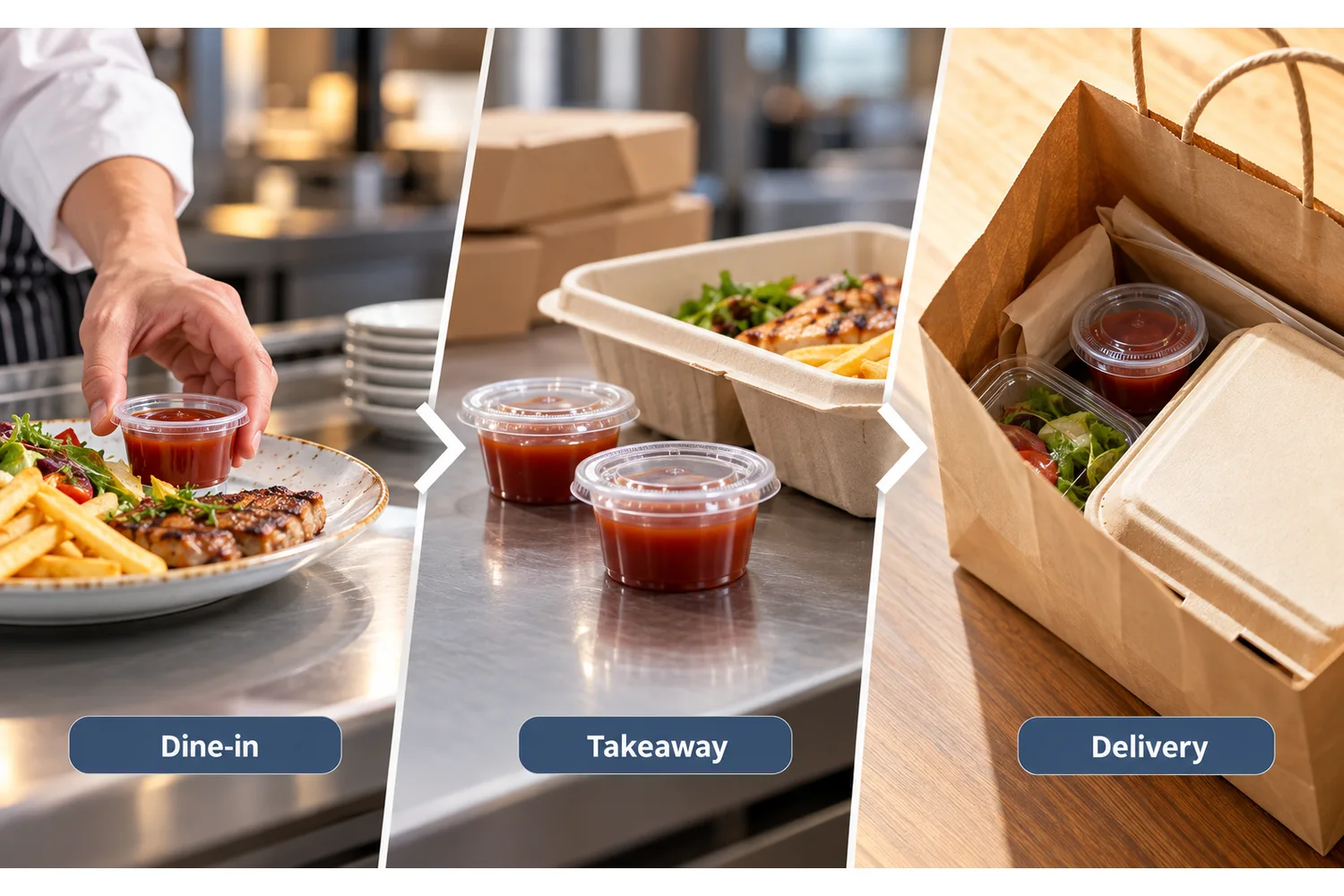
The same sauce portion can need a different packaging setup when the handling path changes. A dine-in condiment may move only from the kitchen to the table. A delivery portion may be filled, closed, stacked beside other containers, held for a period and moved through several orientations before the customer opens it.
| Service Path | What Changes | What to Check |
|---|---|---|
| Dine-in | Short handling path and immediate service | Portion consistency, presentation, easy access |
| Takeaway | Bag packing, waiting time and customer transport | Working headspace, lid application and packed-cup handling |
| Delivery | Longer movement with other containers | Filled cup-and-lid behavior through the actual delivery sequence |
| Catering and events | Pre-portioning, tray organization and rapid distribution | Repeatable fill, stacking and inventory simplicity |
This is also why a larger cup is not automatically safer. Extra space may help a difficult food, but unnecessary oversizing can make portion control less consistent and increase storage or packing volume. The target is enough usable space for the operation, not the largest cup available.
Do not approve a delivery portion cup from an empty cup-and-lid fit alone. Fill the representative food, close the intended lid, pack it in the normal order configuration and evaluate the actual handling sequence.
Why Lid Fit and Headspace Matter
A portion cup can have the correct nominal volume and still be a poor operational fit if the intended lid does not apply consistently or if the normal serving pushes food into the rim area.
Headspace Is Working Space
Unused space at the top of the cup is not automatically wasted capacity. Depending on the food, some working space can help staff dispense the portion, control product near the rim and apply the lid without compressing the fill. There is no universal headspace percentage that should be copied across every sauce and cup.
Rim Size Is a Screening Variable, Not Final Lid Approval
Nominal top diameter can narrow the lid options, but it does not prove compatibility by itself. Rim profile, closure design, dimensional tolerance and the exact cup-and-lid combination still matter. When a lid is critical to the service path, confirm the intended matching lid and evaluate physical samples.
The procurement rule is the same one Cupschina applies more broadly to cup systems: capacity narrows the choice; dimensions and interfaces approve the system.
Portion Cups for Meal Prep, Bento Lunches and Home Use
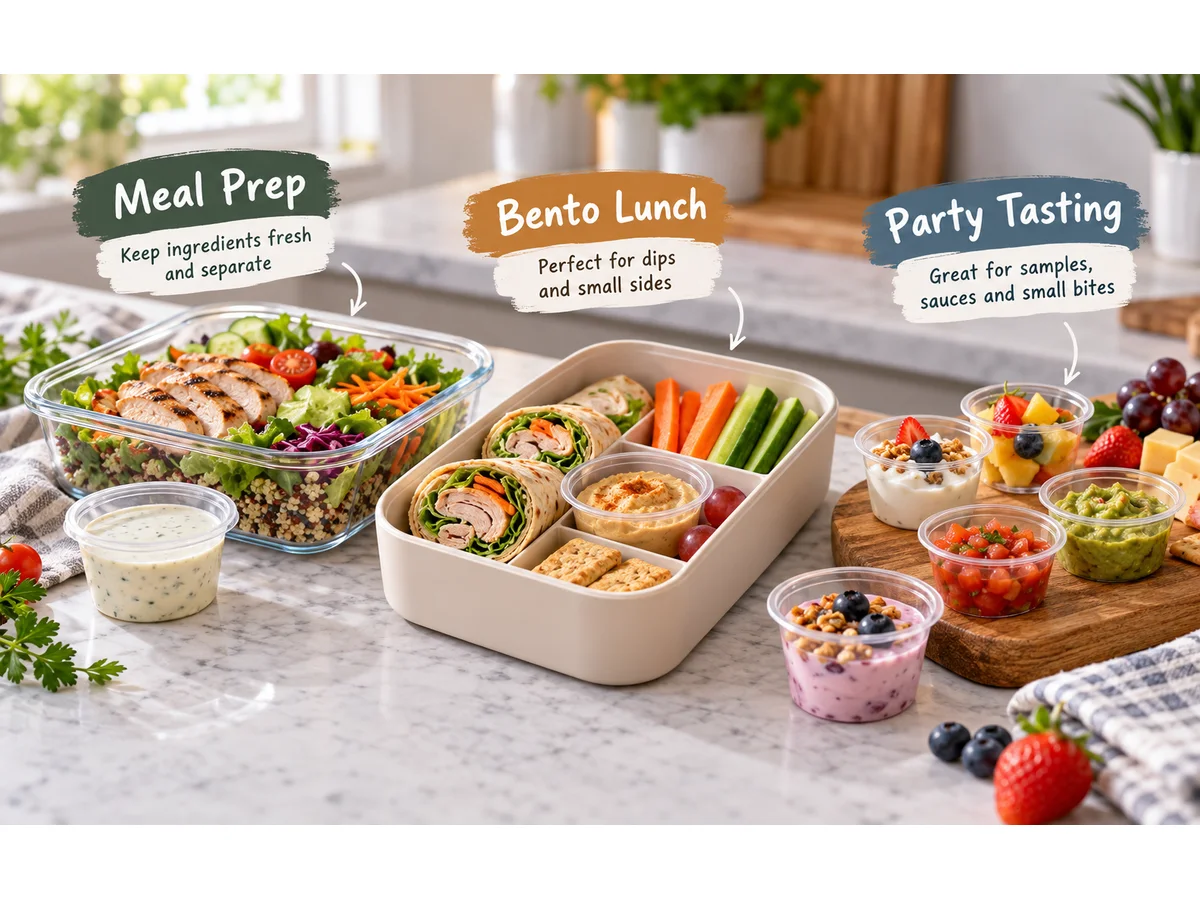
Home users often reach the same size-selection problem as restaurants, just at a smaller scale. A dressing cup for meal prep still needs enough space to close cleanly. A dip packed inside a lunch box still needs an opening that is practical to use. A party tasting cup still needs to match the intended bite or sip rather than simply being “small.”
- Meal prep: keep wet dressings or sauces separate from foods that should remain dry until serving.
- Lunch boxes: compare the cup footprint and height with the available compartment rather than choosing only by ounces.
- Portion control: define the intended serving first, then choose a cup that makes that portion easy to repeat.
- Party tasting: match the cup to the number of bites or sips, food texture and whether a spoon or fork is needed.
These consumer use cases are useful because they reinforce the same core decision logic rather than creating a second article intent. The right size is still the one that fits the serving task, closure and handling path.
Choose Material After the Size and Use Conditions Are Clear
Size selection and material selection are related, but they are not the same decision. Once the portion range and service path are clear, confirm which material and exact SKU are suitable for the intended food and use conditions.
Cupschina lists both PET cup and PLA cup families, including small-cup options. Do not transfer a use claim from one material or SKU to another simply because the cups look similar.
If the application involves warm food, prolonged holding, freezing, microwaving, unusually oily food, or another demanding condition, ask for the exact product specification and applicable documentation before approving the cup. A material name by itself does not establish every temperature, barrier or end-of-life claim.
For a broader material decision, use the PET vs PLA buyer selection guide. Keep the current page focused on the size and handling problem rather than turning a portion-cup sizing guide into a material-comparison article.
Important boundary: PLA and PET are different materials. Do not describe PET as biodegradable, compostable, PLA or plant-based, and do not assume a PLA cup is suitable for a particular hot-food application without the exact SKU data.
Which Small Cup Options Can Buyers Evaluate?
Cupschina currently has commercial pages for multiple small-cup sizes, including 2 oz, 3 oz and 4 oz options. Those pages are useful for building a shortlist, but the final selection still needs to be tied to the exact food, lid and operating requirement.
- 2 oz PET cup options — a starting point when evaluating small clear sample or portion formats.
- 2 oz PLA sauce cup options — a commercial page for buyers specifically considering a small PLA sauce/portion format.
- 3 oz PET cup options — useful for comparing a larger sampling or small-portion format.
- 3 oz PLA tasting cup options — useful for evaluating PLA tasting, sampling and small-portion formats.
- 4 oz PET cup options — useful when the serving needs more usable space than the smaller formats.
- 4 oz PLA dessert cup options — a starting point for PLA dessert, topping and larger small-portion formats.
Do not treat these links as proof that one size is correct for a particular menu item. They are commercial starting points. Ask for the exact candidate specification and intended matching lid before approving a bulk purchase.
For a B2B comparison: send the target food, normal serving quantity, dine-in/takeaway/delivery path, preferred material, lid requirement and destination market through the Cupschina contact page. The useful next step is to narrow the candidate SKU and approval test, not to choose from capacity alone.
How Should Foodservice Buyers Approve a Portion Cup?
A sample only answers useful questions when the buyer defines what is being tested. Looking at an empty cup on a desk cannot establish whether staff can fill it cleanly, whether the lid works with the real portion or whether the closed cup survives the intended handling path.
- Define the menu task. Identify the exact sauce, dressing, dip, condiment, topping, sample or side.
- Define the target serving. Use the normal dispensing method rather than filling to maximum capacity.
- Shortlist the capacity. Use ounce or milliliter size to narrow the candidate range.
- Check the geometry. Review the opening, height, body shape, rim and space needed by the food.
- Confirm the intended lid. Treat the cup and lid as a system when closure matters.
- Run the real handling sequence. Fill, close, pack, move and reopen the cup under representative conditions.
- Record the approved combination. Keep the exact cup reference, lid reference, intended portion and use condition together for purchasing and repeat orders.
For a broader explanation of plain samples, printed samples and approval references, see the plastic cup sample approval guide.
Buyer Checklist
- Food: What exact sauce, dressing, dip, condiment, sample or side will be packed?
- Serving: What quantity is actually dispensed during normal service?
- Capacity: What nominal capacity does the exact candidate cup state?
- Geometry: Are the opening, height and body shape practical for the food and utensil?
- Headspace: Can the normal fill be closed without crowding the rim?
- Lid: Which exact lid is intended to match the cup?
- Service path: Is the cup for dine-in, takeaway, delivery, catering, sampling or home meal prep?
- Material: Has the exact SKU been confirmed for the intended food and use conditions?
- Sample approval: Has the representative food been tested in the exact cup-and-lid combination?
- Repeat orders: Are the approved cup and lid references recorded clearly enough to prevent accidental substitution?
Final Recommendation
Start with the serving task, then use capacity to narrow the shortlist. A smaller sauce portion may fit a small cup, but food texture, headspace, opening geometry and lid application can justify moving to a different format. Takeaway and delivery add another layer because the filled cup has to work through a longer handling path.
For home meal prep and lunch-box use, apply the same logic: decide the portion first, check whether the cup physically fits the storage or lunch system, and confirm the closure works for the intended handling. Do not assume the most compact cup is automatically the most practical one.
For B2B purchasing, approve the exact cup, intended lid, target fill and use condition as one recorded specification. That is more reliable than ordering from a generic description such as “small sauce cup” or from an ounce label alone.
Selection sequence: serving task → target portion → capacity shortlist → geometry and headspace → exact lid → representative filled test → approved specification for bulk and repeat orders.
Frequently Asked Questions
What size portion cup should I use for sauce?
Start from the actual sauce serving rather than a universal size rule. Small sauce portions are often evaluated in roughly the 1–2 oz range, but thickness, dispensing method, headspace and lid application can change the final choice. Test the normal serving in the exact candidate cup and lid before standardizing the size.
Should dressing and thick dip use the same portion cup size?
Not automatically. Thin dressing can move toward the rim during filling and transport, while a thick dip may mound upward and use more working headspace. Chunky dips may also need a wider opening. Equal serving volume does not guarantee equal packaging geometry, so evaluate the foods separately.
What size portion cup is useful for meal-prep dressing or a lunch box?
Choose the size from the dressing or dip portion first, then check the cup's footprint and height against the meal-prep container or lunch-box compartment. A small cup can be convenient, but it still needs enough headspace for closure. Do not select from ounces alone when the cup must fit inside another container.
Do portion cups with the same top diameter use the same lid?
Not necessarily. Nominal diameter is useful for screening, but final fit can also depend on rim profile, closure design, dimensional tolerance and the exact cup-and-lid combination. Ask the supplier to identify the intended matching lid and approve physical samples when closure performance matters.
What should buyers confirm before ordering portion cups in bulk?
Confirm the intended food, target serving, exact cup capacity and dimensions, rim, matching lid, service path, material and relevant use conditions. Then run a representative filled-cup test and record the approved cup-and-lid references. This reduces the risk of selecting a cup that looks correct by size but does not work in the actual service process.