Quick Summary
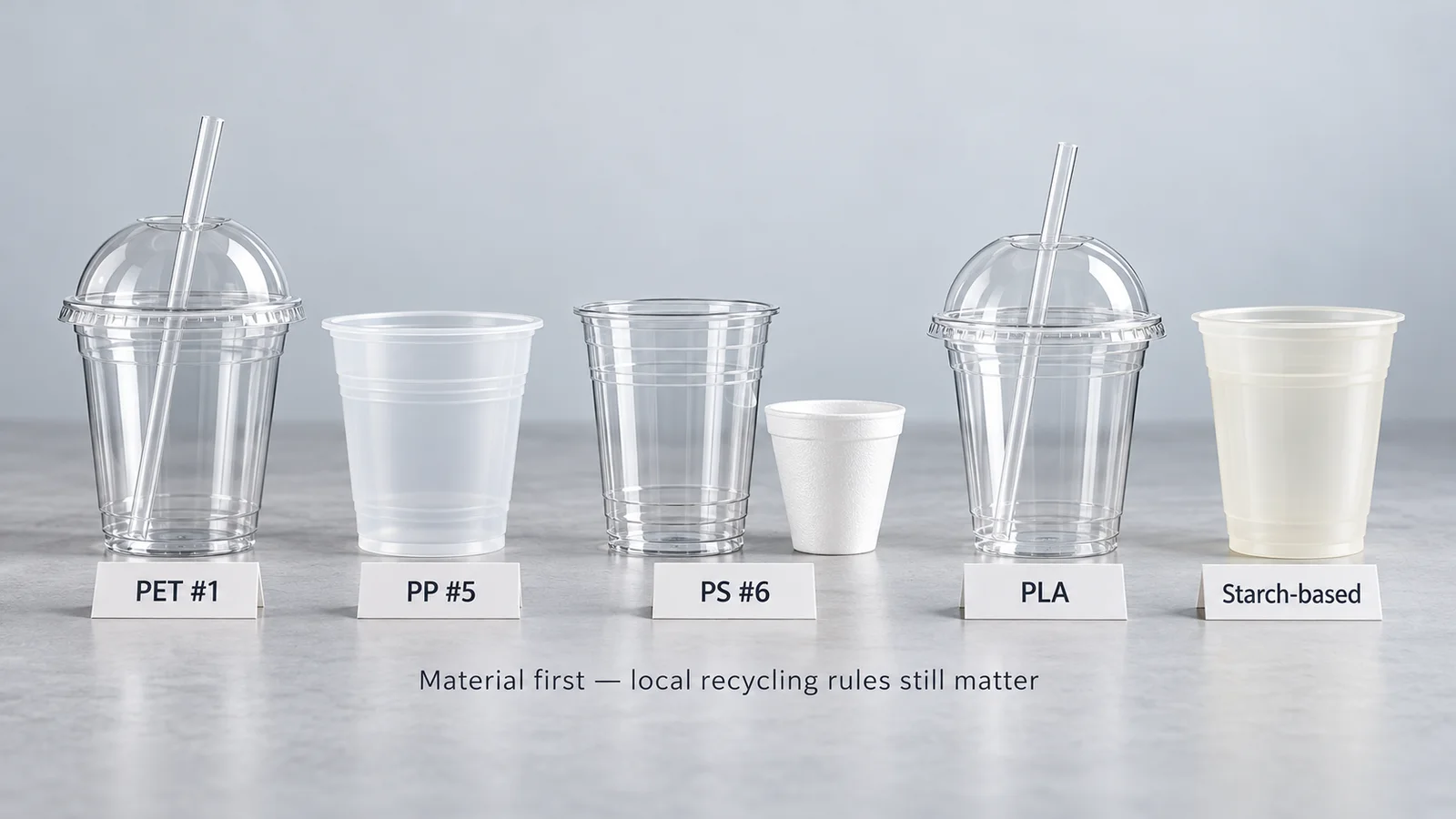
- PET cups have the strongest established recycling pathway where cup-format collection exists. PP is technically recyclable but local acceptance varies. PS has recycling routes in some markets but is often excluded from curbside programs. PLA and starch-based bioplastics should not be placed in conventional PET or PP recycling. Resin Identification Codes identify the polymer; they do not guarantee that a cup is locally recyclable.
Some plastic cups can be recycled, but the word plastic is not enough to answer the question. PET, PP, PS, PLA and starch-based bioplastics belong to different material families and do not enter the same recovery systems. A useful recycling answer has to match three things: the polymer, the finished cup format and the recycling system available where the cup is discarded.
The number molded into a plastic article is a Resin Identification Code (RIC). ASTM D7611/D7611M-26 states that the code identifies the plastic resin; it is not a recycling guarantee and does not mean that a collection or reclamation system exists for that article.[1] The U.S. EPA gives the same practical direction: resin numbers can help identify a plastic, but consumers still need to check local recycling rules.[2]
Plastic-cup recyclability has three layers: first, can the polymer be mechanically recycled; second, can the cup be correctly sorted and processed as that package format; third, does the local program actually collect that cup. A “#1” or “#5” mark answers only the material-identification part.
Which Plastic Cups Are Recyclable?
| Cup material | Typical identification | Practical recycling answer | Main limitation |
|---|---|---|---|
| PET | #1 PET / PETE | Often recyclable where PET cups or thermoforms are accepted | Local programs may treat PET cups differently from PET bottles. |
| PP | #5 PP | Recyclable where rigid PP cups are accepted | Collection and sorting acceptance varies by market. |
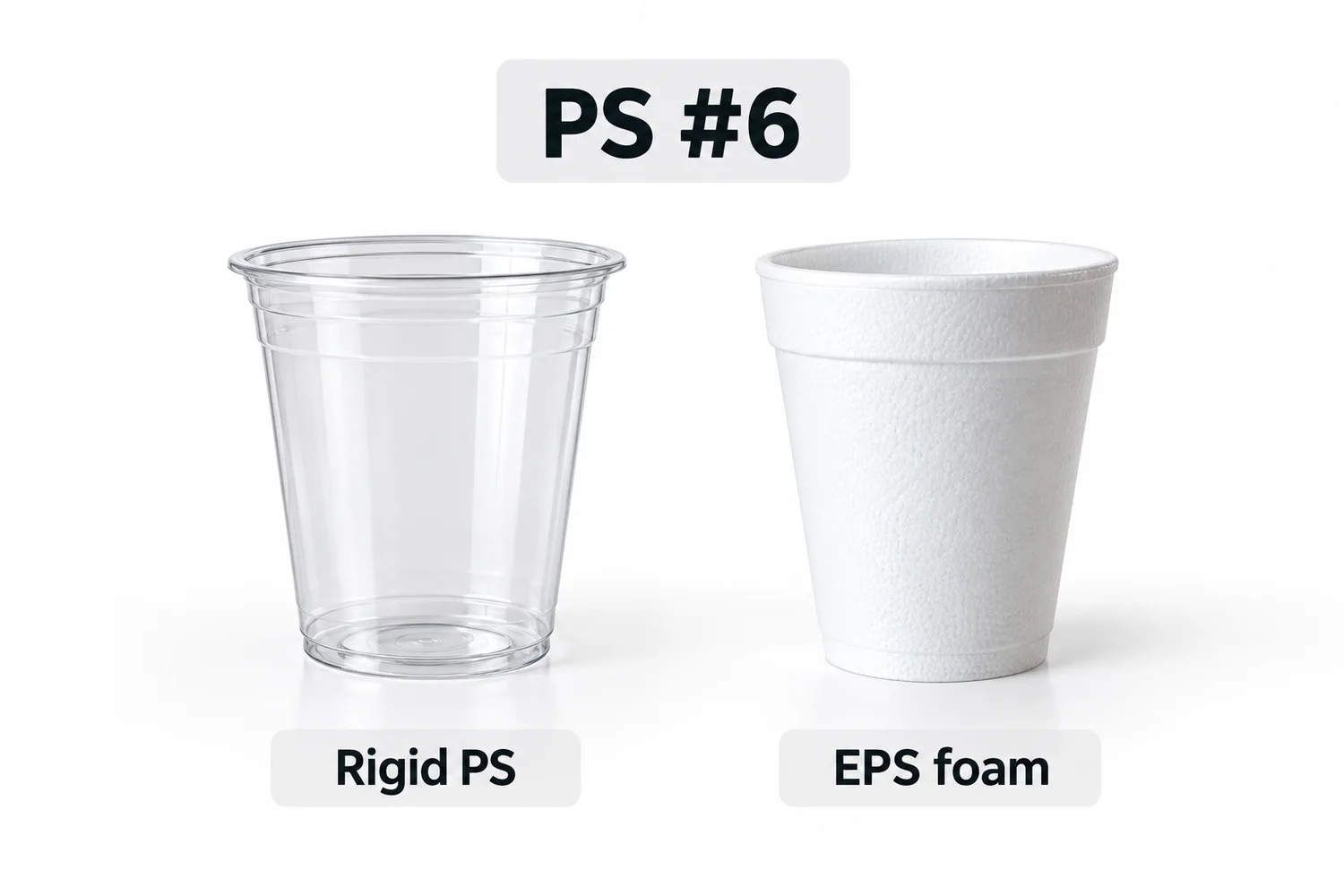
| Rigid PS | #6 PS | Technically recyclable, but often not accepted curbside | Local PS collection and end markets are much more limited. |
| EPS foam | #6 PS / expanded polystyrene | Usually not accepted in standard curbside recycling | Foam has a different density and recovery pathway from rigid PS. |
| PLA | PLA; may appear under #7 / Other | Not for conventional PET or PP recycling | PLA requires a different recovery route and should not be mixed into ordinary PET/PP streams. |
| Cornstarch / starch-based bioplastic | Formulation-dependent | Do not assume conventional recyclability | “Starch-based” can describe a blend rather than one standard recycling resin. |
This table is a material-screening guide. It does not replace the instructions of the municipality, hauler, material recovery facility or commercial waste contractor handling the used cup.
Are PET Cups Recyclable?
Yes, PET cups can be recyclable. PET is polyethylene terephthalate and is identified as resin #1. For clear cold-drink cups, the more precise packaging term is often PET thermoform: NAPCOR defines PET thermoforms as rigid, non-bottle packaging made by heating and shaping PET sheet, and specifically includes cups, tubs, lids, boxes, trays and clamshells.[3]
That distinction matters because a PET bottle and a PET cup can contain the same polymer while entering different collection or sorting decisions. NAPCOR states that PET thermoforms are technically recyclable with PET bottles, while also noting that acceptance and bale specifications vary among reclaimers.[3] In its 2024 North American thermoform analysis, NAPCOR reported that 264 million pounds of PET thermoform packaging—including trays, cups, clamshells and tubs—were collected for recovery in the United States and Canada.[4]
Real recyclability also depends on the finished package. The Association of Plastic Recyclers (APR) notes that PET thermoform sortation can be affected by package size, shape, color and label coverage; accurate sorting into a PET bale is a prerequisite for downstream recycling.[5] A clear PET cup therefore has a strong material-level recycling case, but the local program still needs to accept that cup format.
PET answer: PET #1 is recyclable, and PET cups belong to an established thermoform recycling category. Do not convert that material fact into a universal curbside claim. Check whether the destination program accepts PET cups or PET thermoforms.
For a deeper B2B treatment of the word “recyclable,” see the PET cup recycling claims guide. For PET material selection beyond recycling, the PET cups category provides the current Cupschina product range.
Are PP Cups Recyclable?
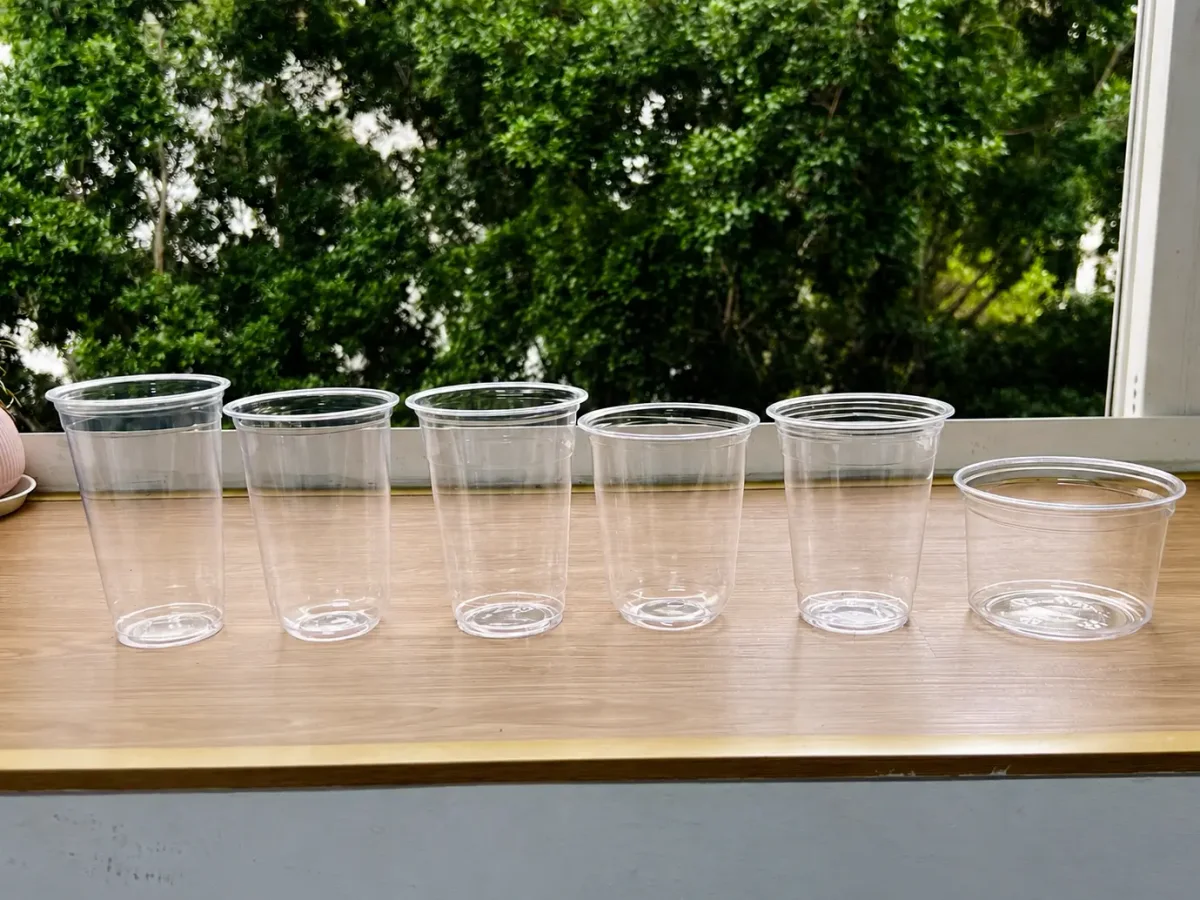
Yes, polypropylene can be recycled, but a PP cup is only practically recyclable where the collection and sorting system accepts rigid #5 PP packaging. PP is identified as resin #5. RecyClass maintains a recycling stream and Design for Recycling guidance for PP containers in Europe, which confirms that rigid PP packaging is a recognized recycling category rather than a theoretically recyclable resin with no recovery route.[7]
The local answer can still be different. San José, California, for example, tells residents that plastic #5 containers can go into its recycling system and lists cups and tubs among common PP items.[10] That local acceptance should not be generalized to every municipality. EPA guidance is to check the program where the item will actually be discarded.[2]
For packaging design, resin identity is again only the starting point. RecyClass assigns recycling guidance using the main polymer together with the package form and coloration, including a specific “Tub, Pot & Cup” format.[7] For a buyer, that is a more useful model than assuming that every #5 item will behave identically in sorting.
PP answer: PP #5 is a recyclable plastic family. Put a PP cup in recycling only when the local program accepts rigid #5 cups or containers.
If the material decision itself is still open, use the PET vs PP cups scientific comparison for clarity, thermal behavior and application differences.
Are PS Cups Recyclable?
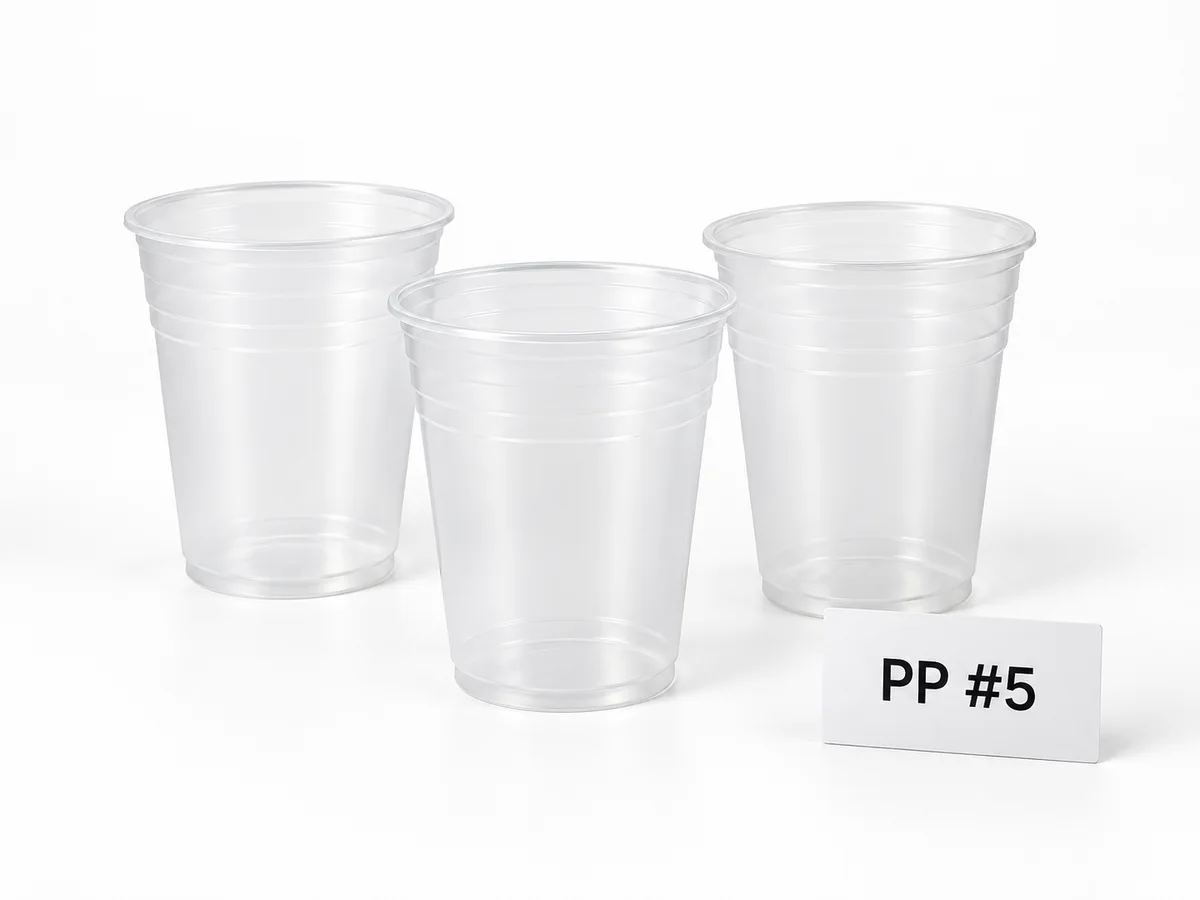
PS needs a more careful answer than a simple yes or no. Polystyrene is resin #6, but rigid PS cups and expanded polystyrene (EPS) foam cups should not be treated as the same recycling format. RecyClass recognizes a PS container recycling stream in Europe, while its design guidance treats foamed PS differently because the density difference makes foam incompatible with the rigid PS recycling stream.[7]
Technical recyclability does not mean common curbside acceptance. San José states that non-foam rigid PS containers are not recyclable in its curbside program, and that EPS foam foodservice packaging—including insulated disposable cups—belongs in the garbage unless an alternative recovery program is available.[11] Cuyahoga Recycles similarly excludes Styrofoam and polystyrene cups from its curbside cup program.[9]
PS answer: rigid PS is technically recyclable where a dedicated PS container stream exists, but many curbside systems do not accept PS cups. EPS foam cups are even less likely to belong in standard curbside recycling. Check the local program before using a #6 recycling instruction.
This distinction is important for authority and accuracy: “PS can be recycled” describes polymer and process capability; “this PS cup goes in the recycling bin” is a local collection claim.
Are PLA Cups Recyclable?
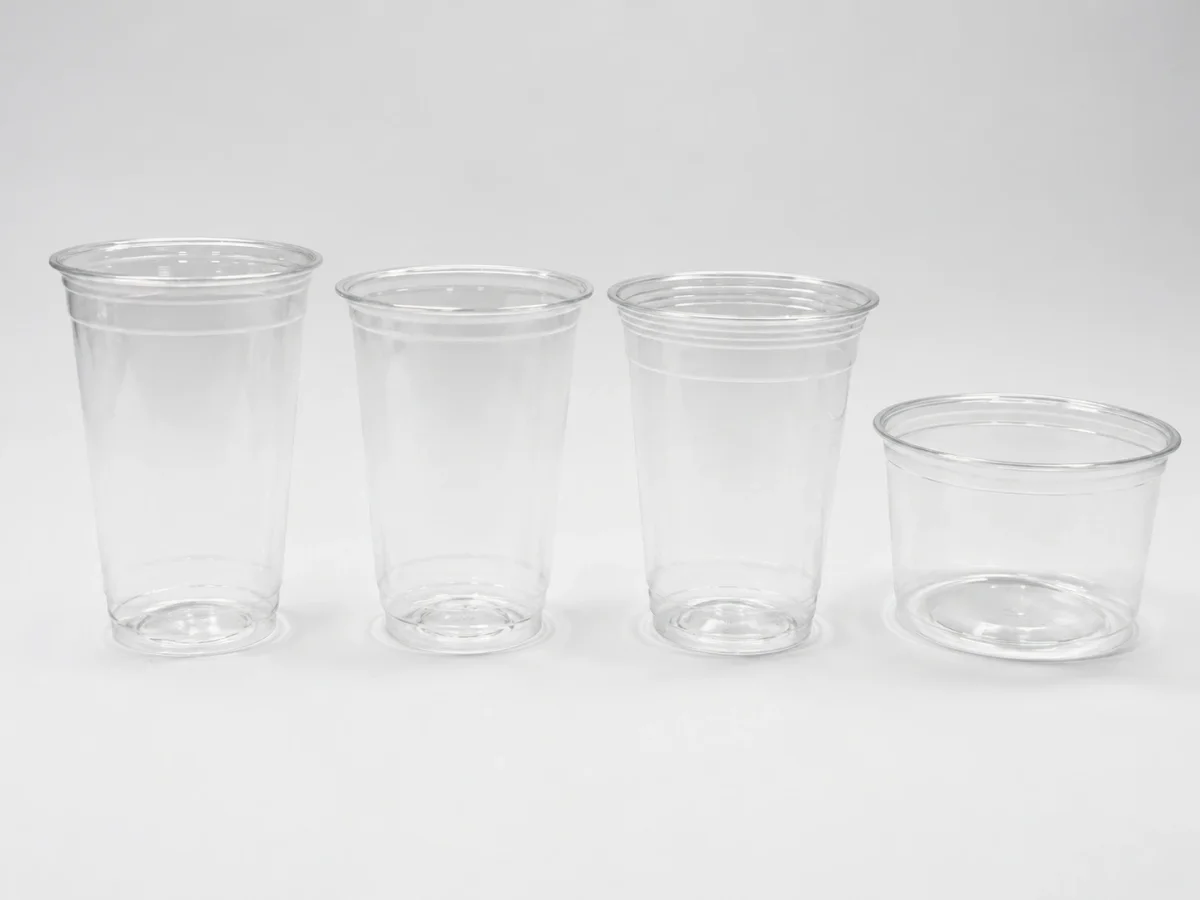
PLA cups should not be placed in conventional PET or PP recycling. PLA, or polylactic acid, is a distinct polymer. A clear PLA cold cup can look very similar to a clear PET cup, but appearance does not make the materials interchangeable.[15]
RecyClass recyclability calculations for PET, PP, PE and PS streams explicitly remove PLA from the recoverable content for those streams, reflecting that PLA does not belong to those conventional polymer recycling pathways.[8] BPI also emphasizes clear identification of compostable packaging so that it can be distinguished from conventional look-alike packaging and directed away from the wrong waste stream.[12]
A local recycling guide gives the practical version of the same rule. Cuyahoga Recycles tells users not to place compostable plastic cups in curbside recycling.[9] That does not mean no technology can ever recover PLA; it means a PLA cup should not be represented as an ordinary PET or PP recyclable cup.
PLA answer: keep PLA out of conventional PET and PP recycling. If a dedicated local recovery route exists, follow that program's instructions; otherwise do not infer recyclability from a clear appearance or a generic #7 mark.
For the material difference itself, see PET vs PLA cups. For compostability evidence and standards, use the separate PLA cup certification guide rather than turning this recycling article into a compostability article.
Are Cornstarch or Starch-Based Plastic Cups Recyclable?
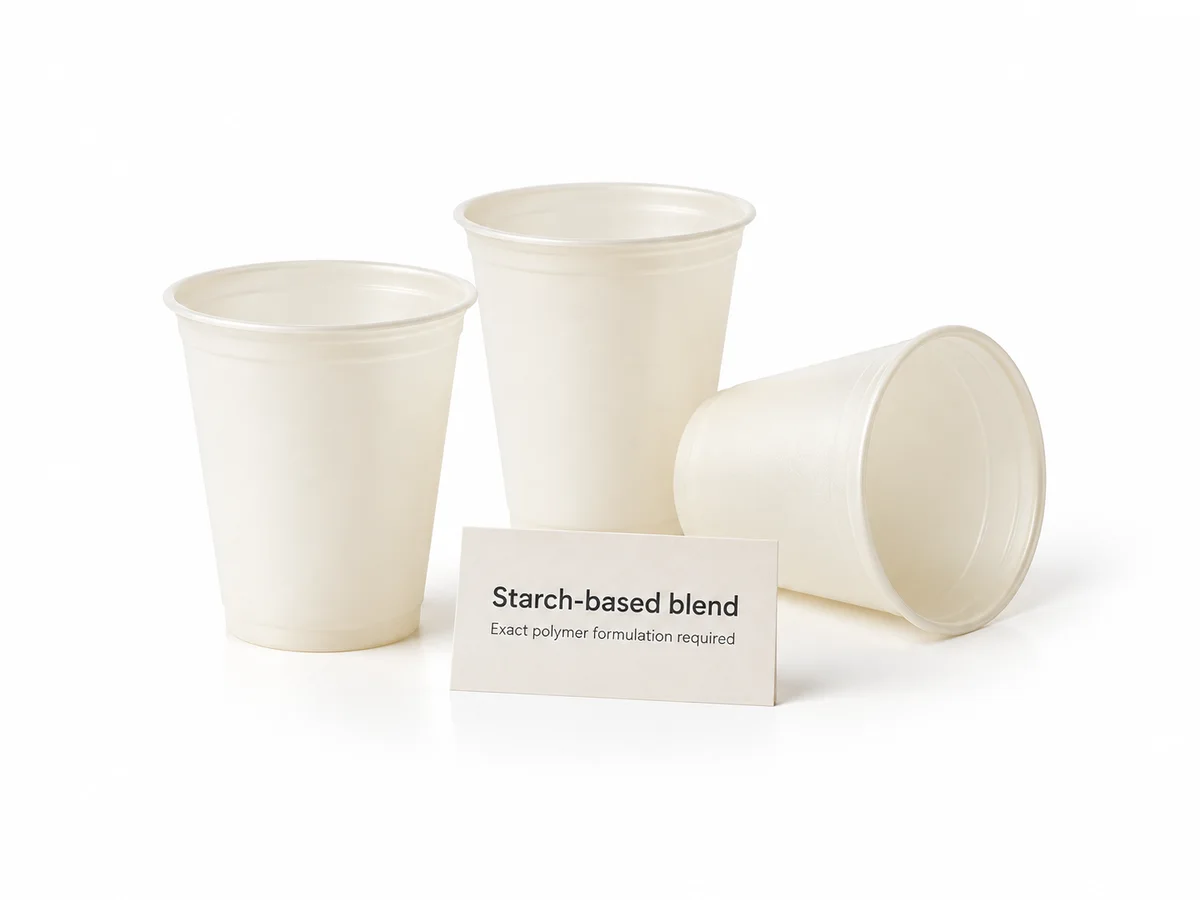
Do not treat “cornstarch plastic” as a standard recycling resin name. PET, PP and PS identify specific polymer families; starch-based can describe a bioplastic formulation or blend. European Bioplastics lists starch blends as a biodegradable bioplastic material group alongside PLA, PHA and PBS rather than as a conventional PET- or PP-type recycling resin.[13]
The formulation can matter substantially. U.S. EPA research on degradable plastics, for example, examined starch/PLA blends in which PLA formed the polymer matrix and starch acted as a biodegradable filler.[14] That is enough to show why the word “cornstarch” alone cannot tell a recycler what conventional resin stream should receive the finished cup.
For a cup marketed as cornstarch-based, biodegradable or compostable, obtain the exact polymer specification before making a recycling statement.[16] Unless a specific recovery program accepts that exact material, it should not be mixed into ordinary PET or PP cup recycling.
Starch-based answer: “made with cornstarch” is not a recycling instruction. Confirm the actual polymer or blend first; do not place the cup in a conventional plastic recycling stream by assumption.
How Do You Check Whether a Plastic Cup Can Actually Be Recycled?
Use the resin mark as the first identification step, not the final answer. The material needs a matching package format and an available local recovery route.
- Identify the polymer. Look for PET/PETE #1, PP #5, PS #6, PLA or a supplier material specification. If the cup only says “biodegradable” or “cornstarch,” request the exact formulation.
- Identify the cup format. A PET cup is commonly a thermoform, not a bottle. Rigid PS and EPS foam are different formats even though both belong to resin #6.
- Check the local acceptance list. Confirm whether the local system accepts that material in a cup, tub or thermoform format rather than assuming that all items with the same resin code are collected.
- Check the complete package. The cup body, lid, sleeve, label and printing can introduce different materials or affect sortability. Follow the local instruction for separation.
- Prepare the accepted cup correctly. Empty liquids and food residue and follow the local program's rules for rinsing, lids, straws and nesting.
Why Sorting Matters
Modern material recovery facilities commonly use near-infrared (NIR) systems to identify plastic resins and then direct positively identified packages into the appropriate stream. APR explains that when a package cannot be correctly identified and sorted, it may be sent to waste or become contamination in another recycling stream.[6]
For PET thermoforms specifically, APR identifies size, shape, color and label coverage as factors that can affect sortation.[5] This is why “made from recyclable plastic” and “designed to move successfully through a real recycling system” are related but not identical claims.
Plastic-industry rule of thumb: resin identity tells you what the cup is made from; sortability determines whether the system can separate it; local acceptance determines whether the user should put it in that recycling bin.
Buyer Checklist
For importers, distributors and foodservice brands, use the following checks before describing a disposable cup as recyclable or printing disposal instructions on the package.
For EU orders, local recycling acceptance and the separate packaging-law obligations should both be checked; the EU PPWR rules for disposable plastic cups explain the regulatory document and timing questions.
- Confirm the exact resin: PET, PP, PS, PLA or a documented blend.
- Do not use the RIC as proof: ASTM states that a resin code is not a recycle code.[1]
- Name the package format: bottle, thermoform cup, rigid PP cup, rigid PS cup and EPS foam can follow different sorting rules.
- Review decoration and components: labels, sleeves, lids, colors and printing can affect sortability or introduce other materials.
- Check the destination system: use the municipality, hauler or recycler that will actually receive the cup.
- Keep PLA and starch-based bioplastics separate from conventional PET/PP recycling: do not rely on appearance or a generic sustainability claim.
- Write the disposal instruction last: material identification and local acceptance should come before a consumer-facing “recycle” message.
Final Recommendation
For disposable plastic cups, PET has the clearest established recycling pathway when PET cup or thermoform collection exists. PP is also a recyclable polymer, but rigid #5 cup acceptance needs to be checked locally. Rigid PS has technical recycling routes in some markets, yet many curbside programs exclude PS cups, and EPS foam is generally even more restricted. PLA and starch-based bioplastics should not be placed in conventional PET or PP recycling unless a specific local program says it accepts that exact material.
The most reliable question is therefore not “Does this cup have a recycling number?” It is: what polymer is this cup, can this finished package be sorted into the correct recycling stream, and does the destination program collect it? That material-first approach is more accurate for consumers and more defensible for B2B packaging specifications.
Frequently Asked Questions
Are clear plastic cups recyclable?
Some are. Clear PET #1 cups can be recyclable where PET cups or thermoforms are accepted. Clear PLA cups should not enter conventional PET or PP recycling. Because PET and PLA can look similar, transparency alone is not a reliable material test.
Are PET plastic cups recyclable?
Yes. PET is a recyclable #1 polymer, and cold-drink PET cups commonly belong to the PET thermoform packaging family. Local collection still matters: confirm that the program accepts PET cups or thermoforms rather than assuming that acceptance of PET bottles covers every #1 package.
Can #5 PP cups go in recycling?
They can where rigid #5 polypropylene cups or containers are accepted. PP has established recycling streams, but collection rules vary. Check the municipality or commercial recycling program that will receive the used cup.
Are #6 PS and Styrofoam cups recyclable?
Rigid PS is technically recyclable where a PS container stream exists, but many curbside programs do not accept PS cups. Expanded polystyrene foam, often called Styrofoam, follows a different recovery pathway and is commonly excluded from standard curbside recycling.
Are PLA or cornstarch biodegradable cups recyclable?
Do not place them in conventional PET or PP recycling by default. PLA is a separate polymer, while “cornstarch-based” can describe a blend rather than one standard resin. Follow a dedicated recovery program only when it explicitly accepts the exact material.
References
- ASTM International — ASTM D7611/D7611M-26: Standard Practice for Coding Plastic Manufactured Articles for Resin Identification. Defines the Resin Identification Code and states that it is not a recycle code.
- U.S. Environmental Protection Agency — How Do I Recycle Common Recyclables?. General guidance to check local recycling programs rather than infer acceptance from a resin number.
- NAPCOR — PET Thermoform Recycling. PET thermoform definition, cup inclusion, recyclability and reclaimer considerations.
- NAPCOR — PET Thermoform Recovery Reaches Record 264 Million Pounds. 2024 U.S. and Canada PET thermoform recovery data released in 2026.
- Association of Plastic Recyclers — PET Thermoform Packaging Design, RES-PET-01. Design and sortation considerations including size, shape, color and label coverage.
- Association of Plastic Recyclers — Near Infrared (NIR) Sorting of Whole Rigid Packages, RES-SORT-01. How MRFs identify and sort rigid plastic packaging by resin signature.
- RecyClass — Online Recyclability Tool. Links polymer, package format, color and actual sorting stream to Design for Recycling guidance, including PP and PS containers.
- RecyClass — Plastics FAQ. Material-stream calculations and treatment of PLA as outside conventional PET, PP, PE and PS recyclable content.
- Cuyahoga Recycles — Cups. Local cup preparation guidance and exclusions for compostable plastic cups, party cups and polystyrene cups.
- San José Recycles — Plastic #5 (Polypropylene). Local example of a municipal program accepting #5 PP containers.
- San José Recycles — Takeout Containers (Foam). Local guidance distinguishing rigid and expanded #6 polystyrene and excluding both from San José curbside recycling.
- Biodegradable Products Institute — Industry Labeling Guidelines. Identification of compostable products to reduce confusion and contamination between waste streams.
- European Bioplastics — FAQ. Describes PLA, PHA, PBS and starch blends as biodegradable bioplastic material groups.
- U.S. EPA Research Project — High Strength Degradable Plastics From Starch and Poly(lactic acid). Demonstrates that starch-based plastics can be polymer blends rather than one standard recycling resin.
- Bioleader — Polylactic Acid (PLA) Cups: The Eco-Friendly Alternative to Plastic. Manufacturer buyer guide distinguishing clear PLA cups from conventional PET recycling and emphasizing local collection instructions.
- Bioleader — Strategic Sourcing Guide: How Global Buyers Should Evaluate Corn Starch Tableware. Manufacturer sourcing perspective on checking the actual polymer carrier and formulation rather than treating “corn starch” as one material identity.