
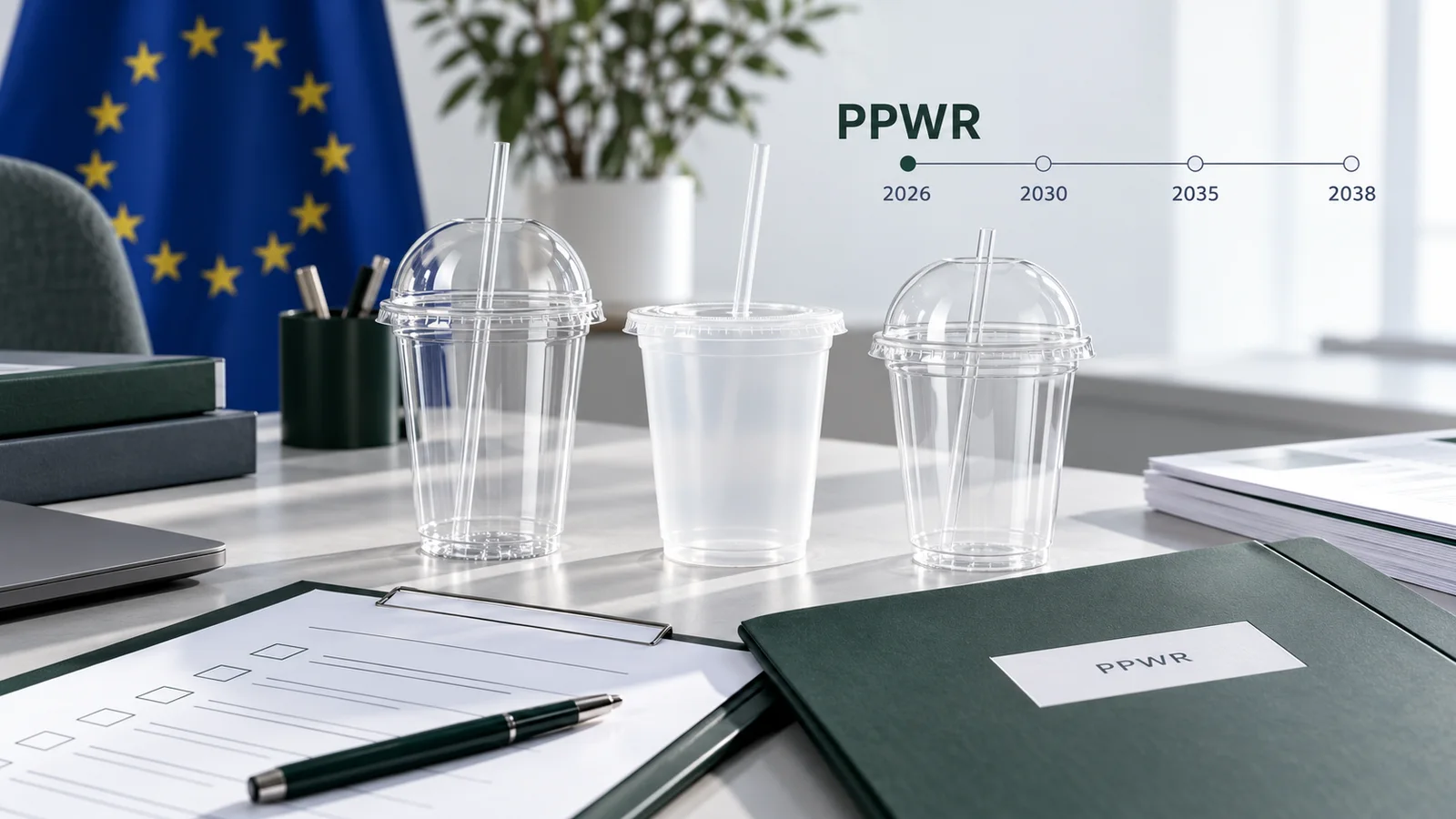
Quick Summary
- Regulation (EU) 2025/40 entered into force on 11 February 2025 and applies from 12 August 2026, but its major packaging requirements do not all start on the same date. For plastic cup buyers, the immediate priorities are correct packaging classification, PFAS limits for food-contact packaging, PPWR technical documentation and importer checks, while harmonised labeling, detailed recyclability criteria, recycled-content targets and HORECA restrictions phase in later. The practical procurement rule is to map each exact cup-and-lid configuration to the requirement and date that actually applies rather than treating PPWR as one single 2026 deadline.
The EU Packaging and Packaging Waste Regulation (PPWR), Regulation (EU) 2025/40, now applies across the European Union. For importers and brands sourcing disposable plastic cups, the practical question is no longer simply whether PPWR applies. Buyers need to know which declaration, technical documents and supporting evidence should cover the exact cup, lid and shipment packaging placed on the EU market.
PPWR entered into force on 11 February 2025 and applies from 12 August 2026.[1] That does not mean every recyclability, labeling, recycled-content and re-use requirement became fully operational on 12 August 2026. Some obligations apply now, while others depend on later dates, delegated acts, implementing acts or specific uses such as HORECA takeaway service.[2]
Core procurement rule: do not treat PPWR as one single deadline. Classify the exact cup-and-lid system first, identify the operator role, then map each applicable requirement to its own effective date and evidence package.
This guide focuses on plastic beverage cups and related service packaging. It is a procurement and compliance overview, not legal advice. Product classification, market role and national enforcement details should be confirmed for the exact commercial arrangement.
What PPWR Documents Are Needed for Disposable Plastic Cup Shipments?
About Bioleader Cups: Bioleader Cups is the specialized cup division of Bioleader®, supplying PLA compostable cold cups, PET clear cups, matching lids and custom-printed beverage packaging to international importers, distributors and foodservice buyers. Our team has export-supply experience coordinating cup specifications, quality checks, packing and shipment documentation for overseas orders, including projects for customers in the European Union.
At Bioleader Cups, we prepare disposable plastic cup orders for EU customers as a shipment-level compliance file rather than treating PPWR as one document attached only to the cup. A commercial shipment normally includes the finished cup together with several packaging materials used to protect, group and transport it. For this reason, we prepare a shipment-level supporting compliance file that can connect the finished product with its raw material and the main packaging components used in the shipment.
These supporting reports are not necessarily submitted automatically to customs for every shipment. In practice, they are kept available for the EU importer, customer, customs authority, market-surveillance authority or internal compliance team when evidence is requested.
Need the document package for your order?
| Shipment component | Typical supporting document | Why we keep it |
|---|---|---|
| Finished PET / PP / PLA cup | Finished Product PPWR Compliance Test Report / applicable PFAS, heavy-metal or packaging compliance evidence | Connects the actual cup SKU placed on the EU market with the applicable packaging requirements. |
| Plastic resin / raw material | SGS, CTI or equivalent Raw Material Test Report, Material Declaration or supporting chemical-compliance report | Provides upstream evidence for the polymer or resin used to manufacture the finished cup. |
| LDPE inner packaging bag | CTI RoHS & Halogen Test Report – LDPE Packaging Bag, or equivalent material-compliance report | Supports the compliance file for the plastic bag used as part of the shipment packaging system. |
| BOPP packing tape | Material supplier's SGS PAHs Test Report – BOPP Packing Tape and/or applicable material declaration | Provides supporting evidence for an additional plastic packaging component used to close shipping cartons. |
| Corrugated shipping carton | Packaging material supplier's SGS PPWR Compliance & Recyclability Test Report – Corrugated Carton, or equivalent paper-packaging evidence | Supports the outer transport-packaging portion of the shipment compliance file. |
| Separate paper label, if used | Paper Label Material Compliance / Heavy Metals / Recyclability supporting report or supplier declaration | Included when a separate paper label forms part of the packaging configuration. |
Bioleader Cups export experience: for a plastic-cup shipment, the commercial invoice or sea waybill may contain only the main product description, but the compliance file can be much broader. We normally trace the finished cup, its raw material and the principal transport-packaging components separately so that supporting evidence can be produced if the EU importer or another authority requests it.
This does not mean that every component requires a document with the words “PPWR Certificate” on the title. The useful question is whether the evidence clearly identifies the material or packaging component, the test or compliance scope, and the shipment or product configuration it is intended to support.
Do Disposable Plastic Cups Need a PPWR Certificate?
There is no single universal document called a “PPWR Certificate” that replaces the conformity process. Depending on the packaging and operator role, the compliance file may include the EU Declaration of Conformity, technical documentation, product- or material-specific test reports, PFAS evidence and other supporting documents. For Bioleader Cups export orders, we identify what each available document actually covers rather than renaming every material supplier report as a cup certificate. If an EU customer asks for a “PPWR certificate,” we first clarify whether they need the EU Declaration of Conformity, a finished-product PPWR test report, PFAS evidence, raw-material documentation or a wider shipment compliance package.
Bioleader Cups PPWR Certificates & Compliance Document Library
Download our supplier declaration, PLA certification files and supporting shipment-packaging test reports. Each file applies only to its identified product or sample and stated test scope. The supplier declaration is not a universal EU PPWR Declaration of Conformity.
Featured Document
Bioleader Supplier Declaration
Bioleader Cups PET & PLA Declaration of Compliance
Supplier Declaration · PET + PLA
PLA Cup Certifications
| Document | Applies To | Document Type | Download |
|---|---|---|---|
| SGS PLA Cups Test Report | Tested PLA cups | Third-party test report | |
| FDA 21 CFR PLA Cups SGS Test Report | Tested PLA cups | Food-contact test report | |
| DIN EN 13432 PLA Cups Certificate | Identified PLA cups | Compostability certificate | |
| BPI Compostable PLA Cups Certificate | Identified PLA cups | Compostability certificate | |
| ASTM D6400 PLA Cups Certificate | Identified PLA cups | Compostability certificate |
PLA files do not automatically apply to PET cups or a different PLA product configuration.
Shipment Packaging Supporting Reports
| Document | Applies To | Document Type | Download |
|---|---|---|---|
| CTI RoHS & Halogen Test Report | Tested LDPE material | Material test report | |
| SGS PAHs Test Report | Tested BOPP tape | Material test report | |
| SGS REACH / SVHC Report | Tested corrugating medium | Material test report | |
| SGS RoHS / TPCH Heavy Metals Report | Tested corrugating medium | Heavy metals test report | |
| SGS PPWR Compliance & Recyclability Report | Tested corrugated carton | Packaging test report |
Shipment-packaging reports apply only to the tested material or sample identified in each document. They are not finished-cup certificates or standalone PPWR declarations; the LDPE report does not establish finished-bag conformity, and the BOPP tape report tests PAHs rather than overall PPWR compliance.
Need a PPWR Document Package for Your Cup Order?
Send us your cup material, size, lid, destination market and order quantity. Bioleader Cups can review which declarations, certificates and supporting reports are available for the exact shipment.
What Changed Under the EU PPWR in 2026?
PPWR replaced the older packaging-waste directive with a directly applicable EU regulation. Its purpose is broader than recycling alone: it covers packaging design, substances of concern, recyclability, recycled content, labeling, re-use, waste prevention, conformity assessment and economic-operator responsibilities.[1]
For a buyer sourcing disposable plastic cups from outside the EU, five questions now matter immediately:
- Is this cup legally “packaging” under PPWR for the intended use?
- Is the finished food-contact packaging within the PFAS limits that apply from 12 August 2026?
- Has the manufacturer completed the applicable PPWR conformity documentation?
- Has the EU importer completed its own checks before placing the packaging on the market?
- Which later obligations need to be designed into the sourcing plan now, even though the legal deadline is later?
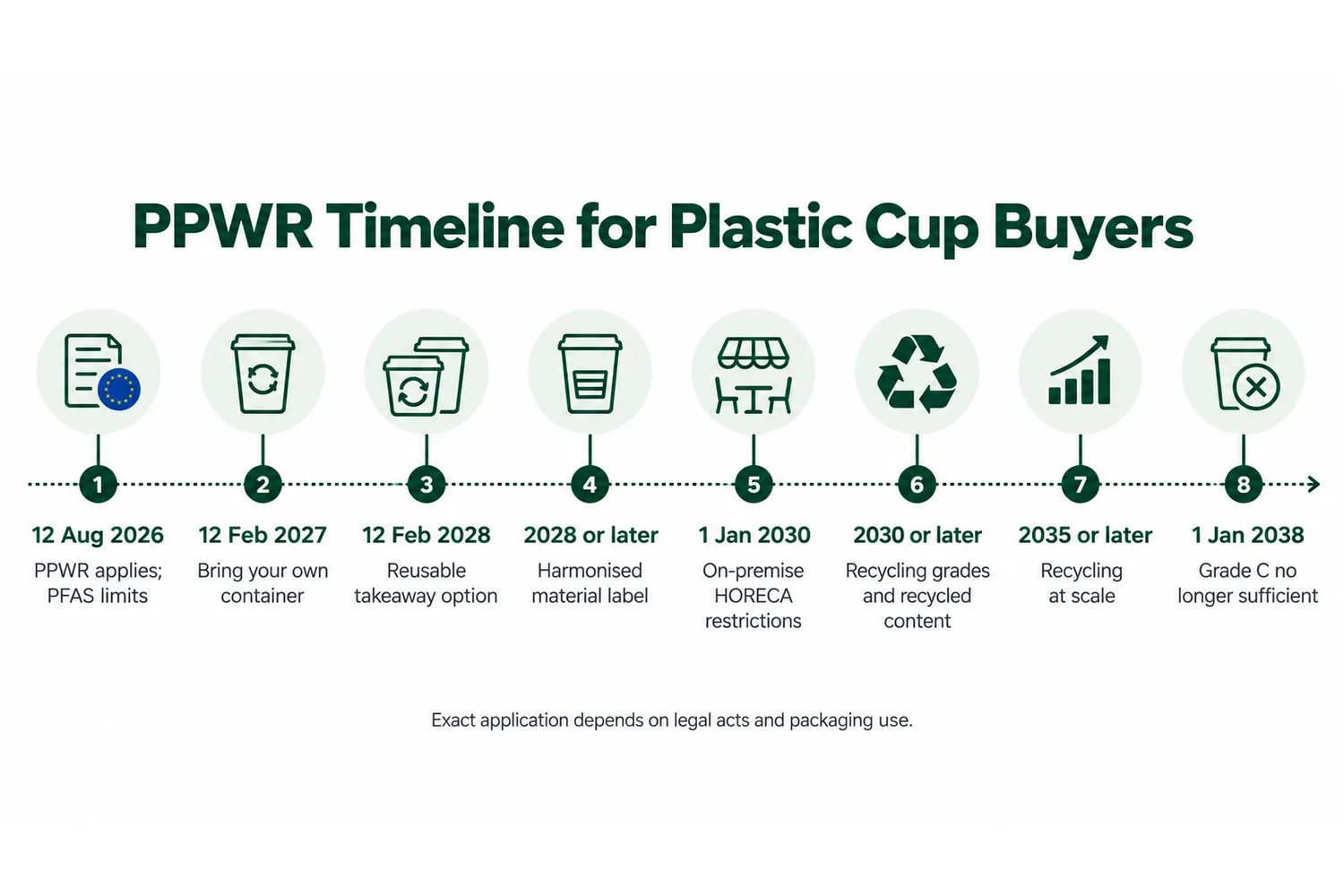
| Requirement | Key timing | Plastic-cup buyer implication |
|---|---|---|
| PPWR general application | 12 August 2026 | Packaging placed on the EU market must be assessed under the new regulation. |
| PFAS limits for food-contact packaging | 12 August 2026 | Finished food-contact packaging must comply with the PPWR PFAS concentration limits. |
| General recyclability requirement | Applies from 12 August 2026 | PPWR states that all packaging shall be recyclable, while detailed design-for-recycling assessment comes later. |
| Takeaway refill system | By 12 February 2027 | Covered HORECA final distributors must allow consumers to bring their own containers. |
| Takeaway reusable-packaging option | By 12 February 2028 | Covered HORECA final distributors must offer a reusable-packaging option within a re-use system. |
| Harmonised material label | 12 August 2028 or later, depending on implementing-act timing | Do not invent or pre-empt a final PPWR label before the applicable system is established. |
| Detailed recyclability grades / design for recycling | 2030 or later, depending on delegated-act timing | Packaging design will be assessed against formal recyclability performance criteria. |
| Minimum recycled content | 2030 or later, depending on implementing-act timing | PET and other plastic packaging may face different targets and exemptions. |
| Certain single-use plastic HORECA packaging restrictions | 1 January 2030 | Disposable cups used for food or drinks filled and consumed on HORECA premises are specifically listed, subject to the regulation's conditions and exceptions. |
| Recyclability at scale | 2035 or later under the regulatory timetable | Recyclability moves beyond design theory toward actual recycling at scale. |
| Grade C phase-out | 1 January 2038 | Subject to the regulation's exceptions, packaging must reach grade A or B rather than grade C. |
Does PPWR Apply to Disposable Plastic Cups?
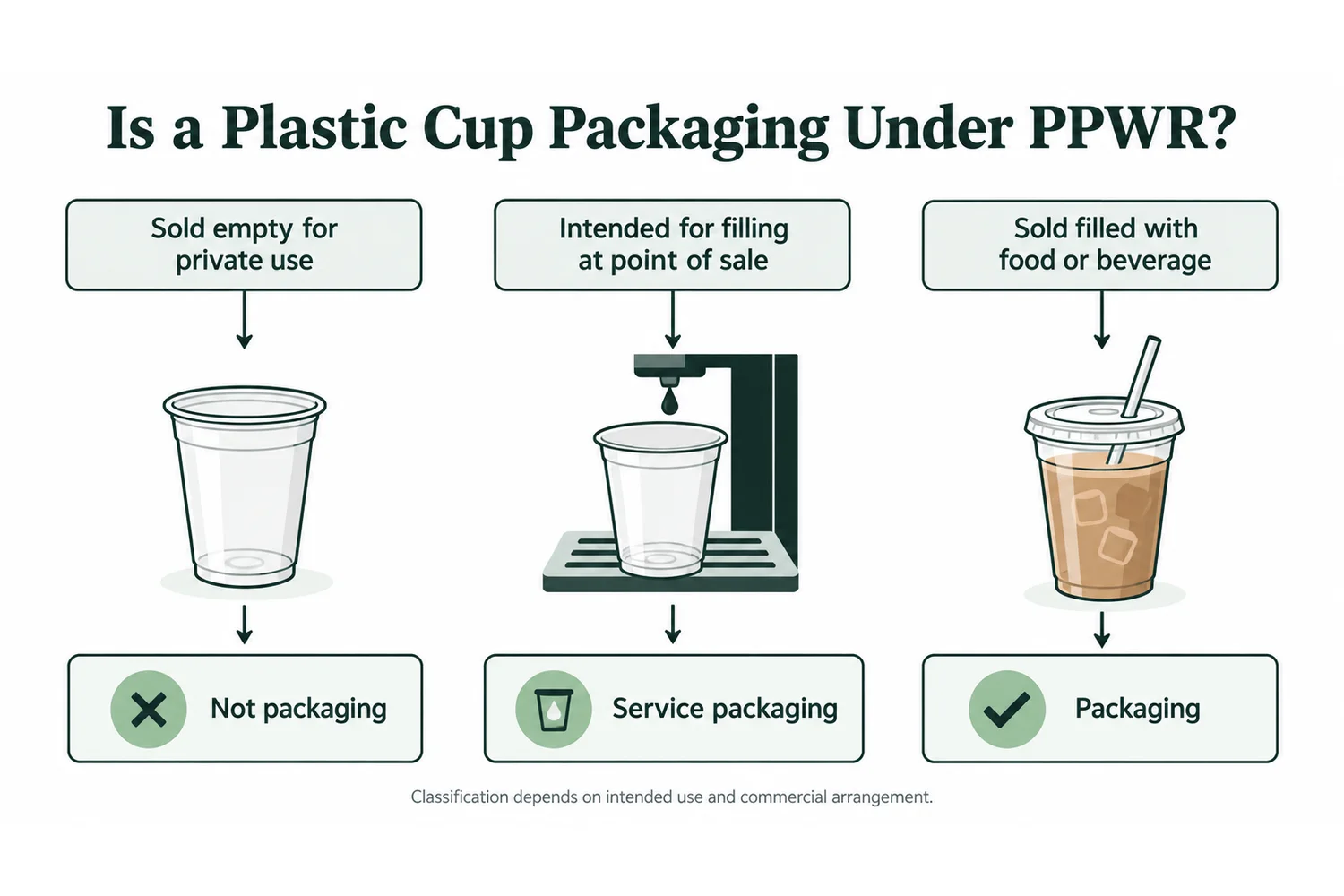
It can, but the physical object alone does not answer the classification question. PPWR explains that cups, food containers and similar items are not treated as packaging when they are designed and intended to be sold empty by the final distributor. The same type of item can be treated as service packaging when it is designed and intended to be filled at the point of sale, or when it is sold by the final distributor containing food or beverages and performs a packaging function.[1]
This distinction matters to wholesalers. A stack of empty cups moving through the supply chain cannot be classified for PPWR purposes only by saying “it is a PET cup” or “it is a PLA cup.” The buyer needs to document the intended commercial use: retail sale as an empty article, point-of-sale filling, takeaway drink service, on-premise HORECA consumption or another packaging function.
Manufacturer insight: material identity and packaging classification are separate questions. PET, PP, PS or PLA tells you what the cup is made from. PPWR classification depends on what the item is designed and intended to do in the market.
Service Packaging Is a Critical Cup Concept
For beverage businesses, many cups are supplied empty but are specifically intended to be filled at a café, juice bar, restaurant, event counter or other point of sale. That use can bring them into PPWR as service packaging even though the manufacturer shipped the cups empty.
This is also why procurement teams should avoid copying a regulatory conclusion from one customer program to another. A cup used in a takeaway beverage program may face a different operational requirement from a cup sold empty to consumers for household use.
What Do PPWR PFAS Rules Mean for Disposable Food-Contact Cups?
From 12 August 2026, food-contact packaging cannot be placed on the EU market if it contains PFAS at or above the concentration limits specified in Article 5(5), to the extent the packaging is not already prohibited by another EU legal act.[1]
| PPWR PFAS threshold | What the regulation measures |
|---|---|
| 25 ppb | Any PFAS measured by targeted PFAS analysis; polymeric PFAS are excluded from this quantification. |
| 250 ppb | Sum of PFAS measured by targeted analysis, where applicable with prior degradation of precursors; polymeric PFAS are excluded from this quantification. |
| 50 ppm | PFAS including polymeric PFAS, with an additional documentation condition where total fluorine exceeds 50 mg/kg. |
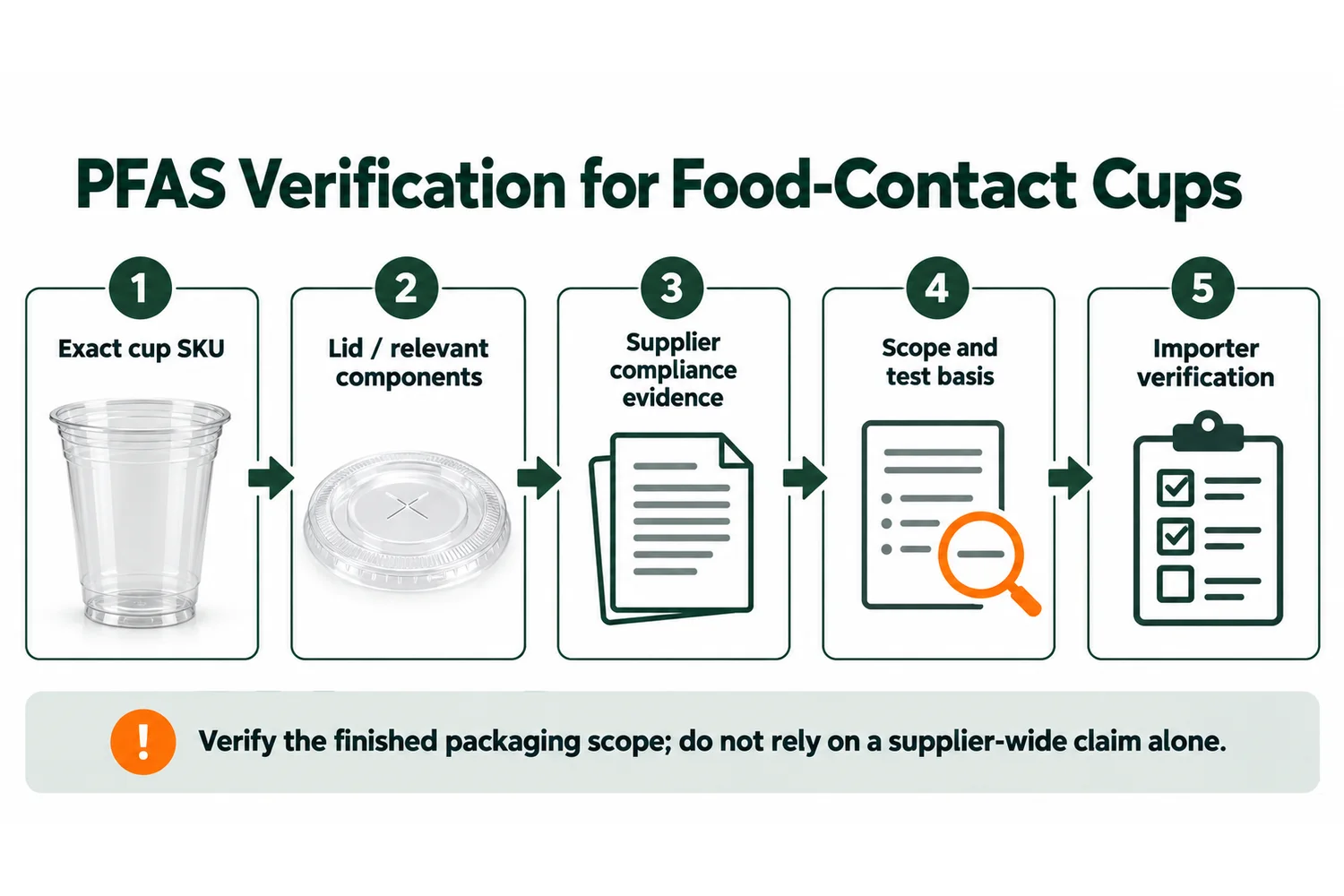
The practical buyer question is not simply, “Does PET contain PFAS?” PPWR regulates the food-contact packaging placed on the market. Procurement teams therefore need evidence with a clear scope: which finished cup, lid, coating, print system or other relevant packaging component is covered by the compliance statement or analytical documentation.
A generic supplier statement such as “our factory is PFAS-free” is not automatically equivalent to SKU-level evidence. The useful questions are: What product or material does the document identify? Which analytical approach or compliance basis was used? Does the scope cover the configuration being ordered? Is the document current enough for the shipment and market?
Do not invent a certificate requirement. PPWR establishes legal limits and compliance obligations; it does not mean every supplier must provide a document with one universal commercial name such as “PPWR PFAS Certificate.” Ask for evidence that supports the exact finished packaging and the applicable legal requirement.
What PPWR Documents Should Disposable Plastic Cup Importers Check?
For packaging within the PPWR conformity framework, the key legal document is the EU Declaration of Conformity supported by technical documentation—not a generic supplier-issued certificate.
PPWR adds a packaging-conformity layer that should not be confused with the familiar food-contact paperwork used for plastic cups. Article 15 requires manufacturers to carry out the applicable conformity assessment, prepare technical documentation and draw up an EU declaration of conformity once compliance has been demonstrated. Article 18 requires importers to check that the manufacturer has completed the applicable conformity assessment and technical documentation, that required documents accompany the packaging and that labeling requirements are met when they apply.[1]
For single-use packaging, PPWR also requires the manufacturer to retain the technical documentation and EU declaration of conformity for five years from the date the packaging is placed on the market. Importers likewise have document-retention and availability obligations under Article 18.[1]
PPWR EU Declaration Is Not the Same as a Food-Contact Declaration
This is an important procurement distinction. A plastic cup sold for food or beverage use may already need food-contact compliance evidence under rules such as Regulation (EU) No 10/2011 and related amendments. PPWR creates a separate packaging-law conformity framework. A buyer should not assume that an EU food-contact Declaration of Compliance automatically satisfies the PPWR technical-documentation requirement, or vice versa.
Cupschina's existing Food Contact Compliance for Plastic Cups guide covers the food-contact side, while the EU Regulation 2025/351 buyer guide addresses the 2026 changes to EU plastic food-contact rules. PPWR should be treated as an additional packaging-compliance layer rather than a replacement for those requirements.
Buyer Document Checklist for PPWR
- Identify the exact cup and lid codes covered by the supplier's documentation.
- Confirm the intended packaging use and whether the item is service packaging.
- Request the applicable PPWR technical documentation or the information needed to support the EU importer's review.
- Confirm that the manufacturer has an EU declaration of conformity where required by PPWR.
- Verify PFAS compliance evidence for food-contact packaging.
- Keep food-contact DoC and migration evidence separate from PPWR packaging conformity evidence.
- Where recycled content is claimed, verify the calculation basis and supporting chain of evidence rather than relying on a visual claim.
- Where recyclability is claimed, confirm whether the claim is based on current local practice, PPWR design criteria, or another standard; do not merge those concepts.
- Check importer identification and document-retention responsibilities for the actual EU operator placing the packaging on the market.
Useful compliance logic: supplier identity is not enough; material identity is not enough; a test report is not enough. The approval file should connect the exact product, intended use, applicable legal requirement and responsible economic operator.
How Do PPWR Recyclability Rules Change From 2026 to 2038?
PPWR Article 6 states that all packaging shall be recyclable. The Commission's 2026 guidance explains that this general requirement applies from 12 August 2026. At the same time, the detailed conformity assessment for design-for-recycling does not become operational until the delegated acts under Article 6(4) enter into force and the applicable transition period has run.[2]
This is why a 2026 buyer should avoid two opposite mistakes:
- Mistake 1: assuming recyclability does not matter until 2030.
- Mistake 2: claiming that a 2030 PPWR recyclability grade has already been formally assigned to a cup in 2026.
2030: Design-for-Recycling Performance Grades
From 1 January 2030, or 24 months after the relevant delegated acts enter into force if that date is later, packaging generally cannot be placed on the market unless it is recyclable within grades A, B or C, subject to the regulation's exceptions. Annex II defines grade A as at least 95% recyclable by weight under the design-for-recycling assessment, grade B as at least 80%, and grade C as at least 70%.[1]
For cup design, this means the future assessment is not simply “PET is recyclable” or “PP is recyclable.” Labels, inks, adhesives, sleeves, pigments, multi-material features and other design choices can influence how the packaging performs against the formal design-for-recycling methodology once those criteria apply.
2035: Recyclability at Scale
The regulatory model then adds a recycled-at-scale dimension from 2035 or later under the timing rules linked to implementing acts. This is a major shift in buyer language: technical material recyclability is not the same as demonstrating that a packaging category is actually recycled at scale.
That distinction is consistent with the practical logic in Cupschina's PET Cup Recycling Claims guide and Are Plastic Cups Recyclable?: the polymer is only one layer of the recycling decision.
2038: Grade C Is No Longer Enough
From 1 January 2038, packaging generally cannot be placed on the market unless it reaches recyclability grade A or B, again subject to the regulation's exceptions. A future-proof cup program therefore needs to track not only whether a material is recyclable in principle, but whether the complete packaging design is moving toward the performance level required by the later PPWR timetable.
What Does PPWR Mean for Recycled Content in PET, PP and PLA Cups?
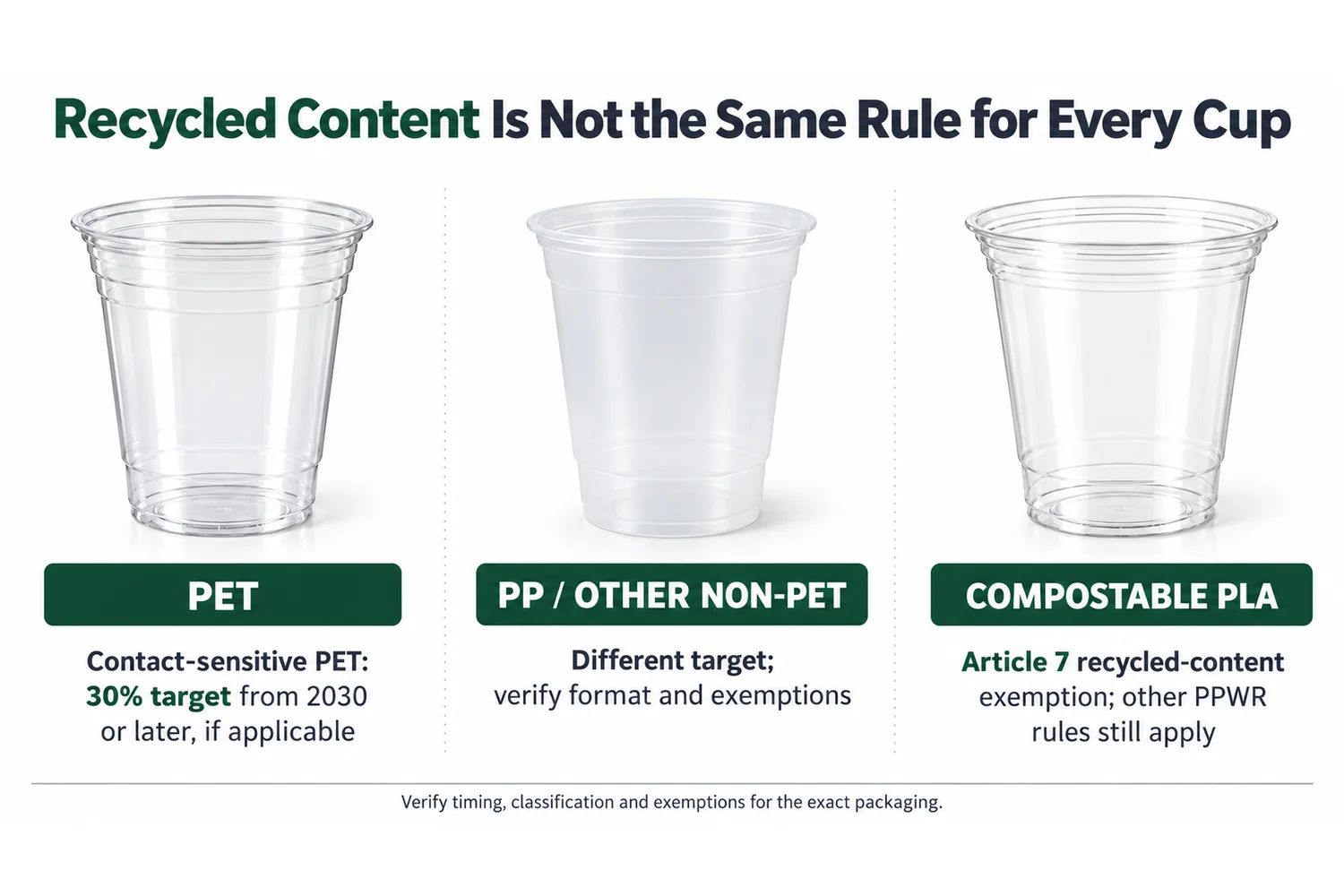
The minimum recycled-content targets do not generally begin in 2026. Article 7 sets the first targets for 1 January 2030 or three years after the relevant implementing act enters into force, whichever is later.[1]
The regulation distinguishes packaging categories. For 2030, it sets 30% recycled content for contact-sensitive packaging made primarily from PET, excluding single-use plastic beverage bottles; 10% for contact-sensitive packaging made from plastics other than PET, again excluding single-use beverage bottles; 30% for single-use plastic beverage bottles; and 35% for other plastic packaging. The calculation is made by packaging type and format as an average per manufacturing plant and year.[1]
Do not translate this into “every PET cup must contain 30% rPET in 2026.” The first PPWR recycled-content date is later, the calculation method is not an individual-cup percentage rule, and the exact category and applicable exemptions still need to be established.
What This Means for PET Cup Buyers
A food-contact PET cup may fall within the contact-sensitive PET category, but the buyer should confirm the formal packaging classification, the applicable Article 7 calculation method and any future implementing rules before writing a contractual percentage into a long-term specification. If a supplier offers an rPET cup now, treat the recycled-content claim as a separate product fact that needs evidence; do not present it as proof that the product automatically satisfies a future PPWR target.
For the material and food-contact issues behind rPET, see Virgin PET vs rPET Cups: Food Contact, PCR Content & Buyer Guide.
What About PP and Other Non-PET Plastics?
Article 7 uses a different 2030 percentage for contact-sensitive plastic packaging made from materials other than PET. Buyers should not convert that legal category into a blanket statement that every PP food cup must carry the same recycled-content percentage without reviewing the exact format, food-contact constraints, available authorised recycling technologies and any later derogations.
What About Compostable PLA Cups?
PPWR explicitly excludes compostable plastic packaging from the Article 7 minimum recycled-content targets. That does not mean compostable packaging is outside PPWR. Article 9 separately regulates compostable packaging and biodegradable plastic polymers, and other PPWR requirements can still apply depending on the package and use.[1]
For procurement, the key distinction is therefore: compostability can affect which PPWR provision applies; it does not create a general exemption from EU packaging law.
How Does PPWR Affect HORECA Disposable and Takeaway Cups?
This is one of the most commercially important parts of PPWR for beverage-cup programs because the regulation distinguishes on-premise single-use plastic packaging from takeaway service.
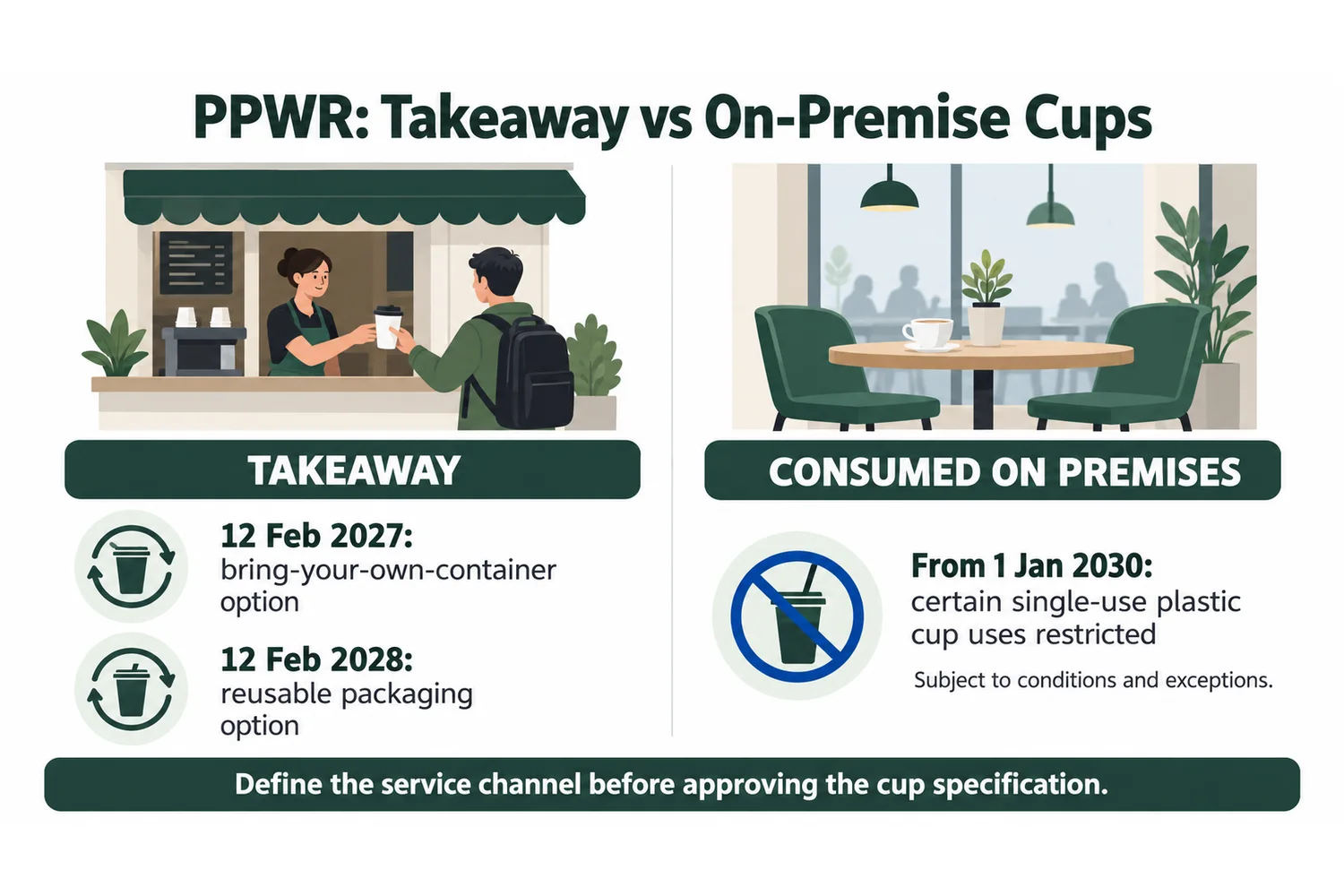
By 12 February 2027: Bring-Your-Own Container for Takeaway
Covered final distributors in the HORECA sector that make hot or cold beverages available in takeaway packaging must provide a system that allows consumers to bring their own container for filling. Consumers using their own container must not be offered the product at a higher cost or on less favourable conditions than the same product sold with single-use packaging.[1]
This requirement does not itself mean single-use takeaway cups disappear in 2027. It creates a refill option that changes the operating environment around disposable cups.
By 12 February 2028: Reusable Packaging Option for Takeaway
Covered HORECA final distributors must also offer consumers the option to obtain hot or cold beverages or ready-prepared food in reusable packaging within a re-use system. Again, the reusable option must not be offered at a higher cost or on less favourable conditions than the equivalent single-use option.[1]
From 1 January 2030: On-Premise Single-Use Plastic Restrictions
Article 25 and Annex V prohibit certain packaging formats and uses from 1 January 2030. Annex V specifically lists single-use plastic packaging for food and beverages that are filled and consumed within HORECA premises, including disposable cups, subject to the regulation's conditions and exceptions.[1]
This is a major procurement distinction. A cup intended for a drink consumed inside a restaurant or café is not automatically the same regulatory use case as a cup intended for takeaway. Buyers should therefore avoid specifications that say only “EU cup” or “foodservice cup.” The intended channel and consumption context need to be part of the product brief.
Commercial implication: PPWR can change the value of a cup program without changing the polymer. The same PET or PP cup may face a different business outlook depending on whether it is used for on-premise HORECA consumption, takeaway service, retail sale or another application.
When Do PPWR Labeling Rules Apply to Plastic Cups?
PPWR introduces harmonised labeling to help consumers identify packaging material composition and sort packaging waste. But this is another area where the dates matter. Article 12 states that the harmonised material-composition label applies from 12 August 2028 or 24 months after the relevant implementing acts enter into force, whichever is later.[1]
That means a buyer should not ask a supplier in 2026 to invent a “PPWR recycling label” that is not yet the final harmonised system. Existing destination-market marking rules and the Single-Use Plastics Directive may still apply to certain products, while the PPWR harmonised label follows its own implementation timetable.
The practical action is to keep artwork files editable and controlled by revision. If a printed cup will be ordered repeatedly through 2027–2029, the branding and regulatory-information area should be managed so required labeling can be updated without redesigning the entire cup identity.
For custom-printed cups, this is a good example of why compliance and artwork approval cannot be completely separated. The cup specification should be locked first, but regulatory text, symbols and required information need their own revision control before each production approval.
How Does PPWR Relate to EU Food-Contact Rules?
PPWR does not replace the EU food-contact framework. Plastic cups intended to contact beverages can still fall under Regulation (EC) No 1935/2004, Regulation (EU) No 10/2011 and subsequent amendments, including Regulation (EU) 2025/351. PPWR addresses packaging requirements; food-contact law addresses the safety and migration framework for the material or article in contact with food.
For a purchasing file, it is useful to separate the questions:
| Compliance question | Primary framework | Buyer evidence focus |
|---|---|---|
| Can the plastic cup contact the intended beverage under the declared conditions? | EU food-contact rules | Material composition, migration conditions, Declaration of Compliance and supporting documentation as applicable. |
| Does the packaging meet PPWR packaging requirements? | Regulation (EU) 2025/40 | PPWR technical documentation, EU declaration of conformity, PFAS, recyclability, recycled-content and labeling requirements as applicable. |
| Can a sustainability statement be made? | Depends on the exact claim and applicable EU / national rules | Evidence supporting the specific claim; avoid turning material identity into an unsupported environmental claim. |
A supplier may therefore have a valid food-contact file and still need additional work for PPWR, or vice versa. The buyer should approve the complete compliance file for the exact cup-and-lid configuration and intended market, not one document in isolation.
What Should Buyers Do by Cup Material?
| Material / format | Immediate buyer focus | Longer-term PPWR planning |
|---|---|---|
| PET food-contact cups | PFAS scope, PPWR conformity documentation, food-contact documentation and correct packaging classification. | Track design-for-recycling criteria and the Article 7 recycled-content path for the exact PET packaging category. |
| rPET cups | Verify the actual recycled-content claim and food-contact basis; do not rely on appearance or a generic PCR statement. | Align future specifications with PPWR calculation methodology and applicable recycled-content rules. |
| PP cups | Verify food-contact and PPWR packaging evidence for the exact finished cup. | Track non-PET contact-sensitive recycled-content rules, design-for-recycling criteria and HORECA use restrictions. |
| PS / EPS cups | Confirm exact format and destination-market restrictions in addition to PPWR documentation. | Pay particular attention to future recyclability performance and HORECA application restrictions. |
| Compostable PLA cups | Verify the exact compostable packaging status, food-contact evidence and PPWR documentation. | Do not apply PET recycled-content logic; Article 7 exempts compostable plastic packaging, while Article 9 and other PPWR provisions still matter. |
For current material selection, see Cupschina's PET cup range and PLA cup range. Those commercial pages should be used to identify the product family; PPWR approval still needs to be tied to the exact destination-market requirement and supplied documentation.
Buyer Checklist
- Define whether the cup is packaging for the intended commercial use and whether it is service packaging.
- Record whether the application is takeaway, on-premise HORECA, retail or another channel.
- Identify the exact cup, lid and any relevant printed or coated components included in the compliance scope.
- For food-contact packaging, verify evidence supporting the PPWR PFAS limits that apply from 12 August 2026.
- Separate PPWR packaging conformity documents from EU food-contact DoC and migration evidence.
- Confirm that the manufacturer has completed the applicable PPWR conformity assessment and technical documentation.
- If you are the EU importer, verify your Article 18 obligations rather than assuming the overseas supplier carries the entire legal role.
- Do not state that every PET cup requires 30% rPET in 2026; check the Article 7 timing, category, calculation method and exemptions.
- For PLA, do not assume compostability removes PPWR obligations; check Article 9 and the exact packaging status.
- Keep artwork and labeling areas revision-controlled for later PPWR harmonised labeling requirements.
- Review HORECA use before committing to a long-term disposable-cup program because takeaway and on-premise uses follow different PPWR pathways.
- Re-check Commission guidance, FAQs and implementing or delegated acts before repeat orders that cross a future PPWR milestone.
Final Recommendation
For plastic cup importers and brands, the most useful PPWR strategy is not to search for one document called a “PPWR certificate.” Build a requirement map around the exact packaging configuration, intended use, responsible operator and deadline.
In 2026, the immediate file should focus on correct packaging classification, food-contact PFAS compliance, manufacturer conformity documentation and importer verification. At the same time, product-development teams should already be watching the later requirements that can change cup specifications: harmonised labeling, design-for-recycling grades, recycled-content targets, HORECA refill and re-use obligations, and the 2030 restriction on specified on-premise single-use plastic packaging.
The central distinction is simple: PPWR applies now, but PPWR does not make every future requirement a 2026 requirement. Buyers who separate current legal obligations from future design targets will make better material, artwork and sourcing decisions—and will be less likely to demand unsupported supplier claims or redesign a cup program too late.
Frequently Asked Questions
Do disposable plastic cups need a PPWR certificate?
PPWR does not create one universal third-party “PPWR Certificate” that replaces the conformity process. Depending on the product and operator role, the compliance file may include an EU Declaration of Conformity, technical documentation, finished-product or material test reports, PFAS evidence and other supporting documents.
What is a PPWR Declaration of Conformity?
The EU Declaration of Conformity is the manufacturer's formal declaration that the packaging meets the applicable PPWR requirements covered by the conformity assessment. It should be supported by the relevant technical documentation. It is different from an EU food-contact Declaration of Compliance.
Does PPWR apply to disposable plastic cups?
It can. Cups designed and intended to be filled at the point of sale can be service packaging, while items designed and intended to be sold empty by the final distributor are treated differently. The exact intended use and commercial arrangement need to be classified.
Do PET cups need 30% rPET under PPWR in 2026?
No general 30% PET cup requirement starts in 2026. Article 7 sets future recycled-content targets from 2030 or later depending on implementing-act timing, and the exact target depends on packaging classification, calculation methodology and applicable exemptions.
Does PPWR ban disposable plastic cups in 2030?
No. PPWR Annex V includes a 2030 restriction for specified single-use plastic packaging used for food and beverages filled and consumed within HORECA premises, including disposable cups, subject to the regulation's conditions and exceptions. Takeaway service follows a different set of refill and re-use obligations.
References
- EUR-Lex — Regulation (EU) 2025/40 on Packaging and Packaging Waste. Official PPWR text covering scope, substances of concern, recyclability, recycled content, compostable packaging, labeling, economic-operator obligations, HORECA restrictions, refill and re-use requirements.
- European Commission — Guidance document for Regulation (EU) 2025/40 on packaging and packaging waste (C/2026/3084). Official 2026 guidance on interpretation and application of selected PPWR provisions, including packaging definitions, operator roles, PFAS, recyclability timing and recycled-content exemptions.
- European Commission — FAQ on Packaging and Packaging Waste Regulation (PPWR). Official FAQ publication dated 3 August 2026.
- European Commission — Packaging Waste. Official overview of the EU packaging and packaging-waste framework.
- Bioleader — PPWR Declaration of Conformity for Foodservice Packaging. Related manufacturer guide and working template for foodservice packaging; not an EU legal authority.
- Bioleader — EU PPWR 2026 Guidance for Foodservice Packaging. Related practical guidance on implementation for foodservice packaging; not an EU legal authority.
- Bioleader — How to Declare Foodservice Packaging Under EU PPWR. Related examples covering foodservice packaging declarations; not an EU legal authority.