
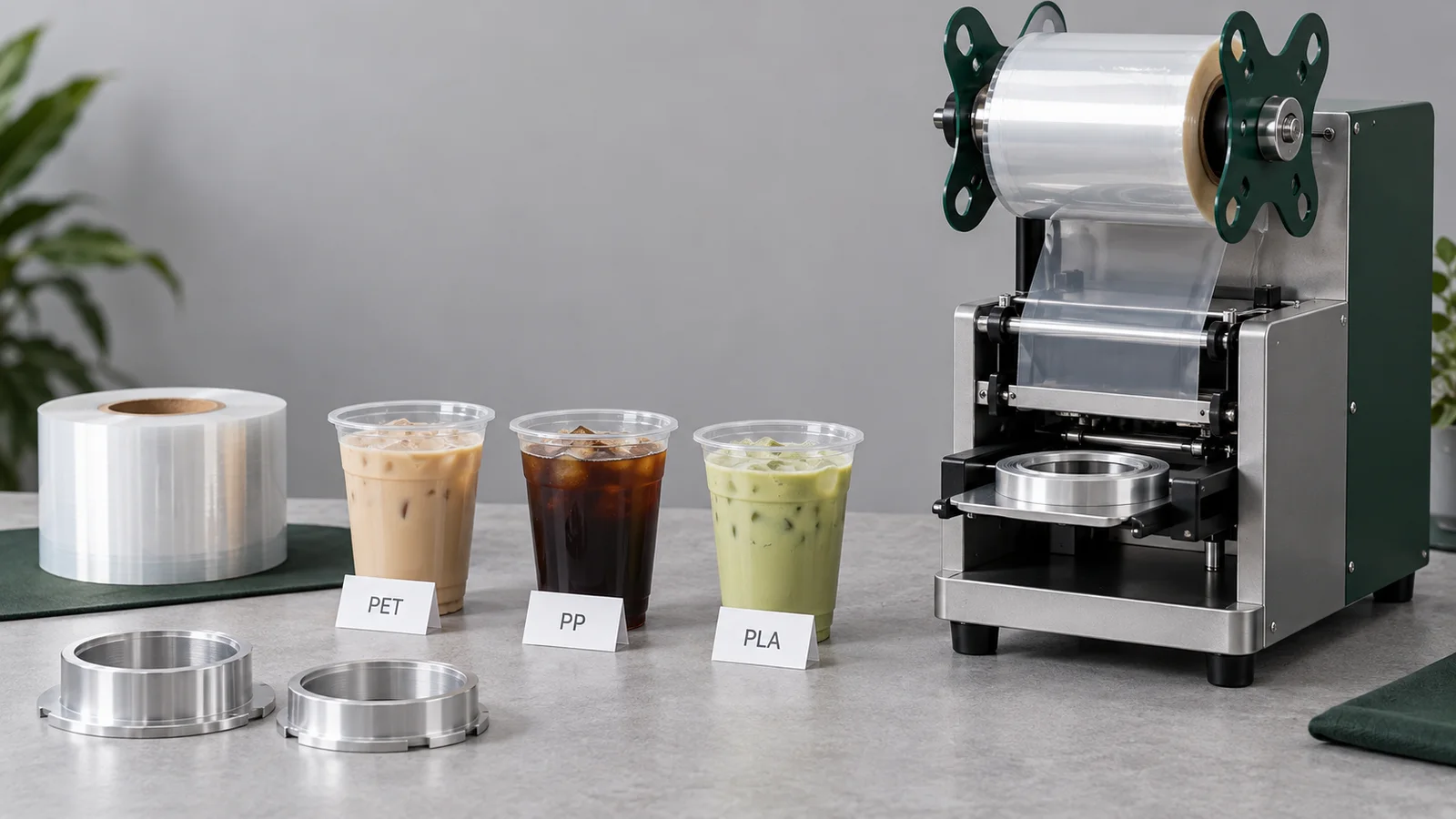
Quick Summary
- PET, PP and PLA cups can work in suitable sealing systems, but material and nominal diameter do not establish compatibility. Approve the exact cup, rim, holder or mold, film and operating setup together, including filled-cup handling and repeat-order records.
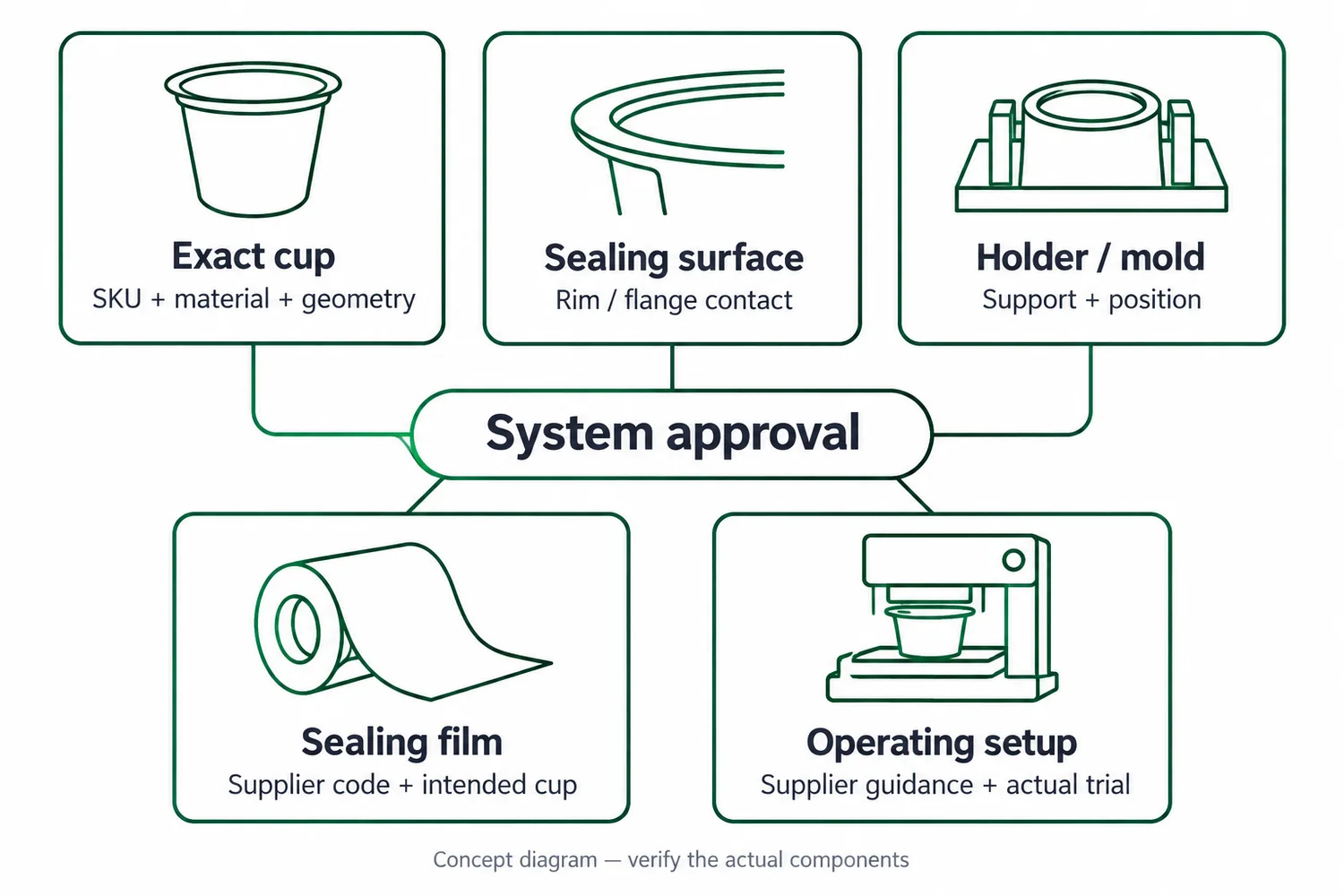
Cup sealing machine compatibility depends on the exact cup, sealing surface, holder or mold, film and operating setup. PET, PP and PLA cups can each work in suitable systems. A material label, a 95 mm or 98 mm diameter, or a cup that fits into the holder is not enough to approve the finished seal.
A replacement cup can look almost identical to the one a shop already uses and still require a different film or support arrangement. The purchasing question is whether the new cup can complete the same sealing and handling cycle reliably. That needs to be answered before the bulk cup order becomes the next store delivery.
What Cups Work With a Cup Sealing Machine?
Start with cups whose supplier can identify the intended sealing surface and provide samples for the proposed equipment. Then confirm that the machine supplier and film supplier support that combination. Treat their recommendations as a starting point for approval on the actual machine.
| Compatibility check | What it controls | What the buyer should obtain |
|---|---|---|
| Cup material and construction | The surface the film must seal to | Exact cup SKU, material identification and any relevant surface specification |
| Rim or flange | The contact area around the cup opening | A drawing and sample showing the actual sealing surface |
| Cup dimensions | Clearance and positioning through the machine cycle | Top diameter, overall height, body profile and dimensions requested by the equipment supplier |
| Holder, mold and tooling | How the cup is supported and presented for sealing | Machine model, installed holder or adapter reference and applicable tooling |
| Sealing film | The cup-to-film interface and machine feed | Supplier film code, intended cup application and roll specification |
| Operating setup | How the selected components form a seal | A supplier-supported setup and a recorded trial on the intended machine |
If the equipment is already installed, collect its model and tooling details first. If the store is still choosing its packaging, settle the required drink format and closure function through the cold drink shop cup-system guide before choosing a sealer around one convenient cup sample.
Why Cup Material Alone Does Not Prove Compatibility
“PET cup” identifies a material family. It does not describe the complete rim profile, the cup's support in the holder or the film selected for the job. Those details explain why a material-compatible film and a physically compatible machine still have to be checked together.
A Snap-Lid Fit Does Not Approve a Sealing Surface
A snap lid engages the cup rim mechanically. Film sealing requires a suitable contact surface and a working cup-to-film bond. A cup sold with matching flat or dome lids should therefore remain an unapproved sealing candidate until its supplier confirms the intended use and samples pass the trial. The plastic cup lids guide explains the different closure functions.
Check Support as Well as Contact
Ask the equipment supplier where the selected cup should sit and how it should be supported. A cup resting in the loading opening does not prove that it will remain correctly positioned during sealing, film cutting and release. Use the specified holder or adapter; do not force a cup into place to make a diameter label appear to match.
PET Cups and Cup Sealing Machines: What Buyers Should Verify
PET cups can be heat sealed in suitable systems, but the question for a purchase order is whether the selected cup has been approved with the specified film and equipment. Ask for the cup code, drawing and physical samples before accepting a general statement such as “works with PET.”
The 16 oz PET cup range, for example, includes different rim options. Choose the exact variant before requesting a holder-fit review. The range name and product photographs are useful for shortlisting; they are not evidence of heat-sealing approval.
When replacing a PP cup with PET, keep the current machine model, holder reference and film code available for comparison. Ask the suppliers which components can remain and which must change. A familiar cup height or an unchanged drink portion does not establish that the old film will bond to the new cup.
How to read the product links in this guide: they identify cup ranges for specification review. They do not certify those cups for a particular sealing machine or film.
PP Cups: Keep the Existing Film and Tooling Records
An established PP setup provides a useful comparison when a buyer is changing cups. Retain the old cup reference, film supplier code and machine setup instead of discarding them as soon as a replacement is proposed. They help identify what has actually changed.
Film selection is more specific than matching material names. Phoenixes' published compatibility table lists several film options for PP cups and a different selection for its PET/PLA category.[1] That supplier-specific table is a reason to request a defined pairing, rather than to buy a roll solely because its description contains “PP” or “PET.”
If a different PP cup is being considered, review its rim and support geometry too. Keeping the same polymer does not make the new cup a duplicate of the approved item.
PLA Cups Need Their Own Sealing Approval
PLA should enter the trial as a separately identified cup specification. Ask the cup and film suppliers to confirm the proposed sealing application, then ask the machine supplier to review the holder and operating setup. A recommendation for another clear cup is not a complete answer.
For example, the 16 oz PLA cup range contains several rim and body formats. Its listed 90 mm regular cup is 135 mm high. That is a dimensional starting point for an equipment review, not a heat-sealing specification.
During the trial, examine both the bond and the cup's shape after sealing and release. Record any rim distortion, film lifting or difficulty removing the cup. A closed-looking top is not enough if the cup has changed shape or cannot complete the store's handling routine.
Do not copy a PET or PP temperature setting into the PLA approval record without supplier guidance. Also keep the sealing operation separate from beverage-use approval: a brief sealing step does not establish that a cold-drink cup is suitable for hot filling.
Does a 95 mm or 98 mm Cup Fit Every Cup Sealer?
No. Nominal diameter narrows the shortlist; it does not approve the machine fit. The rim profile, support location, cup height, body clearance and applicable tooling also need to match. Ask what the machine's stated diameter describes and which holder or adapter is included.
The same issue is visible in other rim families. The 90 mm version in the 20 oz PLA cup range is listed at 158 mm high, compared with 135 mm for the 90 mm regular 16 oz version noted above. Equal top diameters leave a different cup height to accommodate. The equipment supplier must assess that difference; the dimensions alone do not show whether either cup can be sealed.
Request the cup drawing and the equipment supplier's required clearance dimensions. Confirm seating, movement, sealing contact and removal with physical samples. Where a tolerance is needed, obtain it from the applicable cup and tooling specifications instead of applying a universal millimeter allowance. The plastic cup dimensions guide distinguishes capacity, top diameter, bottom diameter, height and rim geometry.
How to Match the Cup With the Sealing Film
Identify the Film Code and the Surface It Seals To
Ask the film supplier: “Which cup material and sealing surface is this exact film designed to seal?” Record the supplier's product code and technical specification. A broad term such as universal film or PET film leaves too much unresolved.
For a coated or multilayer film, ask which side faces the cup and which seal layer or coating performs the bond. The outer film description alone may not identify that interface. Request a sample from the specified film grade, rather than accepting an unlabelled roll for the approval trial.
Check the Roll Against the Machine Feed
Give the film supplier the machine model and its roll requirements: film width, core specification, permitted roll size, winding direction and any registration-mark requirements. Ask the equipment supplier how plain or printed film is detected and advanced on that model. Cup-to-film compatibility does not resolve a feeding or indexing mismatch.
Phoenixes also identifies film installation direction and the film sensor as operating checks.[1] Follow the intended machine's loading instructions rather than borrowing a threading path from a similar-looking sealer.
Agree the Opening Behavior and Proposed Process
Tell the film supplier whether the customer will peel the film, puncture it with a straw or use another specified opening method. Include the actual straw in the trial when relevant. A seal that survives transport may still be unsuitable if the intended customer cannot open it as required.
Obtain the proposed temperature and sealing-time guidance for the selected film, cup and machine. Confirm pressure requirements where the equipment provides a relevant adjustment. Treat these as starting conditions for validation on that system, not settings to transfer automatically to a different cup or film.
How to Test a Cup Before Ordering It for a Sealing Machine
Use this six-step approval sequence before releasing a bulk cup order. It is a purchasing workflow, not a substitute for the machine manual. Agree the sample quantity, acceptance criteria and handling conditions with the suppliers before testing.
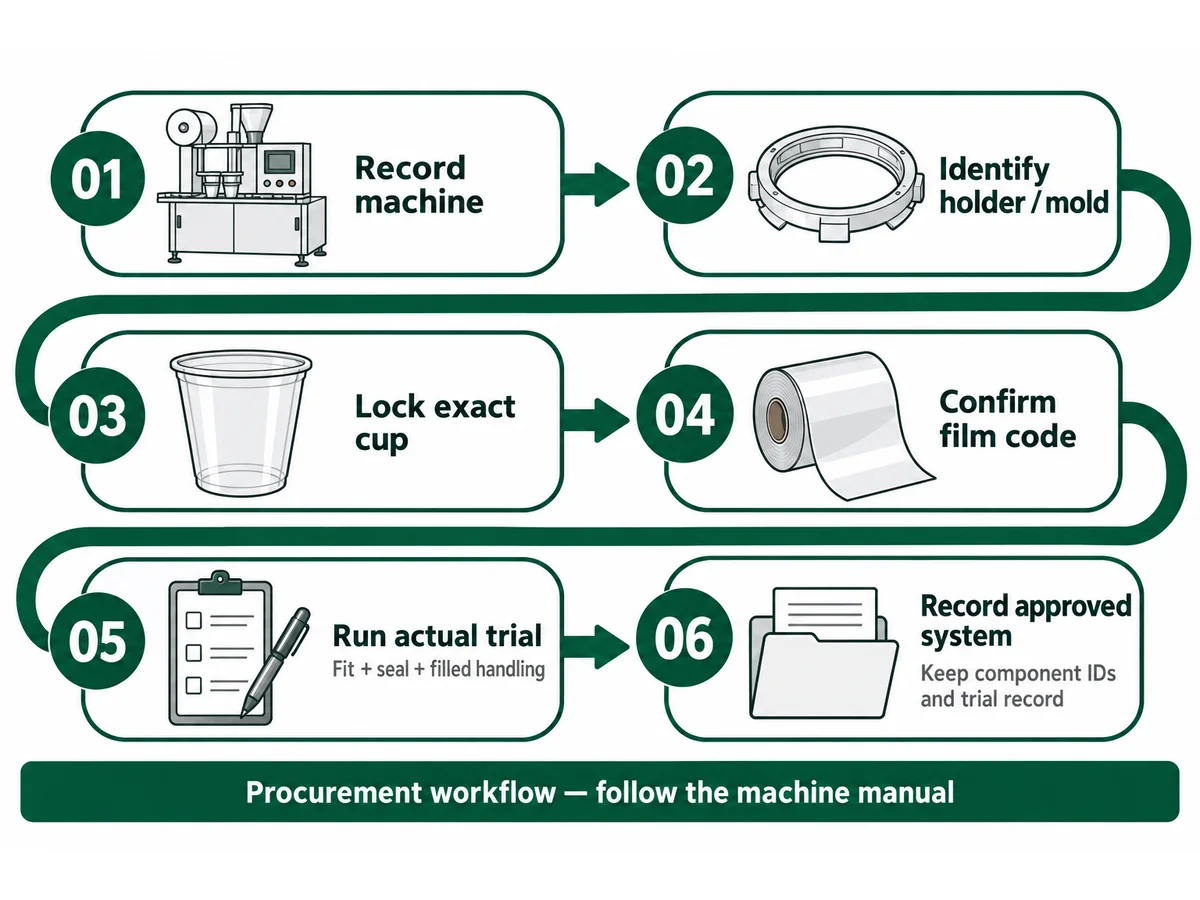
- Record the machine. Note the manufacturer, model and applicable manual. For an existing installation, photograph the model plate and record the current setup. A quotation for “a 95 mm cup sealer” is too broad to identify the machine used for approval.
- Identify the holder, mold and tooling. Record the installed parts and any specified adapter. Ask the equipment supplier to confirm how the candidate cup should be supported. Complete the physical fit review using the machine manufacturer's setup procedure.
- Lock the candidate cup. Identify the exact SKU, material, drawing revision and sample batch. Confirm that the sample represents the cup proposed for supply. Review the rim and body before testing so that an already damaged sample is not mistaken for a sealing-process failure.
- Confirm the film. Record the supplier, film code, roll specification and batch where available. Obtain the proposed application and settings guidance. If the trial uses a substitute film, keep the result separate from approval of the intended production film.
- Run the actual sealing and handling trial. Check cup positioning, film feed, the full seal perimeter, cutting and release. Repeat the cycle across the agreed sample set and review cups after the seal has cooled. Then use the intended beverage, fill level and ice arrangement where relevant, keeping the sealing area clean. Evaluate the agreed carrying, holding and opening conditions; record failures as well as successful samples.
- Record the approved combination. Keep the machine, tooling, cup and film identities with the accepted settings, trial conditions, results and approval date. Link retained samples and photographs to that record. A supplier change or an “equivalent” substitute should trigger review of the affected combination before use.
Distinguish three outcomes in the record: the cup fits, the film seals and the filled package meets the agreed handling requirement. Recording them separately prevents an empty-cup fit check from being treated as delivery approval.
When extending a program to the 24 oz PET cup range, repeat the relevant checks for the selected variant. A larger cup introduces another body profile and filled package to evaluate, even when its nominal rim family matches the smaller cup.
The plastic cup sample approval guide explains how to retain and identify physical references. For a sealing project, extend that record to the film and equipment setup; a retained cup by itself cannot preserve those details.
Why Sealing Can Fail Even When the Diameter Looks Correct
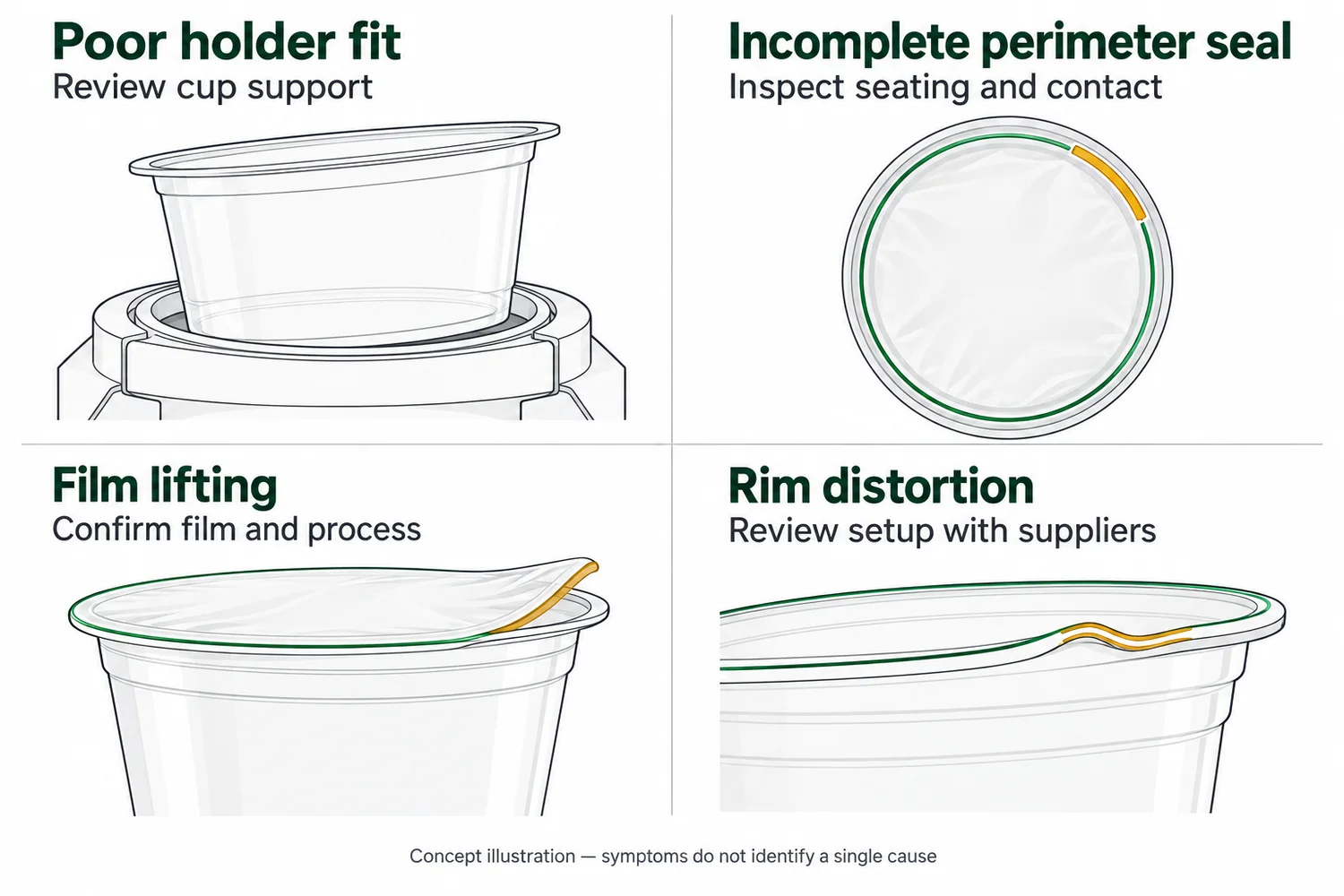
Use the symptom to decide what to inspect next. The possibilities below are diagnostic starting points, not proof of a single cause. Keep component identities and trial settings unchanged while investigating a suspected variable wherever practicable.
| Observed problem | Possible system issue | Next buyer check |
|---|---|---|
| Cup will not seat or release correctly | Holder, support position or body clearance does not suit the cup | Compare the exact cup with the installed tooling and ask the equipment supplier to review fit |
| Film does not bond consistently | Unapproved film pairing, incorrect film orientation, surface contamination or unsuitable process conditions | Confirm the film code and loading direction, inspect the rim and review the recommended setup |
| Only part of the rim seals | Uneven contact, cup positioning, a damaged rim or a tooling problem | Record the unsealed location and have the equipment supplier review support and contact |
| Rim or film changes shape during sealing | The process or support arrangement may not suit the selected combination | Set aside the affected cups and review the setup with the cup, film and machine suppliers |
| A same-size replacement cup fails | Material, rim, height or body profile differs from the approved reference | Compare both cup specifications and rerun the affected approval checks |
More heat is not a general repair. Phoenixes cautions that excessive temperature can damage the film and cup.[1] Resolve a suspected material, seating or film-loading mismatch before making adjustments within the equipment and film suppliers' instructions.
What to Send With a Sealing-Cup Enquiry
Give the cup supplier enough information to discuss a testable combination. Send the following together, rather than asking only for “cups for a sealing machine.”
- Machine manufacturer and model, with the relevant manual or specification.
- Installed holder, mold or adapter reference and clear photographs.
- Current cup code or proposed SKU, material, drawing and physical sample availability.
- Rim or flange details, overall height and any equipment clearance requirements.
- Film supplier, exact product code and roll specification.
- Intended beverage, fill arrangement, handling and customer opening method.
- Agreed trial requirements and any previous failure photographs or records.
- The component that is fixed: existing machine, specified cup or another purchasing constraint.
Bioleader Cups Technical Summary
For an installed machine, begin with its tooling and operating limits, then shortlist exact cups and a suitable film for trial. If a particular cup is fixed by the brand, ask the equipment and film suppliers to work from that cup's drawing and samples instead.
The approval record should identify what the buyer can reorder without silently changing the tested system. Keep nominal capacity and rim diameter as search aids, then use component codes, physical samples and recorded trial results to complete the purchasing decision. Send the machine and film details with the cup enquiry so that the specification review starts with the actual equipment constraint.
Frequently Asked Questions
Can PET cups be used with a cup sealing machine?
Yes, when the exact PET cup is suitable for the intended sealing system. Confirm its sealing surface, holder or mold fit and specified film, then approve the result through an actual sealing and filled-cup handling trial. Matching snap-on lids do not establish heat-sealing compatibility.
Can the same cup sealing machine seal PET, PP and PLA cups?
Some equipment can serve more than one cup material, but the manufacturer must confirm the applicable tooling, film and operating conditions. Approve each exact combination separately. A machine's adjustable temperature range alone does not demonstrate compatibility with all three materials.
Does a 95 mm or 98 mm cup fit every sealing machine with the same diameter?
No. The nominal diameter is a screening specification. Rim profile, cup height, body clearance, support position and tooling can still differ. Compare the actual cup drawing with the machine requirements and verify physical fit before the sealing trial.
What sealing film should I use for PET, PP or PLA cups?
Request a film identified by supplier code and intended sealing application for the exact cup. Confirm the seal-facing side, roll requirements, machine feed and required opening behavior. Material names and labels such as universal film are not substitutes for supplier confirmation and a cup-to-film trial.
What information should I send a cup supplier if my cups must work with a sealing machine?
Send the machine make and model, holder or mold reference, proposed cup SKU and dimensions, film specification, intended beverage and handling requirements. Include current samples or failure records when available, and identify the component that must remain unchanged so the suppliers can plan a relevant trial.
References
- Phoenixes Multi Solutions — How to Choose a Beverage Cup Sealing Machine: Pairing Machines With Sealing Films. Equipment manufacturer's guidance on cup-and-film combinations, film installation and operating checks. Its recommendations describe the supplier's systems and do not establish compatibility for every cup or film sold under the same material name.