
Quick Summary
- Food-grade PLA is not one universal resin grade or one automatic finished-cup approval. For clear thermoformed cups, buyers should separate resin selection, melt-flow behavior, moisture control, sheet extrusion, thermoforming and finished-article food-contact compliance. The manufacturer controls upstream processing; the buyer approves the finished cup, documentation and intended use.
“Food-grade PLA” sounds like a simple material label, but for a clear cup buyer it is only the beginning of the specification. A PLA resin can be intended for food-contact packaging and still require the correct grade, moisture control, sheet extrusion, thermoforming and finished-article verification before it becomes a commercially acceptable cup.
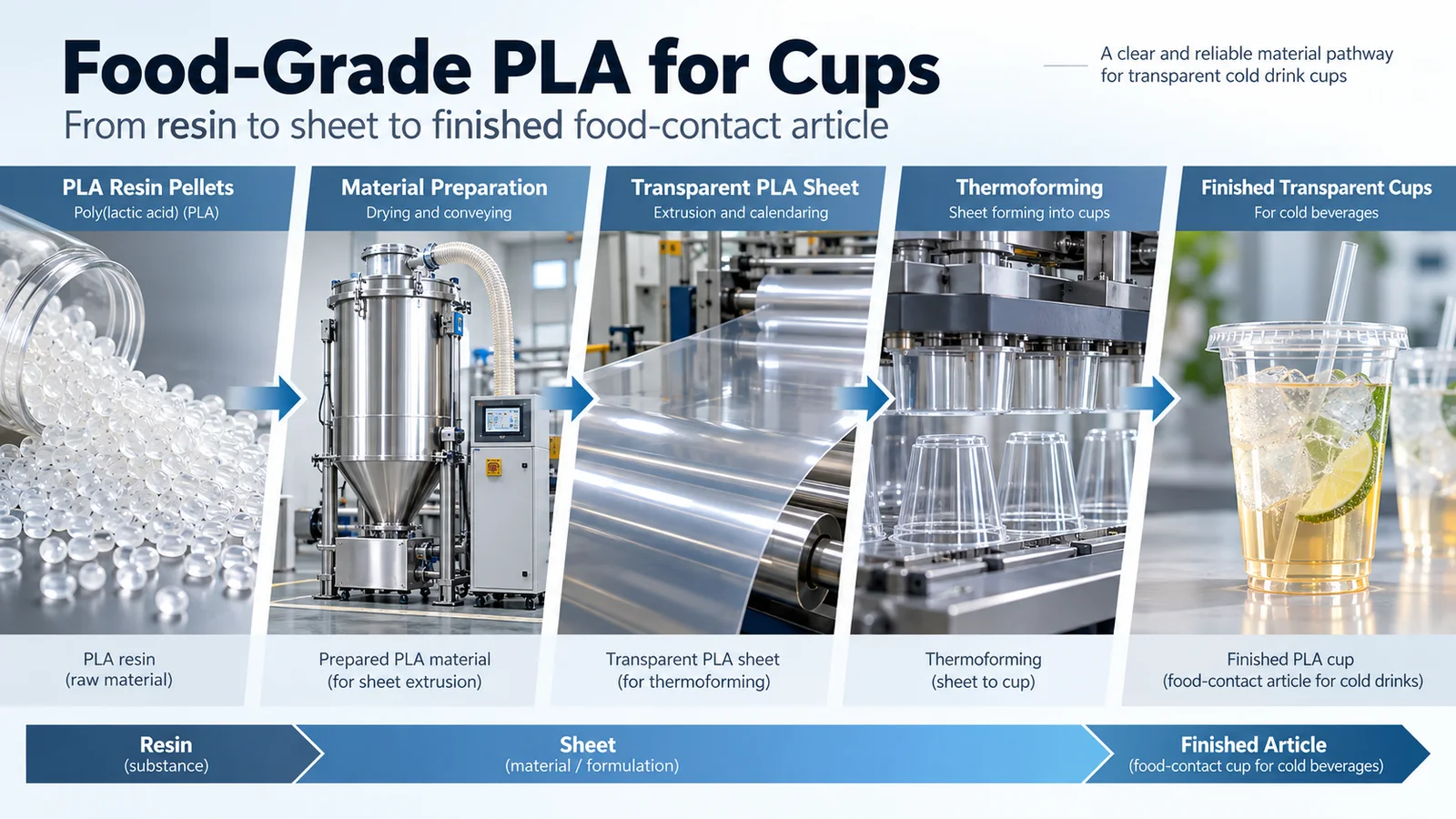
The useful manufacturing chain is:
- PLA resin: select a grade intended for the relevant converting process.
- Material preparation: control storage and moisture before melt processing.
- Sheet extrusion: convert resin into clear, stable sheet suitable for thermoforming.
- Thermoforming: form the sheet into the required cup geometry.
- Finished-cup QC: verify clarity, weight, dimensions, rim geometry and lid fit.
- Compliance review: confirm the finished article and intended food-contact conditions for the destination market.
This guide focuses on that chain. It does not treat PLA as a single universal resin and it does not treat a raw-material certificate as a substitute for finished-product approval.
What Does “Food-Grade PLA” Actually Mean?
In commercial packaging, “food-grade PLA” is commonly used to describe a PLA resin or formulation intended for food-contact applications under defined conditions. The phrase is useful, but it can become misleading when it is treated as a universal approval.
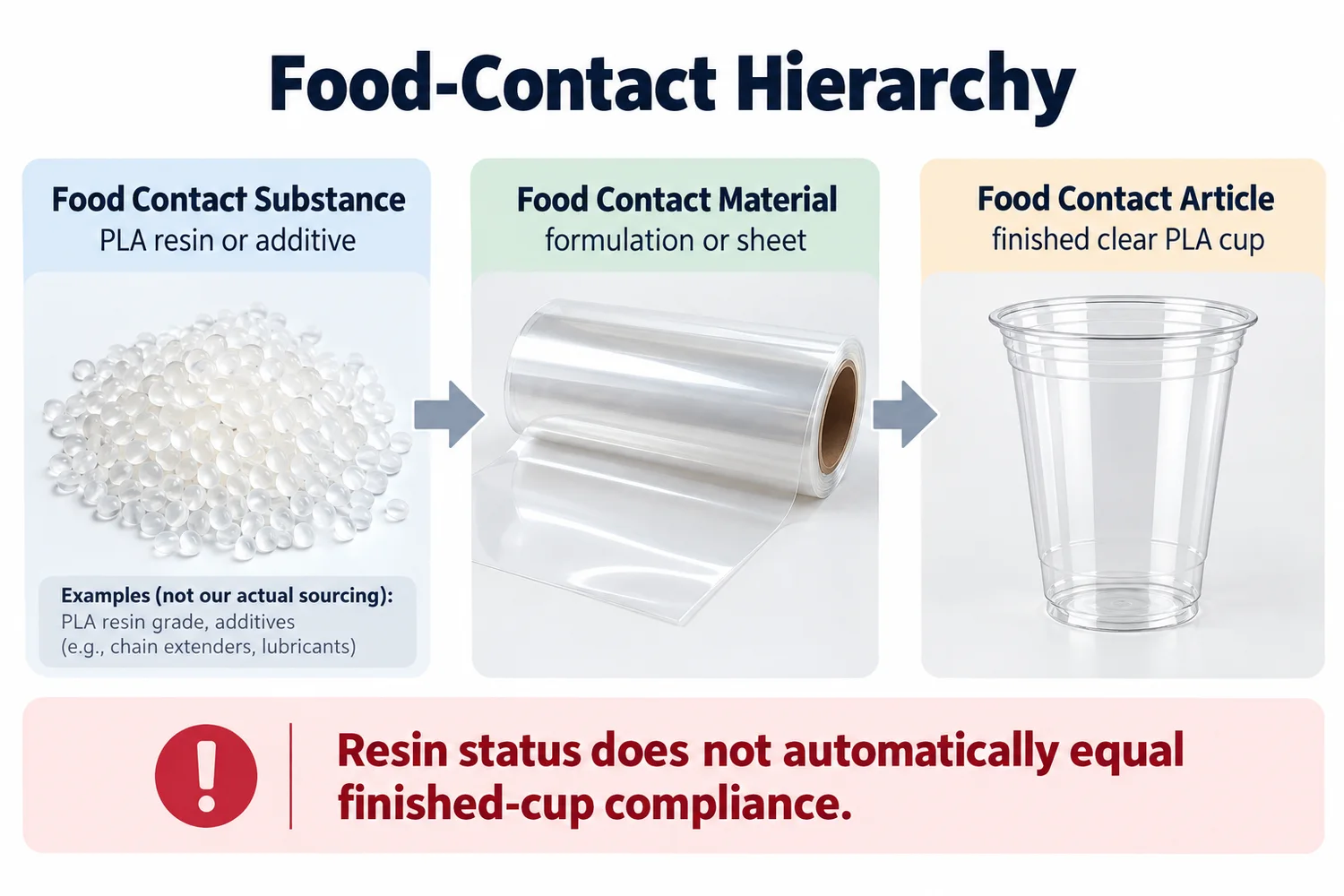
Food-contact regulation normally looks at more than the polymer name. The U.S. FDA distinguishes between a Food Contact Substance, a Food Contact Material and the finished Food Contact Article. A polymer or additive can exist at the substance level, while the cup the buyer receives is the finished article.
Food-contact PLA resin → upstream material status.
Finished PLA cup → the article that actually contacts the beverage or food.
The second cannot be assumed from the first without checking formulation, processing, intended use and applicable documentation.
That distinction is especially important for custom printed or multi-component packaging. Colorants, additives, printing systems, lids and other components may introduce their own food-contact requirements. A resin document therefore answers only the claims that fall within its actual scope.
Is All PLA Food Grade?
No. PLA is a polymer family used in different converting processes and applications. Commercial grades can be designed for extrusion, thermoforming, injection molding, film, fiber and other uses. The fact that two pellets are both PLA does not make them interchangeable.
For a cup manufacturer, three questions should be separated:
| Question | Why It Matters |
|---|---|
| Is the resin/formulation suitable for the converting process? | A thermoforming sheet program needs different processing behavior from a high-flow injection-molding program. |
| Is the material intended for the relevant food-contact use? | Food-contact status depends on the applicable substance/formulation and intended conditions of use. |
| Does the finished cup meet the required market and product specification? | The finished article still needs its own appearance, dimensions, lid-fit and compliance review. |
A buyer should therefore ask more than “Is this PLA food grade?” A better question is: Which material system is used, what documentation covers it, and does that documentation apply to this finished cup and intended destination market?
Why PLA Resin Grades Matter
PLA grades are engineered around different manufacturing requirements. Molecular weight, melt-flow behavior, crystallization tendency, additives and morphology can affect how the material runs through extrusion or molding equipment and how the finished part behaves.
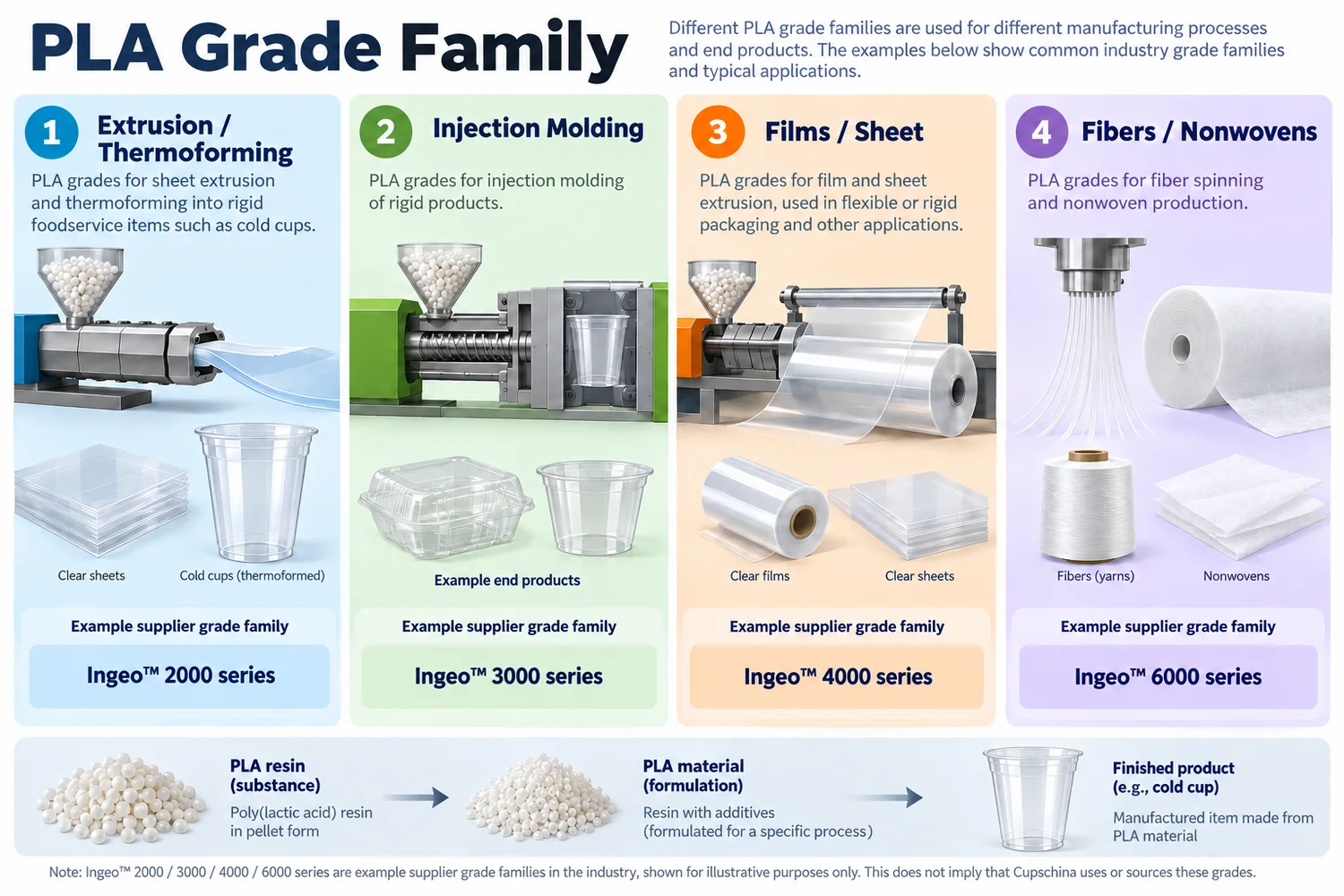
NatureWorks, for example, separates its Ingeo product families by processing route. Its 2000 series is positioned for extrusion and thermoforming, while other series are designed for injection molding, films, sheet, fibers and specialized applications. This is useful as a technical example of a broader rule: “PLA” is not a complete resin specification.
Which PLA Grades Are Used for Extrusion and Thermoforming?
For transparent thermoformed food packaging, the most relevant resin examples are grades designed to produce sheet that can later be formed into rigid packaging.
NatureWorks identifies Ingeo 2003D as a general-purpose transparent extrusion grade and recommends it in its sheet-extrusion guide for sheet production intended for thermoforming applications. The product data sheet also lists potential applications such as food serviceware, transparent food containers and cold-drink cups.
That is a useful industry example, not a universal Cupschina material declaration. It does not mean that every PLA cup manufacturer uses 2003D or that every Cupschina PLA SKU uses that grade.
| Example Grade Family | Supplier Positioning | What a Cup Buyer Should Learn From It |
|---|---|---|
| Ingeo 2000 series | Extrusion / thermoforming | A cup-grade program should start with resin intended for the relevant sheet and forming process. |
| Ingeo 3000 series | Injection molding | An injection grade should not be assumed to be interchangeable with a sheet-thermoforming grade. |
| Ingeo 4000 series | Films & sheet applications | Film/sheet grades can have different morphology and processing targets; they should not be generalized as one “cup resin.” |
| Ingeo 6000 series | Fibers / nonwovens | Same polymer family, different converting requirements. |
The key sourcing lesson is not to memorize grade numbers. It is to understand that resin selection should follow the actual converting route and finished application.
What Does MFI or Melt Flow Rate Mean for PLA?
Melt flow describes how readily a molten polymer flows under a defined test condition. In everyday industry conversation, buyers and suppliers often say MFI (Melt Flow Index). Technical data sheets commonly report MFR (Melt Flow Rate), expressed under a specified test temperature and load.
The test condition matters. A melt-flow number without the test temperature and load is incomplete, and values measured under different conditions should not be treated as directly comparable.
Melt flow can influence how a resin behaves during extrusion, how much melt strength is available for sheet production and how the material responds in downstream forming. But a higher or lower number is not automatically “better.” The required behavior depends on the converting process.
NatureWorks' 2003D technical data sheet, for example, reports its MFR together with the specified test condition. That is the correct way to interpret a melt-flow value: as one controlled material property within a larger resin data set.
Why Moisture Control Matters for PLA Resin
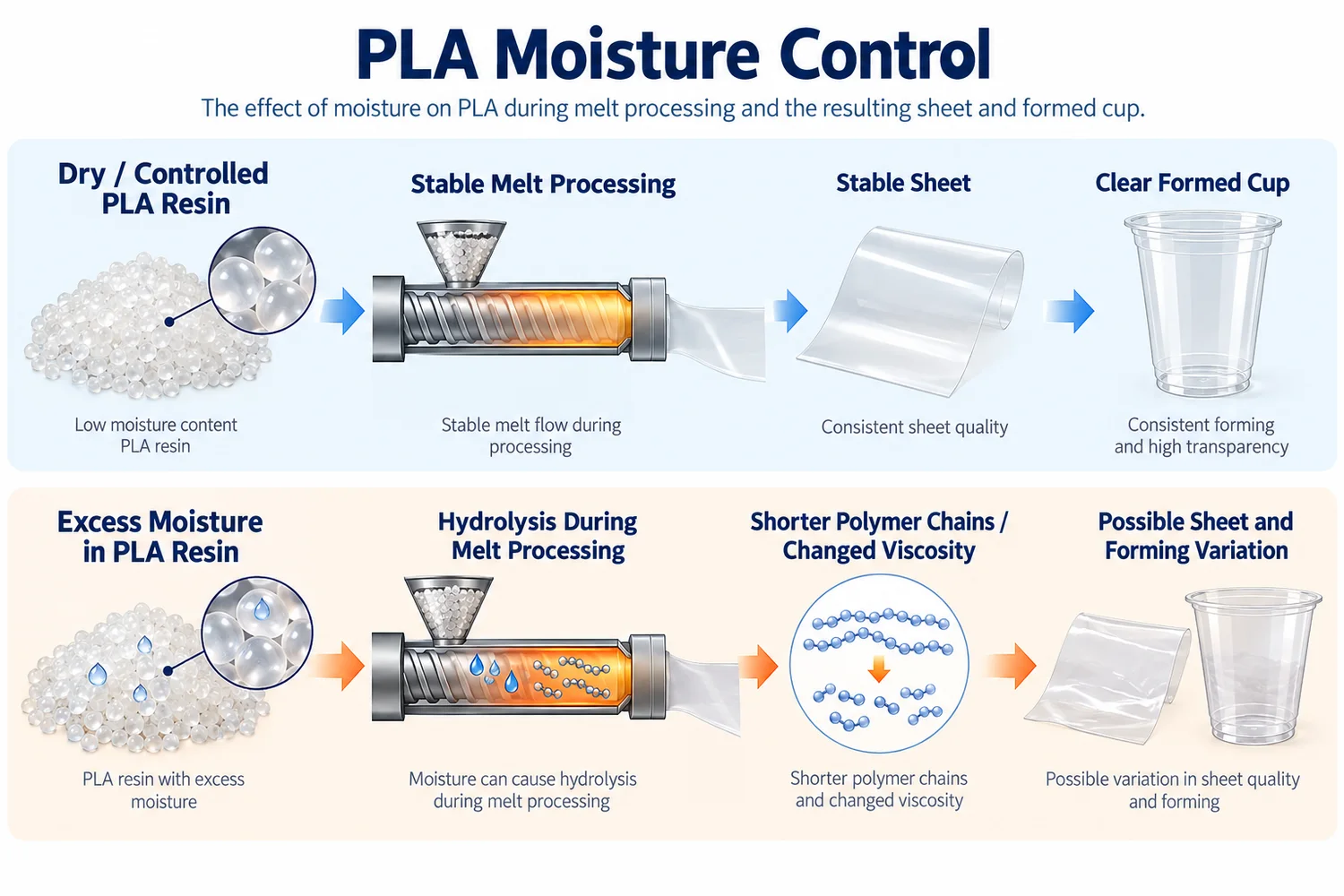
PLA requires moisture control before melt processing. Resin can pick up moisture during storage and handling, and excessive moisture can contribute to hydrolytic degradation when the material enters a hot extrusion process.
Hydrolysis can shorten polymer chains, reducing molecular weight and changing viscosity and processing behavior. The cup buyer does not see this chemistry directly; the buyer sees whether sheet extrusion and thermoforming remain stable enough to reproduce the approved finished cup.
Moisture uptake → melt processing → possible hydrolytic chain degradation → lower molecular weight / changed viscosity → less stable sheet or forming behavior → possible finished-part variation.
This is why resin storage, sealed packaging and controlled material preparation matter. NatureWorks' sheet-extrusion guidance specifically emphasizes minimizing moisture uptake before processing.
Does PLA Resin Need to Be Dried Before Extrusion?
For sheet extrusion, moisture should be controlled according to the selected resin supplier's technical guidance and the actual processing system. The correct drying procedure is grade-specific; it should not be reduced to one universal temperature-and-time formula for all PLA.
This distinction is important because online processing guides often publish exact temperatures, residence times or moisture targets. Those figures can be useful for the grade they describe, but a cup buyer should not automatically copy them into a purchase order for every PLA cup.
From PLA Resin to a Clear Thermoformed Cup
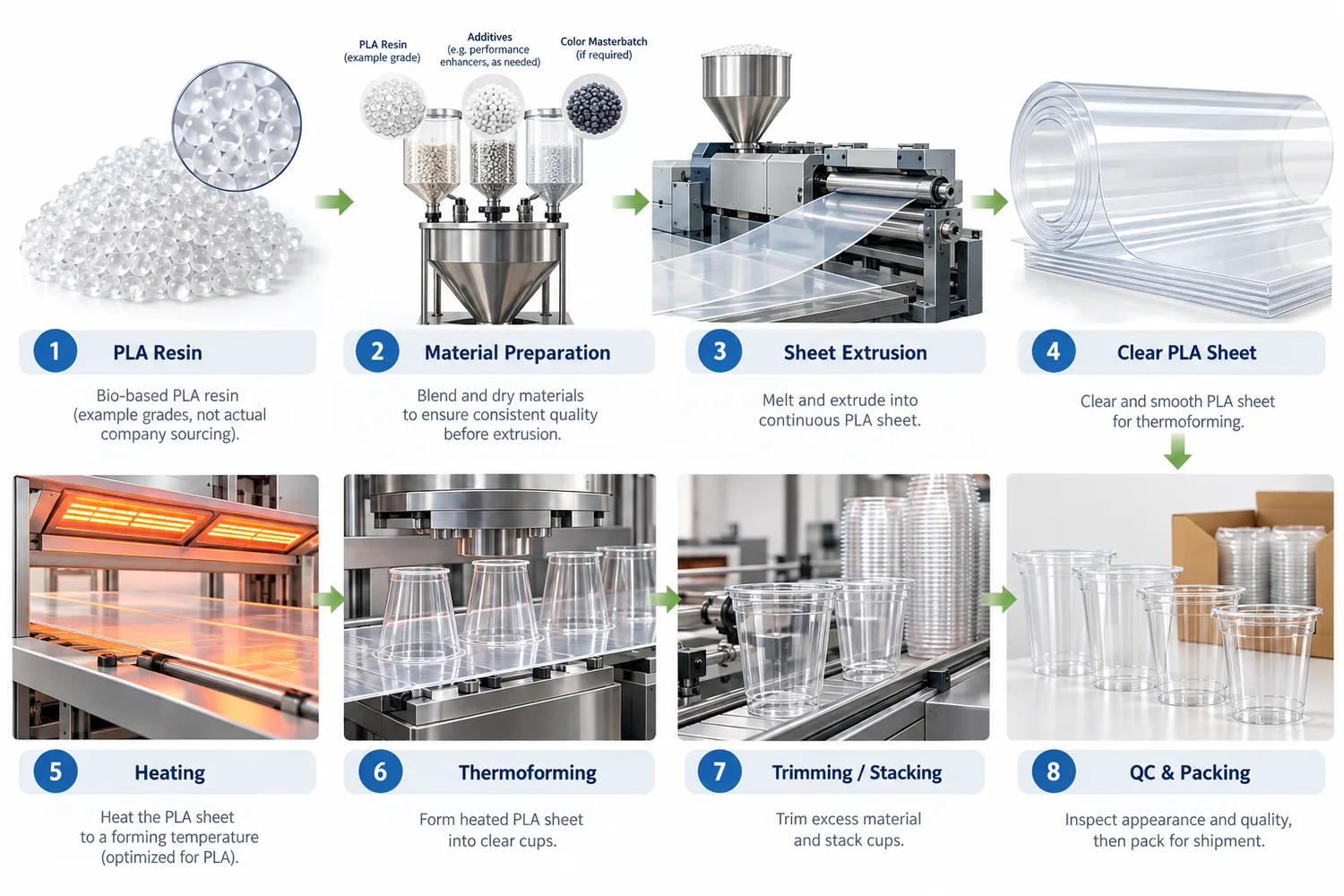
A clear PLA cup is created through a manufacturing chain, not in one molding step. For thermoformed cups, the intermediate sheet is especially important because it transfers the resin properties into the material that will actually be heated and formed into the cup.
- Resin selection: Confirm the material system is suitable for the intended sheet and thermoforming route.
- Material preparation: Control storage, moisture and production handling.
- Sheet extrusion: Produce clear sheet with suitable thickness and surface consistency.
- Sheet heating: Bring the sheet into the forming window without unnecessary thermal damage.
- Thermoforming: Distribute the material into the sidewall, bottom and rim geometry.
- Trimming and stacking: Finish the cup and confirm clean separation and stable handling.
- Inspection and packing: Check appearance, weight, dimensions, rim and packing against the approved specification.
This sequence explains why a resin technical data sheet cannot replace finished-cup QC. A material can meet its resin specification while the finished cup still fails a dimensional, lid-fit or appearance requirement if downstream conversion is not controlled.
How Can PLA Resin Grade Affect Clarity, Rigidity and Forming?
Resin grade influences the processing window available to the converter, but finished-cup performance is always the result of the resin and the process acting together.
| Resin / Process Variable | Possible Effect to Investigate | Buyer-Level Check |
|---|---|---|
| Melt flow / viscosity | Extrusion behavior, melt strength and sheet stability | Does the finished cup remain dimensionally consistent? |
| Molecular weight | Mechanical behavior and processing stability | Does the cup meet the approved handling and rigidity expectation? |
| Moisture | Hydrolytic degradation during melt processing | Are sheet and finished-part quality consistent between lots? |
| Crystallization tendency | Transparency and thermal behavior | Does the cup meet the approved clarity and intended-use condition? |
| Additives / formulation | Processing, appearance and compliance scope | Does the documentation apply to the actual formulation and SKU? |
| Sheet quality | Wall distribution, forming stability and appearance | Are weight and dimensions controlled against the approved sample? |
These are investigation directions, not one-to-one defect causes. A visible finished-cup issue should be traced through the material, sheet and forming records before a root cause is assigned.
Does Food-Grade PLA Resin Make the Finished Cup Food-Contact Compliant?
Not automatically. The food-contact status of a resin or formulation is an upstream requirement. The finished article still needs to be assessed within the applicable regulatory framework and intended conditions of use.
For the United States, FDA terminology distinguishes the substance, the material containing that substance and the finished food-contact article. For the European Union, Commission Regulation (EU) No 10/2011 sets specific rules for plastic materials and articles, including authorised substances, restrictions and migration requirements.
For the buyer-facing document checks, see the food-contact compliance document checklist.
This leads to a practical buyer rule:
Check the exact material/formulation, additives, finished article, intended food-contact conditions and destination-market documentation.
For a custom cup, printing inks or other decorative components may also need to be reviewed within the applicable food-contact system. A supplier should not use one upstream resin statement as evidence for claims that sit outside that document's scope.
Food-Contact Compliance Is Not the Same as Compostability Certification
PLA sourcing often becomes confusing because food contact, biobased content and compostability are discussed in the same sales conversation. They answer different questions.
| Claim | What It Answers | What It Does Not Automatically Prove |
|---|---|---|
| Food-contact compliance | Whether the material/article meets the applicable food-contact rules for defined use conditions | Industrial compostability |
| Biobased content | Origin of carbon/feedstock under the relevant method | Food-contact suitability or compostability |
| Industrial compostability | Performance under the applicable compostability standard and certification scope | Universal biodegradation in nature or food-contact compliance |
| PLA resin identity | Polymer family / material identity | That the finished cup is certified or accepted in every market |
Buyers evaluating compostability documents should use the existing PLA Cup Certifications Explained guide rather than treating food-contact paperwork as a substitute for ASTM D6400, EN 13432, BPI or other applicable compostability evidence.
Does the PLA Resin Grade Determine Heat Resistance?
Resin grade influences thermal behavior, but it does not define the finished cup's complete safe-use or storage limit by itself. The finished article also reflects crystallinity, formulation, sheet history, wall thickness, geometry, forming conditions, exposure time and mechanical load.
This is particularly important for clear PLA cold cups. A high-heat or crystallized PLA formulation used for another application should not be used to justify a heat-resistance claim for a standard transparent cup.
For cup selection, buyers should confirm the exact finished-product use conditions rather than relying on a resin melting point or a generic “heat-resistant PLA” statement.
For storage and transport risks, see why clear PLA cups can soften during storage and shipping.
How Bioleader Cups Controls PLA From Resin to Finished Cup
For a cup manufacturer, the useful control point is not one raw-material number. It is the connection between material preparation, forming and the finished specification. Bioleader Cups treats PLA cup production as a connected chain in which the selected material and process must reproduce the approved cup consistently.
Material Preparation
The selected PLA material program is reviewed for the intended cup application, with material handling and moisture control treated as part of production preparation. The exact resin supplier and grade should be confirmed for the relevant SKU or project rather than assumed from a generic PLA description.
Sheet and Forming Control
Sheet quality and thermoforming are managed as linked steps because clarity, wall distribution, rim geometry and dimensional consistency are created through conversion, not by resin identity alone.
Finished-Cup QC
Buyer-relevant checks focus on the finished article: appearance, weight, dimensions, rim condition, stacking and lid fit against the approved specification.
Documentation Scope
Food-contact, compostability and other claims should be checked against the exact SKU, material system and destination-market requirement. One certificate should not be used to support claims outside its scope.
This is the practical difference between resin knowledge and cup manufacturing knowledge. The resin gives the converter a processing platform; manufacturing control determines whether the finished cup actually matches what the buyer approved.
What Should Buyers Actually Specify?
Most importers, distributors, beverage brands and foodservice buyers do not need to write an Ingeo grade number or an MFR target into every cup purchase order. Unless the project has a validated material-engineering requirement, the commercial specification should focus on the finished product and the evidence that supports it.
- Exact cup SKU / product reference: Avoid approving only “PLA cup” as a generic material description.
- Intended application: Confirm the actual cold beverage or cold-food use.
- Material requirement: Confirm PLA and any project-specific formulation or sourcing requirement that has been agreed.
- Food-contact documentation: Confirm the evidence required for the destination market and intended use.
- Compostability documentation: Review separately when the finished product is being marketed with an industrial-compostability claim.
- Capacity and dimensions: Approve nominal capacity together with top diameter, bottom diameter and height where applicable.
- Cup weight: Use the approved product specification rather than assuming all cups of one capacity use the same material weight.
- Clarity and appearance: Set a visual approval reference for the transparent finished cup.
- Rim and lid fit: Approve the exact cup-and-lid combination physically.
- Approved sample: Retain a reference for bulk-production and repeat-order comparison.
- Storage / transport conditions: Confirm handling requirements for the exact PLA cup program.
For an actual product shortlist, compare the 12 oz PLA cup range and 16 oz PLA cup range, then confirm the exact variant, rim and matching lid rather than treating the resin label as a complete specification.
For product-level selection, see How to Choose PLA Cups for Compostable Cold Drink Programs. For dimensions and lid systems, use the PLA Cup Sizes Guide.
Buyer Checklist for Food-Grade PLA Cups
- Do we know the exact finished cup SKU rather than only the polymer name?
- Is the material system appropriate for the actual sheet / thermoforming route?
- Is food-contact evidence tied to the correct material and intended use?
- Are food-contact and compostability documents being reviewed as separate claims?
- Has the supplier avoided treating one resin grade as a universal PLA grade?
- Are MFI / MFR figures being interpreted with their actual test conditions?
- Is moisture control treated as a manufacturing requirement before melt processing?
- Are clarity, weight and dimensions controlled on the finished cup?
- Has the exact rim and lid combination been physically approved?
- Are any temperature or storage claims tied to the actual finished product rather than a generic resin value?
- Is an approved sample available for bulk and repeat-order comparison?
For bulk-shipment checks, use the Plastic Cup Quality Control Guide. For pre-production approval, use the Plastic Cup Sample Approval Guide.
Final Recommendation
Food-grade PLA should be understood as part of a controlled material-and-manufacturing system, not as a universal label that solves every food-contact and product-quality question.
The manufacturer has to select a resin system appropriate for sheet extrusion and thermoforming, protect that material from uncontrolled moisture, convert it into stable sheet, form the required cup geometry and verify the finished article. The buyer should then approve the variables that matter commercially: exact product, use condition, documentation, clarity, weight, dimensions, rim geometry, lid fit and repeat-order consistency.
When a technical problem occurs, trace it through the chain instead of blaming one number. MFR can affect processing, but it does not prove lid fit. Moisture can contribute to degradation, but a brittle cup does not automatically prove wet resin. A food-contact resin document can support upstream material review, but it does not automatically approve the entire finished packaging system.
To review a bulk-order specification, contact Bioleader Cups with the intended application, destination market, cup reference and sample-approval requirements.
Frequently Asked Questions
What is food-grade PLA?
Food-grade PLA commonly refers to a PLA resin or formulation intended for food-contact packaging under defined conditions. It is not one universal PLA grade, and the finished cup still needs to be reviewed for its formulation, intended use and applicable food-contact requirements.
Is all PLA safe for food contact?
No. PLA is used in multiple grades and applications. Food-contact suitability depends on the exact material/formulation, additives, processing and intended conditions of use. Buyers should request documentation that applies to the actual finished product and destination market.
What does MFI mean in PLA resin?
MFI is commonly used as shorthand for melt-flow behavior. Technical data sheets often report Melt Flow Rate (MFR) under a defined temperature and load. The value helps describe processing behavior, but it should not be judged without its test condition or used alone to decide whether a resin is suitable for a cup.
Why must PLA resin be kept dry before processing?
Excess moisture during melt processing can contribute to hydrolytic degradation, shortening polymer chains and changing viscosity and processing behavior. The exact drying procedure should follow the selected resin grade and manufacturing process rather than one universal setting.
Does food-grade PLA resin mean the finished cup is automatically food-contact compliant?
No. Resin food-contact status is an upstream requirement. The finished cup must still be reviewed for the actual formulation, additives, intended conditions of use and destination-market requirements. Food-contact compliance and compostability certification should also be verified separately.