
Quick Summary
- Disposable clear plastic cups are commonly produced through material preparation, sheet production, thermoforming, trimming, stacking, inspection and packing. Bioleader publicly reports integrated PLA and PET cup production with up to 40 million pieces of monthly capacity. Buyers should still control the exact material and cup specification, dimensions, rim and lid system, appearance, printing when applicable, packing and approved references rather than relying on generic process settings.
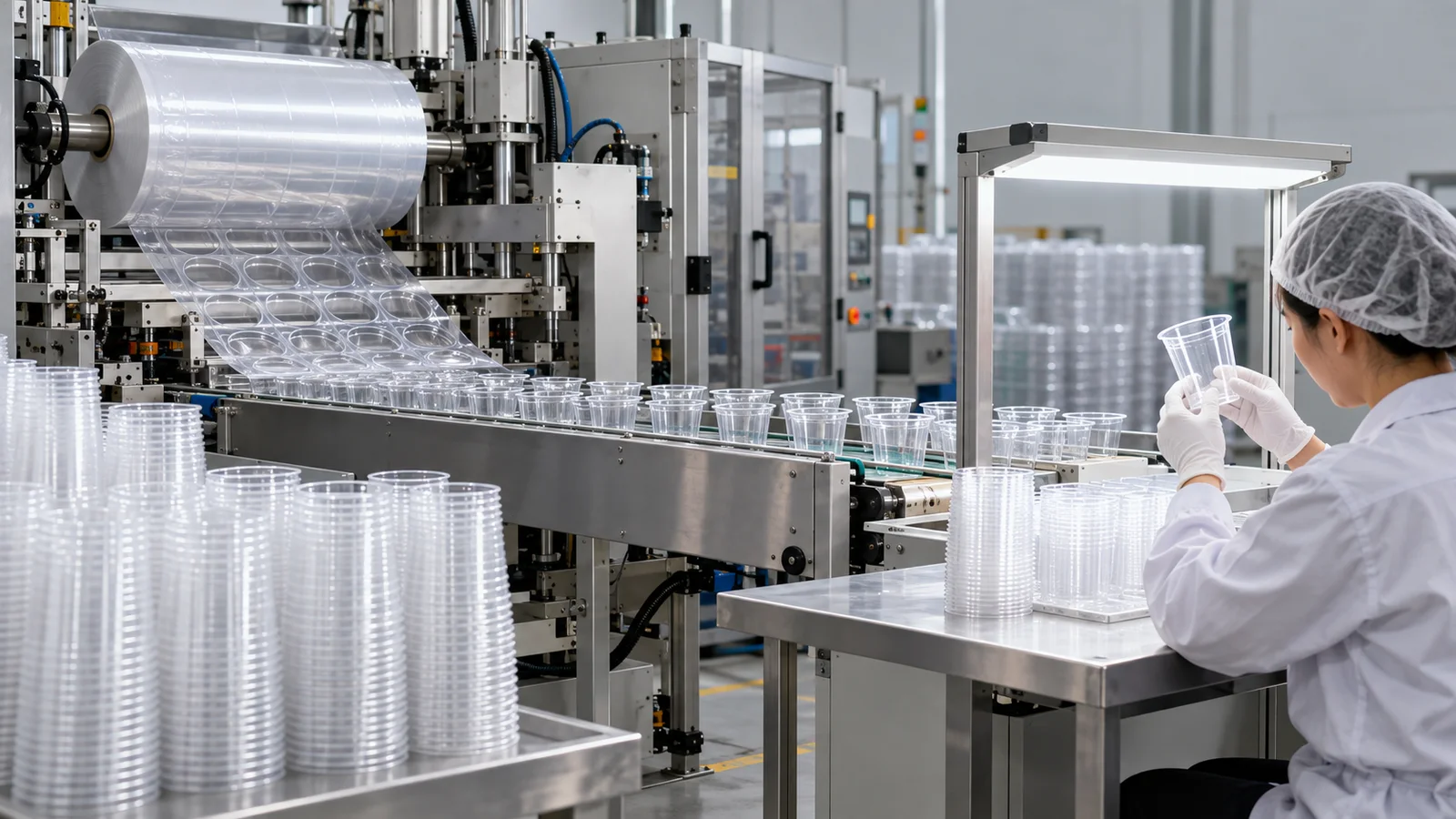
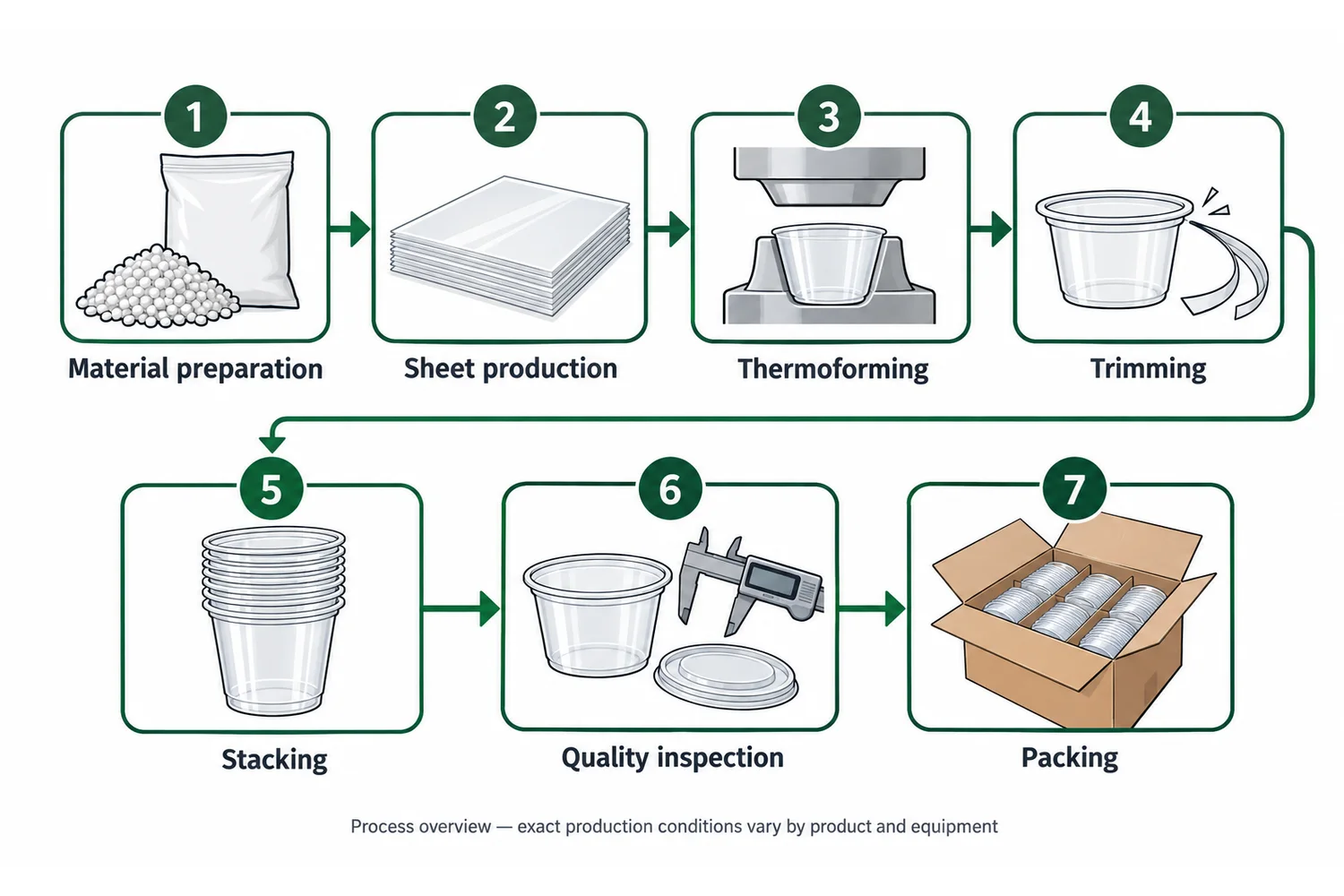
Disposable clear plastic cups are commonly made by preparing the selected plastic material, producing formable sheet, thermoforming that sheet into cup shapes, trimming and separating the cups, stacking them, inspecting the finished product and packing accepted units. The exact route depends on the material, cup design and production equipment, so this article focuses on the thermoformed cup process used for many clear disposable cold-drink formats.
For a wholesale buyer, the important question is not simply how a machine creates a cup. It is which finished-product characteristics the manufacturing process must reproduce from one production run to the next. A cup can carry the same nominal capacity and still differ in dimensions, rim geometry, lid fit, body profile, stacking behavior, appearance or packing configuration.
The manufacturing rule for buyers: approve the product specification that production must reproduce. Material, exact cup format, dimensions, rim and lid pairing, artwork when printed, packing and retained references matter more to procurement than unverified machine settings.
How Are Plastic Cups Made? The Manufacturing Process at a Glance
A thermoformed cup moves through a connected sequence. Each stage changes the material or confirms that the finished result still matches the required product.
| Stage | What happens | Buyer relevance |
|---|---|---|
| Material preparation | The specified plastic feedstock is prepared for the selected production route. | The order should identify the intended material and exact cup specification. |
| Sheet production | Plastic is converted into sheet suitable for subsequent forming. | Sheet consistency is upstream of the geometry and appearance of the formed cup. |
| Thermoforming | The sheet is made formable and shaped against production tooling to create cup cavities. | The forming stage establishes the physical cup geometry that later has to match the approved product. |
| Trimming and separation | Individual cups are cut and separated from the formed sheet. | Finished edges, rim condition and separation quality affect the usable product. |
| Stacking | Cups are nested into controlled stacks for handling and packing. | Stacking and denesting behavior can matter in foodservice handling and dispensing. |
| Inspection | Finished cups are compared with the applicable product and order requirements. | Dimensions, rim, appearance, lid fit, printing and packing may become inspection points depending on the order. |
| Packing | Accepted cups are sleeved, cartoned and identified according to the agreed order configuration. | Packing affects receiving, inventory control, distribution and repeat-order consistency. |
What Bioleader Publicly Reports About Its Cup Manufacturing Scale
Public manufacturing data is useful only when its scope is clear. Bioleader's official manufacturing update states that its PLA and PET cup system includes 3 fully automatic sheet extrusion machines, 5 fully automatic cup production and packaging lines, and 3 semi-automatic cup production lines. The same source states that each of the five fully automatic cup lines can reach a maximum daily output of 300,000 cups, while combined monthly PLA and PET cup capacity can reach up to 40 million pieces.[1]
The published system also lists 2 fully automatic lid production lines, 1 semi-automatic line for special or custom lids, 3 fully automatic packing lines, and 2 fully automatic 8-color printing and packing machines.[1] These figures describe Bioleader's self-published production scale; they should not be read as third-party audited capacity or as a guarantee that every SKU can run at the maximum rate.
| Publicly disclosed item | Bioleader published figure | How a buyer should interpret it |
|---|---|---|
| Automatic sheet extrusion machines | 3 | Shows in-house sheet-production scale supporting the cup-forming workflow. |
| Fully automatic cup production and packaging lines | 5 | Describes the number of publicly reported high-volume cup lines. |
| Maximum output per fully automatic cup line | Up to 300,000 cups per day | A stated maximum line capability, not a promised daily output for every material, size, print job or order. |
| Semi-automatic cup production lines | 3 | Provides additional flexibility for specialized or project-based production. |
| Combined PLA and PET cup capacity | Up to 40 million pieces per month | Useful for supplier-scale assessment; actual order scheduling still depends on SKU, tooling, printing, packing and production allocation. |
What is not publicly specified: the Bioleader sources reviewed for this article do not publish a universal thermoforming temperature, forming pressure, cycle time, or numeric dimensional tolerance for PLA/PET cups. Those values should remain product- and process-specific rather than being inferred from generic plastics-processing references.
Bioleader's public PLA cup product tables do publish nominal SKU data such as cup weight, top diameter, bottom diameter and height.[2] These are useful product specifications, but a nominal value is not the same thing as an allowable manufacturing tolerance. If a buyer needs a tolerance band for a critical interface, it should be confirmed against the applicable drawing, specification or approved QC requirement for that exact SKU.
Step 1: Material Preparation and Sheet Production
The process starts by defining what material and cup program will be produced. A material family such as PET or PLA is important, but it is not a complete purchasing specification. The exact cup still needs its own dimensions, shape, rim system, intended lid and other order details.
Buyers comparing material options can begin with the PET cup range and PLA cup range, then use the PET vs PLA cups buyer guide when the purchasing decision is still at the material-selection stage.
Why Sheet Production Matters to the Finished Cup
In a thermoforming route, the plastic material is converted into sheet before the cup itself is formed. The sheet is therefore part of the manufacturing chain between the material specification and the finished article.
A buyer normally does not need to prescribe internal extrusion settings unless a controlled technical agreement requires them. The more practical task is to define what the finished cup must match. If a supplier changes a process variable but still meets the approved product specification and agreed quality criteria, the buyer's focus remains on conformity of the delivered cup.
Do Not Approve Material by Appearance Alone
Clear cups made from different materials can look similar. Product photographs and transparency are not reliable substitutes for the supplier's material identification and the exact SKU being ordered. Keep material identity in the purchasing record rather than relying on visual recognition after the cups arrive.
Step 2: Thermoforming Creates the Cup Geometry
During thermoforming, plastic sheet is made formable and shaped against production tooling so that cup cavities are created. After the formed sheet stabilizes sufficiently for downstream handling, the cups can move to trimming and separation.
The useful buyer question is not which universal temperature, pressure or forming time should be used. Those conditions depend on the material, sheet, tooling and equipment. The purchasing question is whether the finished geometry matches the approved cup.
Forming Establishes More Than Capacity
Nominal capacity is only one commercial description of a cup. The formed product also has a top or rim geometry, overall height, bottom diameter, body taper and wall profile. Those variables influence what the cup can interface with after manufacturing.
This matters because a cup is rarely used alone. It may need to match a lid, fit a holder, stack inside a sleeve, sit in a carrier or work within a customer's operating setup. Two cups carrying the same ounce description should therefore not be treated as interchangeable without specification review.
The Rim Is a Functional Interface
For cups supplied with snap lids, the rim becomes one of the most important functional interfaces. A nominal rim diameter can narrow the lid shortlist, but it does not prove that every lid carrying the same diameter description will fit every cup.
The cup and lid compatibility guide explains the buyer logic in more detail: identify the exact cup, identify the intended lid and approve the physical combination rather than approving only the nominal diameter.
Step 3: Trimming, Separation and Stacking
After forming, individual cups need to be separated from the surrounding sheet. Trimming creates the individual finished articles, while stacking organizes those cups for subsequent inspection, handling and packing.
Trimming Is Part of Finished-Cup Quality
A formed cavity is not automatically a finished cup. The separated article needs a usable edge and an intact rim. If a cup is distorted or damaged during trimming or downstream handling, the forming stage may have been correct while the finished item is still unsuitable.
This is one reason inspection should be tied to the finished product rather than only to the upstream process. The buyer receives trimmed, stacked and packed cups, so acceptance criteria should focus on the delivered configuration.
Stacking and Denesting Affect Real Foodservice Use
Disposable cups are normally distributed in stacks. The cup therefore needs to be considered not only as a single object but also as a repeated nested unit. Excessively tight nesting, irregular stacks or damage introduced during handling can create problems later at a café, beverage line, distributor warehouse or packing station.
Where denesting or dispensing behavior is critical, include that use condition in sample approval. Do not assume that a visually acceptable stack automatically proves suitability for a particular dispenser or automated device.
Step 4: Critical Quality Points After Forming
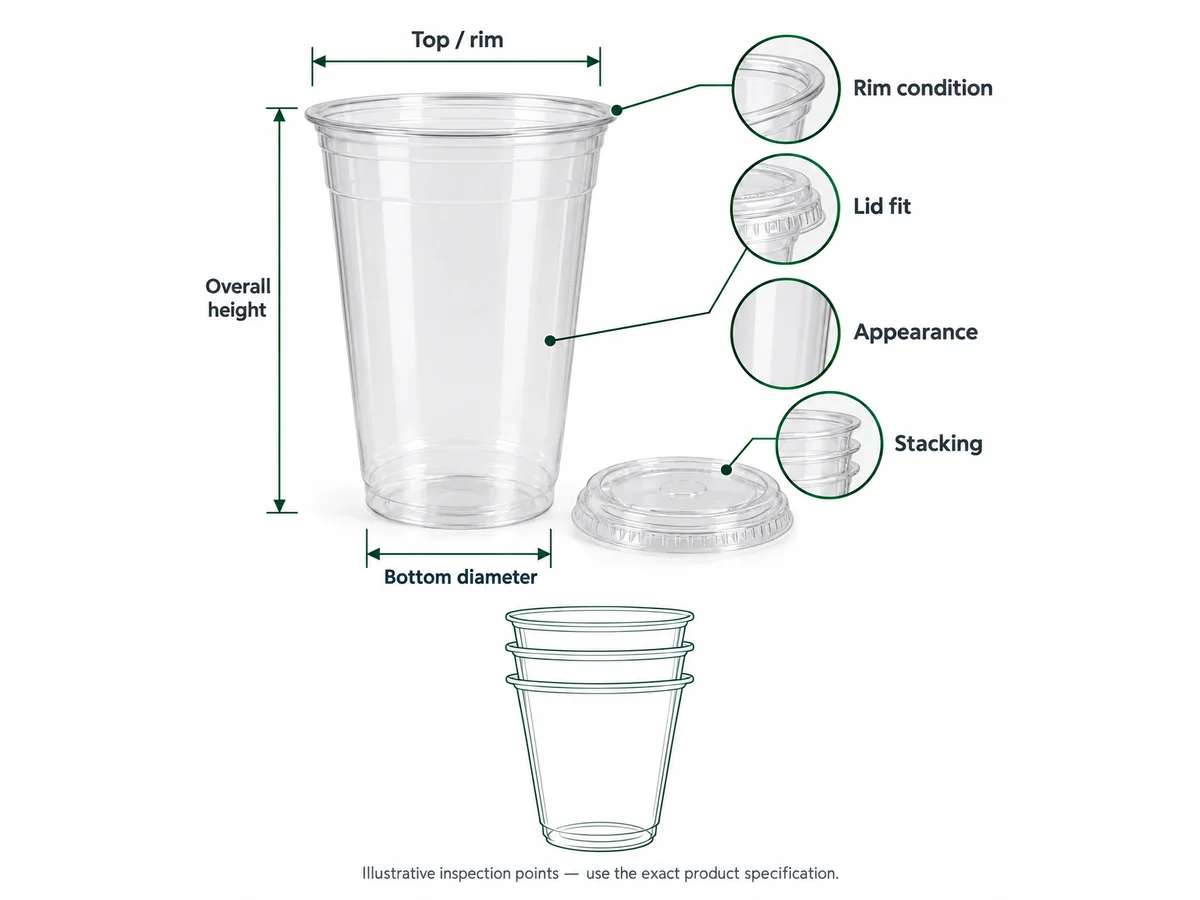
The most useful manufacturing article for a buyer connects production stages with measurable or observable finished-product checks. The exact inspection plan should be agreed for the product and order, but the following areas commonly deserve attention.
| Quality point | Why it matters | Buyer verification |
|---|---|---|
| Product identity | Prevents the wrong material, cup variant or revision from being accepted as an equivalent. | Use an exact SKU, controlled specification or approved sample reference. |
| Dimensions | Can affect lids, holders, carriers, packing and other interfaces. | Confirm the dimensions that are relevant to the intended application. |
| Rim condition | The rim interacts with the intended lid and contributes to closure performance. | Inspect the rim and verify fit with the exact approved lid. |
| Appearance | Clear-cup presentation may be part of the buyer's merchandising requirement. | Use agreed visual criteria and representative samples rather than vague terms such as “good clarity.” |
| Stacking | Irregular nesting can create handling or service problems. | Review representative stacks and denesting where the application requires it. |
| Printing | Wrong position or revision can make an otherwise correct cup commercially unusable. | Link the order to the released artwork and an approved printed reference when applicable. |
| Packing | Incorrect sleeves, quantities, cartons or identification can disrupt receiving and distribution. | Approve the packing configuration and labeling requirements with the order. |
For a shipment-level inspection framework, use the plastic cup quality control guide. Manufacturing explains where variation can enter; QC determines how the finished order will be checked against the approved reference.
Common Manufacturing Risks Buyers Should Understand
A buyer does not need to diagnose every factory problem from a photograph. The better approach is to observe the finished symptom, identify which specification is affected and ask the supplier to investigate the relevant production stage.
| Observed issue | Why it matters | Buyer action |
|---|---|---|
| Dimensions differ from the approved cup | The cup may no longer match the lid, holder, carrier or packing system. | Compare the delivered sample with the controlled specification and confirm whether the change is intentional. |
| Rim looks distorted or inconsistent | Lid fit can become less reliable even when nominal diameter is unchanged. | Quarantine representative samples and test them with the exact approved lid. |
| Cups stick together or denest poorly | Service speed and dispensing can be affected. | Document the stack, affected quantity and use condition; compare with the approved reference. |
| Appearance varies within the shipment | Clear-cup presentation may become inconsistent across locations or batches. | Define what visual feature changed and compare it with agreed appearance criteria. |
| Printing position or artwork differs | The physical cup may be correct while the branded product is still wrong. | Verify the released artwork revision, print position and approved printed sample. |
| Packing configuration changes | Receiving, inventory and distribution assumptions may no longer match. | Check sleeves, carton configuration and labels against the purchase order. |
Do not turn symptoms into unsupported process claims. A lid-fit complaint does not by itself prove which forming variable changed. A visual defect does not prove a particular machine setting was wrong. Record the product symptom first, then let the supplier investigate the manufacturing cause against the controlled production and QC records.
Why Two Cups With the Same Capacity Can Be Different Products
Nominal ounce or millilitre capacity is useful for menu planning and early product selection. It is not a complete manufacturing identity.
Two cups described as the same capacity can still differ in:
- top or rim geometry;
- overall height;
- bottom diameter;
- body taper and sidewall profile;
- matching lid family;
- stacking behavior;
- printable area;
- packing configuration.
This distinction matters during quotation. If two suppliers quote “16 oz clear cups,” the buyer should first determine whether both quotations describe an equivalent cup specification. Otherwise, a unit-price comparison may be comparing two different products.
Procurement shortcut to avoid: “same capacity” should not be treated as “same cup.” Use capacity to shortlist products, then use dimensions, rim, lid, application and the exact approved reference to identify the item that can actually be reordered.
What Buyers Should Approve Before Bulk Production
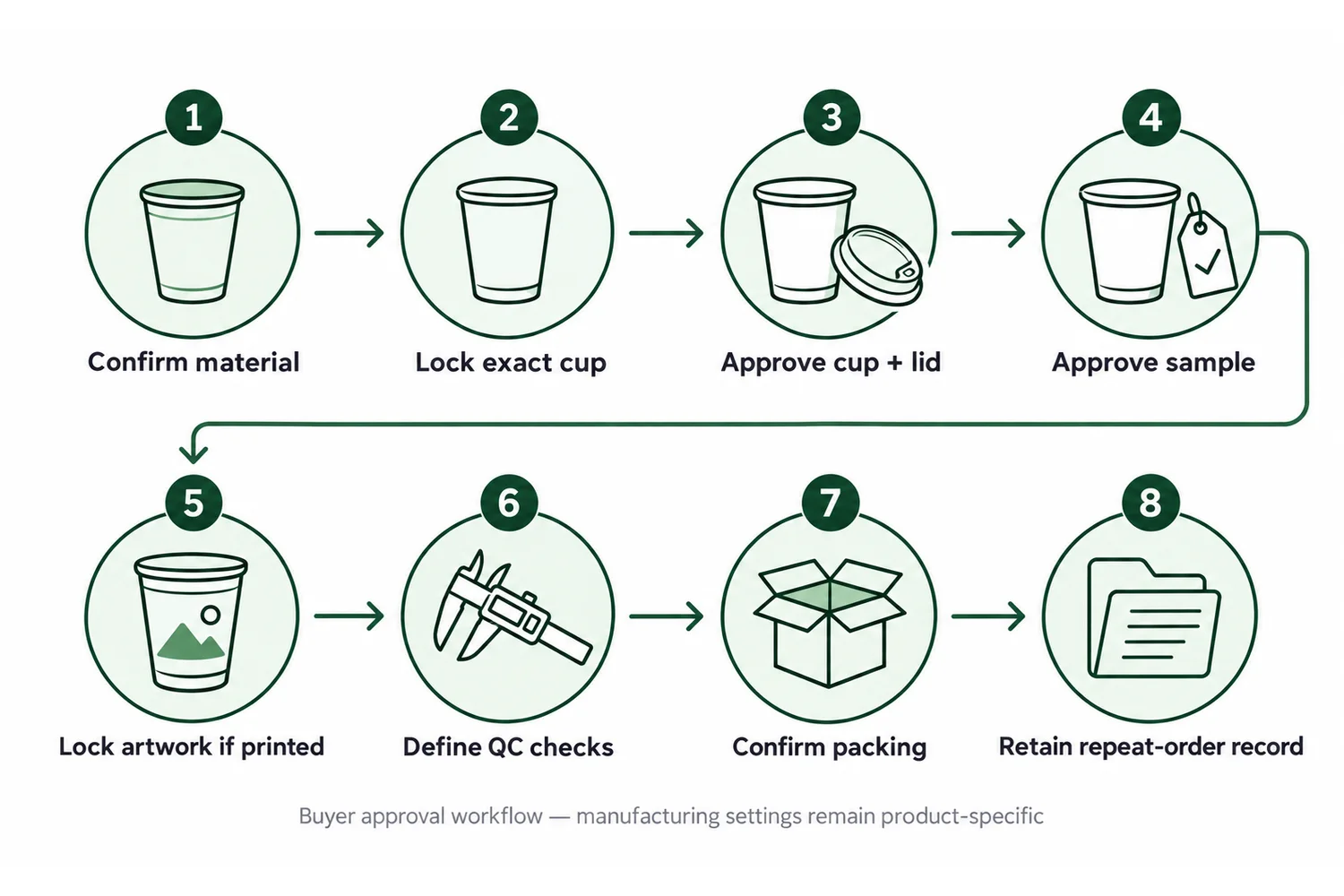
Manufacturing control becomes commercially useful when the buyer knows what must be locked before the production run. The following sequence keeps approval tied to the product rather than to a vague catalog description.
- Confirm the intended material. Record PET, PLA or the other specified material together with the exact product reference. Do not rely on transparency or product photographs to identify material later.
- Lock the exact cup. Use the SKU, drawing, controlled dimensions or another unambiguous product reference. “16 oz clear cup” is not enough for repeat-order control.
- Confirm the rim and lid system. Identify the exact lid intended for that cup and physically approve the combination where lid fit matters.
- Approve the representative sample. Make clear what the sample proves: appearance, dimensions, lid fit, printing, packing or another defined requirement.
- Lock the artwork revision when printing is included. The physical cup should be selected before the print layout is treated as final because cup geometry and print area are connected.
- Define the important inspection points. Tell the supplier and inspector which product characteristics are critical to acceptance rather than asking for a generic “quality check.”
- Confirm packing and identification. Sleeve, carton and labeling requirements should be part of the approved order configuration.
- Retain the approval reference. Keep the accepted specification, sample identity, lid reference, artwork revision and packing record together for repeat orders.
The plastic cup sample approval guide explains why plain samples, printed samples and retained production references serve different purposes. A sample only controls what it has actually been selected and documented to approve.
Inspection and Repeat Orders: Reproduce the Approved System
A first order and a repeat order should refer to the same controlled product definition. That does not mean every production run will be visually indistinguishable at a microscopic level. It means the supplier and buyer should know which specification, sample, artwork and packing references govern acceptance.
Inspection Needs an Approval Reference
An inspector cannot meaningfully verify “good quality” without defined criteria. The inspection record should connect the shipment to the exact ordered cup and the characteristics that matter to the buyer. Where a lid is part of the order, inspect the cup and lid as a system rather than as unrelated line items.
Repeat Orders Need Version Control
A repeat order becomes risky when the commercial description stays the same but one technical element changes silently. Examples include a different cup variant, a substitute lid, a revised artwork file or a different carton configuration.
Keep the accepted identifiers together. If the supplier proposes an equivalent item, review which interfaces are affected before accepting the substitution. A new cup with the same nominal capacity may require renewed lid-fit, print-layout, sample or packing approval.
How Manufacturing Knowledge Improves a Plastic Cup RFQ
The manufacturing process should change the questions asked during sourcing. A weak enquiry leaves major variables undefined:
Weak RFQ: “Please quote 16 oz clear plastic cups with lids.”
A stronger enquiry identifies what is known and marks the remaining variables for supplier confirmation:
- Intended beverage or foodservice application.
- Required or candidate material.
- Nominal capacity.
- Exact cup reference or required dimensions where available.
- Required lid function and any existing lid reference.
- Plain or custom-printed requirement.
- Quantity structure for quotation.
- Packing and labeling requirements that affect receiving or distribution.
- Destination market and any documents the buyer needs to review.
- Which specification or component is fixed and which variables remain open to supplier recommendation.
For the broader supplier, sample, QC and order-approval sequence, continue with the guide to sourcing disposable plastic cups from China. If branding is part of the project, the commercial route then connects naturally to custom printed plastic cups after the underlying cup specification is selected.
Buyer Checklist: Plastic Cup Manufacturing and Quality Verification
- Confirm the material together with the exact cup reference.
- Do not approve a cup by nominal capacity alone.
- Record the dimensions that affect the intended application.
- Identify the exact rim and matching lid combination.
- Use a representative physical sample where the product needs fit or appearance approval.
- Define what the sample actually approves.
- Lock the released artwork revision for printed cups.
- Tell the supplier which finished-product characteristics are critical for QC.
- Confirm sleeve, carton and labeling requirements.
- Keep the specification, sample, lid, artwork and packing references for repeat orders.
- Reapprove affected interfaces when an “equivalent” cup, lid or other component is proposed.
Final Recommendation
For many disposable clear cup programs, the manufacturing sequence can be understood as material preparation, sheet production, thermoforming, trimming, stacking, inspection and packing. That sequence answers how the cup is produced, but it is only the beginning of a useful B2B purchasing decision.
Buyers should control the result that production must reproduce: the correct material and exact cup, the dimensions that matter, the rim and lid system, the approved appearance, the released artwork where printing is included, and the agreed packing configuration. Those references give the supplier a defined target and give QC a meaningful basis for acceptance.
Do not fill missing information with universal machine temperatures, forming pressures, cycle times, tolerances or other factory parameters. Those values belong to the applicable material, equipment, tooling and controlled production process. Public Bioleader capacity figures can support supplier-scale evaluation, but they do not replace SKU-level approval. The buyer's stronger position is to define the finished product clearly, approve representative references and preserve them for inspection and repeat orders.
Frequently Asked Questions
How are plastic cups made?
Many disposable clear plastic cups are made by preparing the selected material, producing formable plastic sheet, thermoforming the sheet into cup cavities, trimming and separating the cups, stacking them, inspecting the finished product and packing accepted units. Not every plastic cup uses the same process, so the exact production route should be confirmed for the selected material and cup design.
What is thermoforming in plastic cup manufacturing?
Thermoforming is a production method in which thermoplastic sheet is made formable and shaped against tooling to create the required cup geometry. The formed cups are then separated from the surrounding sheet and continue to downstream handling, inspection and packing.
Are PET and PLA cups manufactured in exactly the same way?
PET and PLA clear cups can both be produced through thermoforming routes, but they should not be treated as identical materials with automatically identical production conditions. Buyers should approve the exact material and cup specification and avoid transferring unverified machine settings or performance claims from one material to another.
Why is the rim important when manufacturing plastic cups?
The rim is a functional interface with the intended lid. Its geometry and condition can affect lid fit, so a nominal diameter should be used only to shortlist possible lids. Final approval should be based on the exact cup-and-lid combination rather than on the diameter label alone.
What should buyers inspect before accepting a bulk plastic cup order?
Inspection should follow the approved order rather than a generic visual check. Depending on the product, relevant points can include product identity, dimensions, rim condition, lid fit, appearance, stacking, printing and packing. The buyer should define the critical acceptance references before bulk production so the inspector knows what the shipment must match.
References
- Bioleader — Bioleader Expands PLA & PET Cup Manufacturing Capacity for Global Supply. Official manufacturer disclosure covering sheet extrusion equipment, cup production lines, packing and printing lines, maximum daily line output and combined monthly PLA/PET cup capacity. Figures are self-published by Bioleader and are not presented here as an independent capacity audit.
- Bioleader — Compostable Plastic Cups PLA. Official product table publishing nominal PLA cup SKU weights and dimensions. The page provides nominal specifications; it is not used here as evidence of a universal numeric manufacturing tolerance.