
Quick Summary
- Choose PET cup sealing film by the sealing interface and the complete operating system—not by the word PET on the film alone.
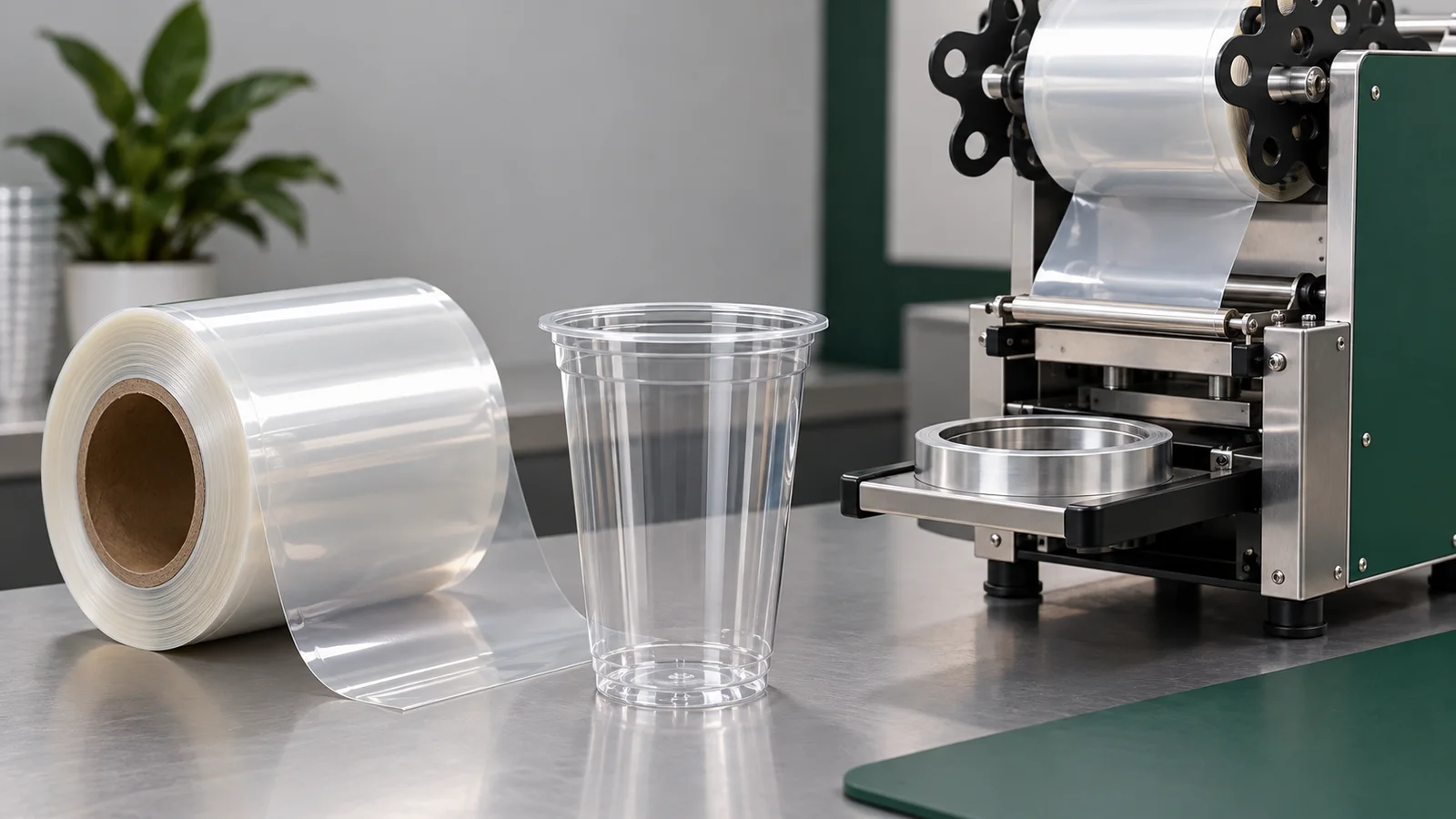
Choose PET cup sealing film by the sealing interface and the complete operating system—not by the word “PET” on the film alone. The exact PET cup, the film’s heat-seal layer, roll format, cup sealing machine, tooling and operating setup should be approved together with a physical trial. A film can feed through the machine and still fail at the cup rim; a cup can have the correct nominal diameter and still be wrong for the holder or sealing head.
For buyers who have already selected PET cups, the practical question is not “Which plastic film looks right?” It is: which exact film is specified or tested to seal to this cup, fit this machine, and produce the required bond and opening behavior?
This article stays focused on PET cup sealing film selection. If the broader question is whether PET, PP or PLA cups can physically work with an existing sealer, start with the cup sealing machine compatibility guide. That page treats the machine and tooling as the main constraint; this page treats the PET cup and film interface as the main decision.
PET Cup Sealing Film Selection Rule
Approve the combination, not the material name. The useful approval record is: exact PET cup + exact film reference + machine/tooling reference + validated setup + accepted physical result.
What Sealing Film Works With PET Cups?
Use a sealing film whose heat-seal system is specified or tested for the exact PET cup being used, then confirm that the roll format fits the machine and run a trial with the actual cup, film and sealing equipment. Do not approve the film from the words “PET film” or from cup diameter alone.
Some suppliers use trade names such as PET-compatible film or PET-ES film. Those terms can help narrow the shortlist, but they are not universal material standards. Phoenixes, for example, publishes its own compatibility table for PET-ES and other films and explicitly says the final result must be checked with the actual container, film and machine.[1]
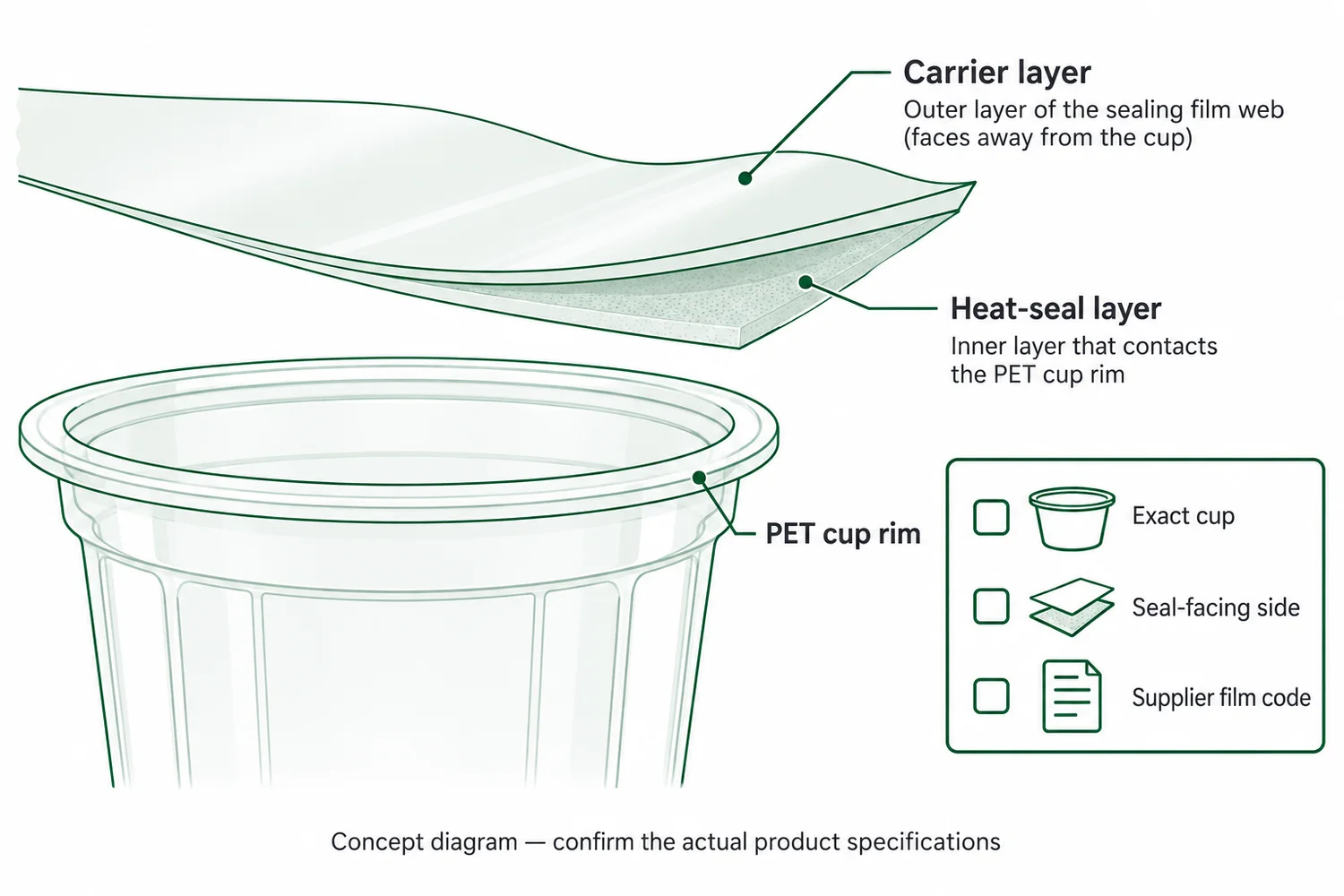
That supplier-side qualification is important because sealing film is not just a visible sheet placed over the drink. The part that must bond is the heat-seal interface at the cup rim. A film may use a carrier layer, printed layer, barrier layer, sealant or heat-seal coating depending on its construction. The layer facing the rim is the one that has to form the intended bond.
Bostik’s heat-seal materials documentation illustrates the distinction: heat-seal resins and coatings can be designed to bond to different rigid substrates, including PET cups and trays.[3] The practical procurement question is therefore:
“Which container substrate and sealing surface is this exact film designed to seal to?”
That is more useful than asking only, “Is this film made from PET?”
Why “PET Film” Does Not Automatically Mean “PET Cup Compatible”
The name of the outer film web does not, by itself, identify the chemistry that forms the seal to the cup rim. In a coated or multilayer lidding structure, the carrier and the heat-seal layer can perform different functions.
Carrier Layer and Sealant Layer Are Different Decisions
The carrier gives the film much of its handling behavior: stiffness, transparency, printability and mechanical support. The sealant or heat-seal coating is responsible for creating the bond at the rim. Depending on the product, that sealant may be formulated to seal to PET or to another rigid substrate.
This is why a buyer should request the actual film specification or product code rather than accept an unlabelled roll described verbally as “PET film.” If a supplier changes the film construction while keeping a similar appearance, the cup-seal behavior can change even though the roll looks almost identical.
Easy-Peel and Tight-Seal Behavior Are Not the Same Requirement
A film can be compatible with the cup and still produce the wrong opening experience. Some beverage programs need a consumer to peel the film cleanly. Others expect the film to remain tight and be punctured with a straw. The target bond strength and opening method should therefore be defined before the film is approved.
Do not treat “stronger seal” as automatically better. A film that survives handling but tears badly, delaminates unpredictably or cannot be opened as intended can still be the wrong film for the application.
Printed and Unprinted Film Add Different Controls
Plain film mainly raises questions of material compatibility, roll format and seal performance. Printed roll stock also adds artwork repeat length, registration marks, print orientation and sensor detection. A PET-compatible seal layer does not solve a registration problem on an automatic sealer.
What Buyers Should Check on the PET Cup Before Choosing Film
The exact PET cup is part of the sealing specification. “95 mm PET cup” or “98 mm PET cup” is a screening description, not a complete sealing-interface definition.
1. Exact Cup SKU or Approved Sample
Start with the exact cup that will be ordered. Do not validate a film on one supplier’s PET cup and automatically transfer that approval to another cup with the same nominal diameter. Rim profile, wall geometry, stiffness and manufacturing details can differ.
For buyers still narrowing the cup range, the PET cup sizes guide helps separate nominal capacity from the dimensions that actually define a cup system. Cupschina’s PET cup category can then be used to identify commercial candidates before a sealing trial.
2. Rim and Actual Sealing Surface
The film bonds where the sealing head presses the film against the cup. Inspect that contact area rather than looking only at the cup body. A bent, inconsistent or poorly seated rim can create partial sealing even when the film chemistry itself is appropriate.
Ask whether the cup was designed for film sealing and whether the supplier has a specific sealing-surface requirement. If the answer depends on the exact cup drawing or sample, use that evidence rather than assuming every PET rim is equivalent.
3. Dimensions That Affect Machine Tooling
Top diameter helps narrow the tooling options, but the holder or mold may also depend on cup height, body clearance, support location and rim geometry. The plastic cup dimensions guide explains why nominal capacity and top diameter are not enough to approve an equipment interface.
4. Confirm That Film Sealing Is the Intended Closure System
A cup designed around snap-on flat or dome lids should not automatically be treated as a film-sealing cup. The plastic cup lids guide separates rigid lid systems from sealing-film closures. Procurement teams should decide which closure system is being approved before locking the cup specification.
What Buyers Should Check on the Sealing Film Specification
The film specification should identify both the seal compatibility and the roll format required by the machine. Buying by appearance or trade name leaves too many uncontrolled variables.
| Variable | What to Verify | Why It Matters |
|---|---|---|
| Film reference | Supplier product code, grade or controlled specification | Prevents an untracked “similar” roll from replacing the approved film |
| Target substrate | Film is specified or tested for the intended PET sealing surface | The outer web name alone does not prove seal compatibility |
| Seal side | Which side or coating faces the cup rim | Incorrect orientation can prevent the heat-seal layer from contacting the cup |
| Opening behavior | Easy peel, tight bond, straw puncture or another defined use | A technically closed seal can still fail the customer-use requirement |
| Roll width | Matches the intended machine specification | Compatible seal chemistry does not solve a roll-feed mismatch |
| Core / roll setup | Core, roll size and winding direction where specified | The roll must load and advance correctly in the actual machine |
| Registration | Printed-film repeat and registration marks where applicable | Automatic cutting and artwork position depend on sensor and feed control |
| Supplier starting window | Documented process guidance for the exact film | Provides a starting point for testing, not a universal production setting |
Kai Will’s technical guidance makes the same broader point: film choice involves cup material, film suitability and machine roll requirements together rather than film material alone.[2]
Do Not Create a Universal PET Sealing Temperature
Different film suppliers publish different working windows for their own products, and the final result also depends on the cup and machine. Use the film supplier’s and equipment manufacturer’s documented starting guidance, then establish the approved setting with the actual PET cup and film. Do not copy a temperature from another supplier’s film table into your purchase specification.
How the Cup Sealing Machine Changes the Film Decision
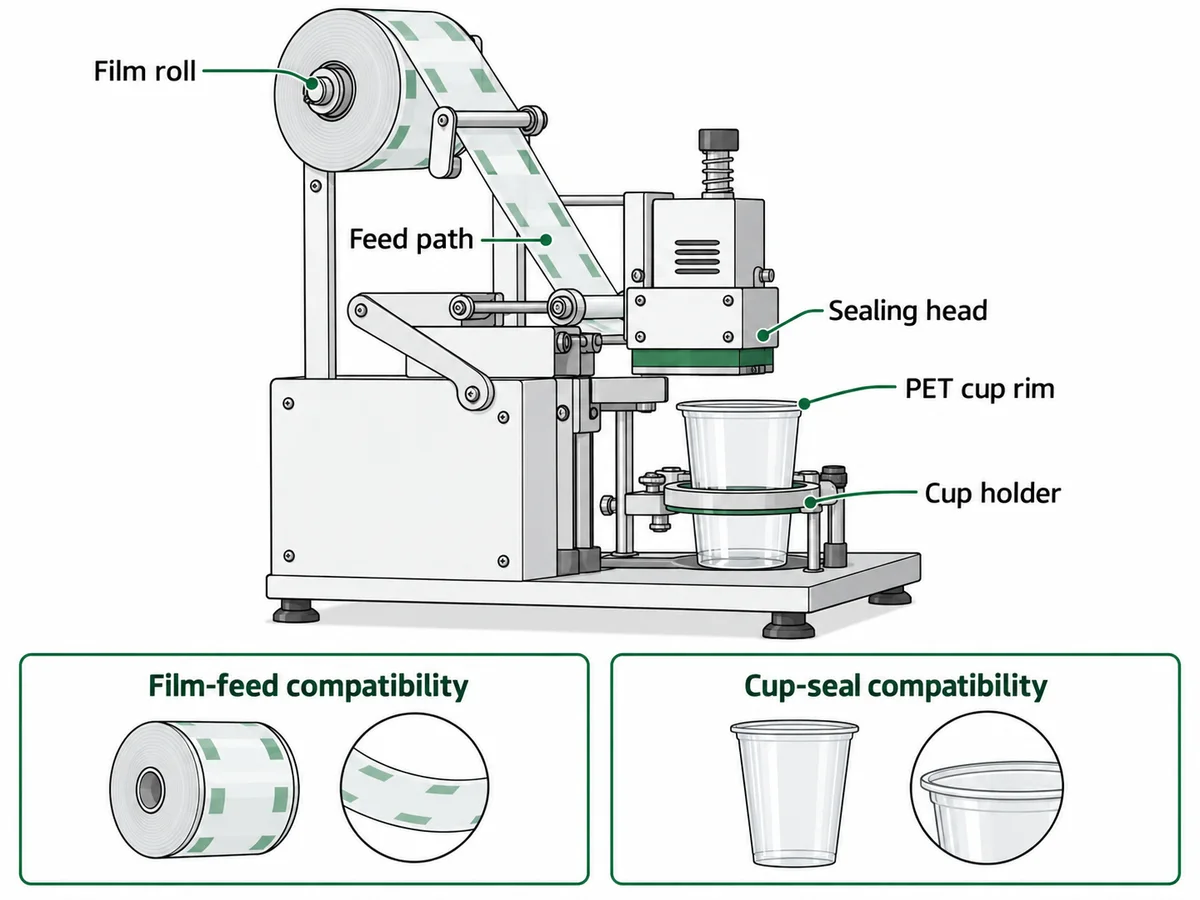
A PET-compatible film still has to run through the intended machine. The sealing machine determines whether the roll can be loaded, advanced, detected, cut and pressed onto the cup in the required position.
Machine Model and Film Feed
Give the film supplier the exact machine model where possible. Confirm the required film width, core specification, permitted roll dimensions and winding direction from the equipment documentation. If printed film is used, confirm how the machine reads registration marks and controls the cut position.
A machine can feed the roll correctly and still make a poor seal. Film-feed compatibility and cup-seal compatibility are separate checks.
Holder, Mold or Cup Support
The cup must sit at the correct height and position under the sealing head. If the holder does not support the cup correctly, only part of the rim may contact the film evenly. Raising the temperature does not correct a mechanical seating problem.
Sealing Head and Operating Controls
The machine determines which process variables can actually be adjusted. Depending on the equipment, the operator may have control over temperature, sealing time, pressure or a defined machine cycle. Use the machine manual and film supplier guidance as the starting point, then validate the combination physically.
The parent cup sealing machine compatibility guide goes deeper into mold, holder, clearance and material-system approval. This article only uses those machine variables where they affect PET sealing film selection.
How to Test PET Cup Sealing Film Before Bulk Ordering
The final proof of compatibility is an actual trial using the production-intent PET cup, the specified film and the intended sealing machine. A supplier compatibility chart is useful for shortlisting; it is not a substitute for the approval trial.
- Identify the exact PET cup. Record the cup supplier, SKU or sample reference and the rim format being tested.
- Identify the exact film. Record the supplier, product code, seal side, roll specification and intended opening behavior.
- Confirm the machine and tooling. Record the machine model and the holder, mold or adapter used for the test.
- Load the film correctly. Confirm winding direction, seal side and sensor/registration setup where relevant.
- Establish the working setup. Start from documented supplier and machine guidance, then adjust only within the process allowed for the system.
- Inspect the full circumference. Check for continuous sealing rather than judging one point on the rim.
- Evaluate the opening behavior. Peel or puncture the film as the end user will. Confirm the seal is neither unintentionally weak nor impractically difficult to open.
- Check the cup after sealing. Look for rim distortion, cup deformation, film lifting, wrinkling or difficulty removing the cup from the holder.
- Run a handling check. Evaluate the sealed cup under the handling conditions relevant to the beverage program.
- Record the approved combination. Keep the cup reference, film reference, machine/tooling reference and approved setup linked to the sample record.
For procurement teams formalizing the approval stage, the plastic cup sample approval guide explains how an exact-SKU sample, production sample and retained approval reference serve different purposes.
Bioleader Cups Procurement Rule
Do not approve a sealing film because it sealed one cup once. Approve the repeatable combination: exact cup, exact film, exact machine/tooling and a documented operating setup. That record is what protects a repeat order when a supplier changes a cup source, film grade or machine line.
Why PET Cup Sealing Film Fails
A weak PET cup seal does not automatically mean “increase the temperature.” Failure can come from the film chemistry, wrong seal-side orientation, cup seating, rim contact, machine setup or a mismatch between the approved and actual materials.
| Failure | Do Not Assume | Check First |
|---|---|---|
| Film does not stick | “The machine is too cold” | Film-to-PET compatibility, seal-side orientation, actual rim surface and approved process setup |
| Film peels too easily | “The film is low quality” | Whether easy-peel behavior was intentional, plus the exact cup/film pairing and trial result |
| Only part of the rim seals | “Increase heat” | Cup seating, rim flatness, holder/mold support and sealing-head alignment |
| PET rim deforms | “The cup is defective” | Heat exposure, cycle setup, tooling support and whether the film/system combination is appropriate |
| Film feeds but seal is weak | “The machine is broken” | Film specification, heat-seal layer, cup interface and process settings |
| Same-diameter PET cup behaves differently | “All 95 mm or 98 mm cups are equivalent” | Exact SKU, rim profile, cup geometry and sealing surface |
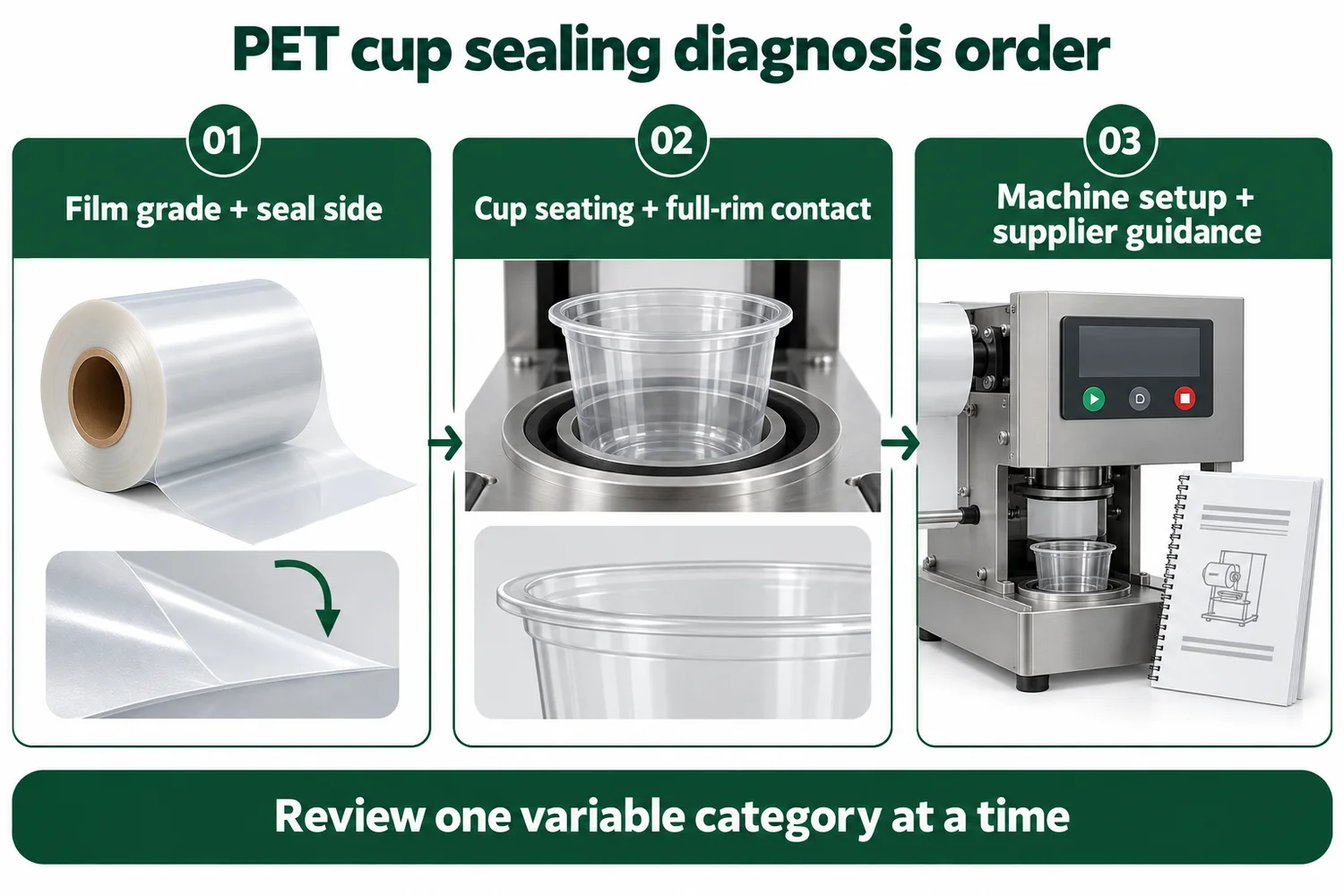
Use a Diagnosis Order Instead of Random Adjustment
When a seal fails, change one category at a time. First confirm that the film grade is intended for the PET interface and installed with the correct side facing the cup. Then confirm cup seating and full-rim contact. After that, review the machine setup against the documented starting guidance.
Randomly increasing temperature can hide one problem while creating another. If the cup is not sitting flat, more heat does not make the sealing head contact the missing area correctly. If the film chemistry is wrong for the cup, extra dwell time does not turn the sealant into a different material.
For broader finished-order inspection after the PET cup and film system has already been approved, use the plastic cup quality control guide.
PET Cup Sealing Film Approval Matrix
This matrix separates screening information from final proof. The purpose is to stop one familiar term—PET, 95 mm, transparent film—from being used as a substitute for system approval.
| Variable | What to Verify | Approval Evidence |
|---|---|---|
| Exact PET cup | SKU, drawing or controlled physical sample | Approved cup reference |
| Sealing surface | Rim/flange actually contacted by the film | Drawing, supplier confirmation or physical trial |
| Film compatibility | Exact film specified or tested for the PET interface | Film specification plus trial |
| Film roll format | Width, core, roll setup, winding and registration where applicable | Machine requirement matched to supplied roll |
| Machine | Model, holder/mold, sealing head and relevant controls | Equipment specification and actual setup |
| Operating setup | Validated conditions for the selected cup, film and machine | Approved trial record |
| Final result | Continuous seal, intended opening behavior and acceptable cup condition | Physical approved sample |
Buyer Checklist for PET Cup + Film + Machine Approval
- The exact PET cup SKU or controlled sample is fixed.
- The cup is intended or approved for the proposed film-sealing application.
- The film supplier has identified the exact film grade or product code.
- The film’s heat-seal side and target cup substrate are documented.
- The required opening behavior—easy peel, tight seal, straw puncture or other use—is defined.
- Roll width, core, roll direction and registration requirements match the intended machine.
- The machine model and holder/mold or tooling reference are recorded.
- The initial operating window comes from the applicable film and machine guidance rather than a generic internet table.
- The actual PET cup + film + machine combination has been trialed physically.
- The approved result and setup are retained for repeat-order control.
Final Recommendation
Do not buy PET cup sealing film from the word “PET” alone. Start with the exact PET cup and its sealing surface, then shortlist films whose heat-seal system is intended for that interface. After that, check whether the roll format works with the intended cup sealing machine and tooling.
The final approval should come from an actual sealing trial. Supplier compatibility tables, cup diameter and film trade names are useful screening tools, but none of them proves the full system by itself.
For repeat orders, keep one controlled record that ties together cup SKU + film reference + machine/tooling reference + approved setup + physical approval sample. If any one of those elements changes, recheck the combination before assuming the previous approval still applies.
Buyers who have not yet fixed the PET cup itself can review the current PET cup range first, then move through film selection and machine testing after the exact candidate cup is identified.
Frequently Asked Questions
What sealing film should I use for PET cups?
Use a sealing film whose heat-seal system is specified or tested for the exact PET cup and sealing surface. Trade terms such as PET-compatible or PET-ES can help shortlist options, but they are not universal standards. Confirm the film grade, seal side, roll specification and final performance with the actual PET cup and intended sealing machine.
Does PET film always seal PET cups?
No. The visible carrier film and the heat-seal layer can have different functions. What matters is whether the sealing layer or coating is designed to bond to the PET cup rim under the intended process. Approve the exact film specification rather than assuming that any roll described as PET film will seal every PET cup.
What temperature should I use to seal a PET cup?
There is no universal PET cup sealing temperature. Film suppliers publish working guidance for their own products, and the final setting also depends on the cup and machine. Use the applicable supplier and equipment guidance as the starting window, then validate the actual PET cup + film + machine combination instead of copying a generic temperature from another system.
Why does PET cup sealing film not stick?
Common causes include an incompatible film grade, the wrong film side facing the cup, poor cup seating, incomplete rim contact, unsuitable machine settings or a change in the actual cup or film specification. Do not increase temperature first by default. Confirm the film-to-PET interface and mechanical seating before adjusting the operating setup.
How do I approve PET cup sealing film before a bulk order?
Run a trial with the exact production-intent PET cup, exact film grade and intended machine/tooling. Check full-rim sealing, opening behavior, cup deformation, film lifting and the handling performance required by the beverage program. Record the approved cup, film, machine/tooling and setup so the same combination can be controlled on repeat orders.