

Quick Summary
- Regulation (EU) 2025/351 has applied since 2025-03-16, while its main finished-article transition allows qualifying products first placed on the market before 2026-09-16 to continue until stocks are exhausted.
- For new supply after the transition, buyers should verify an updated Declaration of Compliance and supporting file for the exact cup and lid, intended food, time, temperature and relevant article construction.
- The amendment strengthens rules on substance purity, downstream information including relevant NIAS, supporting documentation, migration-test evaluation and controlled reprocessing of manufacturing offcuts.
- Disposable cups and lids should not be subjected to reusable-article requirements by default; repeated-use instructions and three-cycle stability testing matter when an article is actually designed and marketed for repeated use.
After 2026-09-16, a plastic cup or lid buyer should not approve a new EU supply program from a generic “EU compliant” statement. Regulation (EU) 2025/351 amended the EU rules for plastic food-contact materials, recycled plastic and good manufacturing practice. The practical task is to connect the exact cup and lid to an updated Declaration of Compliance (DoC), appropriate supporting documentation and the real conditions of use. This article focuses on procurement verification; it is not a substitute for legal advice or a competent authority's interpretation.
The Short Answer: What Changes After 2026-09-16?
Qualifying plastic materials and articles that complied with the previous rules and were first placed on the market before 2026-09-16 may continue to be placed on the market until stocks are exhausted. For articles first placed on the market after that date, buyers should expect compliance with the amended framework rather than relying on the transition. Start with the broader plastic-cup food-contact document checklist, then add the Regulation 2025/351 checks below.
Three Dates Buyers Must Not Confuse
The regulation entered into force twenty days after its publication in the Official Journal and has applied since 2025-03-16. Its transitional provisions then create two later operational dates. These dates answer different questions.
| Date | What it means | Buyer action |
|---|---|---|
| 2025-03-16 | Regulation (EU) 2025/351 applies. | Use the amended rules as the current regulatory baseline. |
| 2025-12-16 | If a non-updated intermediate product or manufacturing substance is first placed on the market after this date under the transition, its DoC must state that it does not comply with Regulation 2025/351 and may only be used for articles to be placed on the market before 2026-09-16. | Do not accept an intermediate-material declaration without reading its transition statement and downstream-use limit. |
| 2026-09-16 | Cut-off for first placing qualifying old-rule finished articles on the market under the stock transition. | For new post-transition supply, obtain current evidence. For older stock, document when and by whom it was first placed on the market. |
The Transition Is Not a Blanket Recall
The wording concerns when a compliant article was first placed on the market. It does not say that every qualifying cup or lid already first placed on the market before 2026-09-16 must be removed on that date. Buyers using transition stock should nevertheless retain traceable purchase, batch and first-placement records rather than relying on an undated supplier assurance.
Verify the Exact Cup and Lid, Not a Material Family
A PET, PP or PLA resin statement does not identify the finished article. The DoC and supporting file should map to the commercial SKU, dimensions, material construction, colorants, additives, manufacturing operator and intended use. A buyer reviewing a 12 oz clear plastic cup should not assume that the same file automatically covers a different wall thickness, rim geometry, color or production site.
Cup and Lid Evidence Should Be Mapped Separately
The cup body and closure can use different polymers, formulations and manufacturing processes. Request article identification and evidence for each component, then assess the complete serving configuration. A cup DoC should not be stretched to cover an unidentified lid. Likewise, dimensional fit is a performance question, not proof of food-contact compliance; use the flat, dome, sip and straw-lid buyer guide to define the closure type before matching the compliance file.
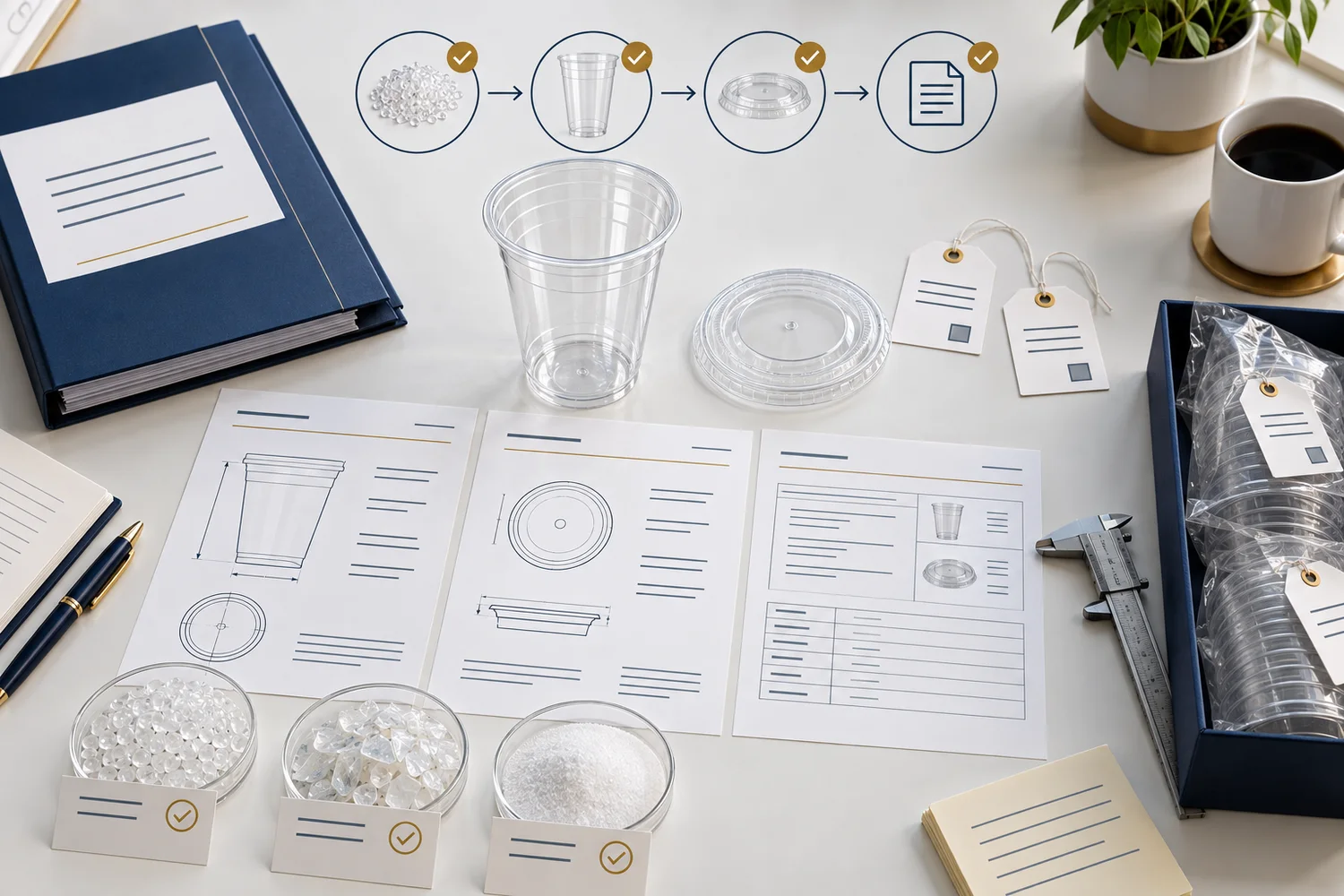
What to Check in the Updated Declaration of Compliance
Regulation 2025/351 changes Annex IV of Regulation (EU) No 10/2011. In addition to the established identification, issuer, date, compliance and intended-use information, the supply chain must provide adequate information on restricted substances and relevant non-intentionally added substances (NIAS) when their presence could make the final material non-compliant with Article 3 of Regulation (EC) No 1935/2004.
| DoC review point | What the buyer should verify | Common weak evidence |
|---|---|---|
| Article identity | Exact cup or lid code, construction and responsible operator can be matched to the PO and approved sample. | A resin family name or broad catalogue statement. |
| Declaration date and basis | The declaration is current and reflects EU 10/2011 as amended, including Regulation 2025/351. | An undated declaration copied from an old template. |
| Restricted substances and NIAS | Adequate downstream information is supplied where restrictions, specifications or relevant NIAS affect final compliance. | “No harmful substances” without substance, limit or assessment context. |
| Intended use | Food type, contact time, temperature and any restrictions match the beverage service. | A pass statement with no use conditions. |
| Special material information | Reprocessing batches and authorised substances manufactured from waste include the added confirmations where applicable. | No explanation of recycled, waste-derived or reprocessed input. |
At intermediate stages, the amended text also requires identification and amount information for specified restricted substances and for certain intentionally used substances where genotoxicity has not been ruled out and foreseeable migration could exceed 0.00015 mg/kg food. A finished-article buyer does not need every supplier's proprietary formula, but the compliance chain must transmit enough information for the downstream operator to make and support the final assessment.
Purity and Supporting Documents Need More Than a Pass Page
The amended Article 8 requires substances used to manufacture plastic food-contact materials and articles to have a high degree of purity. Identity, applicable specifications and restrictions, risk assessment under Article 19, and relevant EFSA guidance can all matter. The rule also addresses authorised substances manufactured from waste, where incidental contamination needs to be controlled.
Article 16 requires appropriate supporting documentation and now expressly connects the purity requirements to that file. Evidence may include test conditions and results, calculations, modelling, analyses, safety evidence and compliance reasoning. Buyers do not normally receive the manufacturer's entire confidential technical dossier, but they should verify that an auditable supporting file exists, that its conclusion applies to the ordered articles, and that it can be made available to competent authorities.
Ask for an Evidence Index, Not Only a Lab Report
A useful supplier package lists the current DoC, applicable specifications, migration reports or calculations, material declarations, risk assessments, manufacturing site and change-control status. This is more reliable than treating one laboratory report as a universal certificate. The same document map can be incorporated into a pre-shipment plastic-cup quality-control plan.
Migration Evidence Must Match the Real Use and Current Evaluation Rules
Regulation 2025/351 updates Annex V compliance-testing provisions, including analytical-method working ranges, corrections and the use of measurement uncertainty when evaluating a specific migration limit. A buyer does not need to recalculate the laboratory's statistics, but should confirm that the report uses a suitable method and states the result, limit, uncertainty approach, food simulant, time, temperature and article represented.
Surface-to-Volume Ratio Can Matter for Small Cups
The amended Article 17 allows a surface-to-volume ratio equal to or higher than 6 dm²/kg of food for several article groups, including containers intended for less than 500 ml, subject to stated exclusions. Many small drink cups fall within that size band. The buyer should check which ratio the laboratory used and why, rather than assuming every capacity shares the same calculation. The derogation does not apply to articles intended for food for infants and young children.
Test the Intended Contact, Not an Easier Fiction
The evidence should represent the intended beverage and foreseeable contact conditions. For cup-and-lid systems, confirm whether the closure's actual food-contact or splash-contact use has been addressed and whether the sample represents the final material, color and geometry. A cup-and-lid compatibility check should then verify rim fit and service performance separately.

Reprocessed Offcuts Need GMP Segregation and Traceability
The amendment distinguishes controlled reprocessing of qualifying manufacturing offcuts and scraps from waste-based recycling. Under the added GMP rules, material intended for reprocessing must be separated from waste as close as technically achievable to its point of generation and collected in a dedicated closed system or clean, recognizable containers that prevent contamination.
The quality-assurance system must prevent mixing with different compositions, other materials or waste, and transfers and mixing of the same composition must be recorded and traceable. If a cup or lid supplier uses in-process regrind, the buyer should ask how the source, composition, collection, batch identity, allowable proportion and reinsertion are controlled. “Factory recycled” is not an adequate process description.

Single-Use and Repeated-Use Articles Require Different Checks
Regulation 2025/351 adds information duties for final plastic articles intended for repeated use. The responsible operator must provide instructions that slow deterioration, describe observable changes indicating deterioration and warn about damage or foreseeable misuse that may increase migration or make the article unsuitable for continued food contact. Examples in the regulation's recitals include cracking, crazing, blistering, delamination, deformation and permanent loss of gloss or transparency.
Annex V also strengthens repeated-use migration verification: the same sample is generally tested three times with fresh simulant, and compliance considers the third result and the stability of results across the three contacts, subject to the regulation's detailed criteria and scientific-evidence provisions. These requirements should not be copied mechanically onto an ordinary disposable cold-drink cup. First decide whether the product is genuinely designed and marketed for repeated use, and document that status in the specification.
A Practical Post-September 2026 Buyer Workflow
- Freeze the ordered configuration. Record cup and lid codes, material, dimensions, color, print, site and intended beverage conditions.
- Classify the timeline. Establish when the article was first placed on the market and whether transition stock is involved.
- Map declarations. Obtain current DoCs for the cup and lid, and connect them to upstream material information and the responsible operators.
- Review use restrictions. Match food type, temperature, time, single-use or repeated-use status and any surface-to-volume basis.
- Review the supporting-evidence index. Confirm the applicable migration evidence, purity support, NIAS assessment approach and special waste-derived or reprocessing information.
- Approve representative samples. Keep plain and printed reference samples linked to the final specification and file. A structured golden-sample approval process helps prevent later scope drift.
- Control changes. Require written notification before changing resin grade, additive, colorant, regrind practice, dimensions, lid design, artwork, site or process.
For custom artwork, add ink, print-side, set-off and GMP controls to the review before approving a custom printed cup program. A valid unprinted-cup file does not automatically assess every printing system or finished variant.
Final Recommendation
Use 2026-09-16 as a procurement checkpoint: identify the exact article, classify the first-placement date, obtain the current DoC, and confirm that supporting evidence covers the intended use and relevant amendments. Keep the cup and lid separate during document mapping, then bring them together for service-fit and finished-program approval.
The strongest buyer file is not the longest file. It is the one that creates a clear, current and traceable line from material inputs to exact cup and lid SKUs, realistic use conditions, supporting assessment, approved samples and controlled production changes. If the supplier cannot establish that line, pause approval and request a product-specific compliance review before ordering.
Frequently Asked Questions
Does EU Regulation 2025/351 ban all old plastic cup stock after 2026-09-16?
No. The transitional provision says qualifying plastic materials and articles that complied with the earlier rules and were first placed on the market before 2026-09-16 may continue to be placed on the market until stocks are exhausted. Buyers relying on that transition should retain evidence of the article's compliance and first-placement timeline.
Does a cup Declaration of Compliance cover the lid?
Only if the declaration and supporting scope clearly identify and cover that lid. Cup bodies and lids may use different polymers, formulations and processes, so buyers should map evidence to each exact component rather than assume one document covers the full set.
Does Regulation 2025/351 require a new universal EU certificate?
No universal finished-product certificate replaces the regulatory file. The practical evidence normally includes an updated DoC and appropriate supporting documentation such as specifications, test results, calculations, modelling, analyses and safety reasoning relevant to the exact article and intended use.
Must disposable plastic cups pass three repeated-use migration tests?
The amended three-contact stability provisions address articles intended for repeated food contact. An ordinary disposable cup should not be reclassified as reusable by default. Buyers should define the product's intended use first and apply the appropriate testing conditions and legal requirements.
What should buyers request from a plastic cup or lid supplier after September 2026?
Request an article-specific, dated DoC; exact SKU and construction identification; intended-use restrictions; an index of supporting migration, purity and NIAS evidence; relevant reprocessing or waste-derived-substance confirmations; representative approved samples; and a written change-notification commitment.
Official References
- Commission Regulation (EU) 2025/351 — Official Journal text
- Commission Regulation (EU) No 10/2011 — Plastic materials and articles intended to contact food
- Regulation (EC) No 1935/2004 — Food-contact materials framework
- Commission Regulation (EC) No 2023/2006 — Good manufacturing practice
- European Commission — Food-contact materials legislation
Treat 2026-09-16 as a document-and-scope checkpoint, not a generic certificate deadline
- Confirm whether the article was first placed on the market before or after the transition date; do not interpret the rule as an automatic recall of qualifying earlier stock.
- Obtain a current DoC and supporting evidence that identify the exact cup and lid, intended use, relevant substances and applicable restrictions.
- Review cup and lid evidence separately, then verify the complete serving configuration and realistic food-contact conditions.
- Distinguish single-use articles, reusable articles, manufacturing regrind and recycled plastic because different provisions and evidence apply.
Buyer Checklist
- Record the exact cup and lid SKU, material, color, dimensions, supplier and manufacturing site.
- Confirm the first-placement timeline and whether any transitional stock basis is being used.
- Obtain a dated DoC issued under the current EU 10/2011 framework as amended by Regulation 2025/351.
- Verify intended foods, contact time, temperature, single-use or repeated-use status and surface-to-volume basis.
- Check restricted-substance, relevant NIAS, purity and waste-derived-substance information in the supply chain.
- Review migration evidence for the exact or technically justified representative article and current evaluation rules.
- If manufacturing offcuts are reprocessed, verify segregation, closed collection, batch traceability and composition controls.
- Require documented change notification for resin, additives, colorants, dimensions, lid design, print, site or process changes.
Need a Cup-and-Lid Compliance File Reviewed Before Ordering?
Send Cupschina your destination market, cup and lid SKUs, intended beverage, contact conditions, artwork and order volume. We can help organize available product specifications and supplier documentation for your buyer review.


